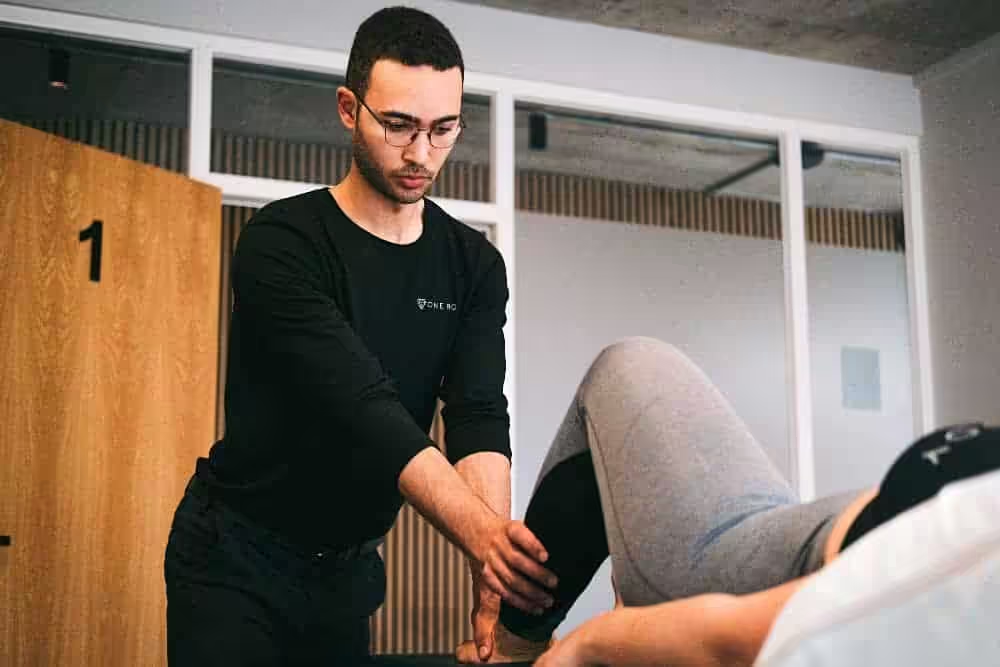
Running injury physiotherapy in London treats the overuse injuries of the knee, shin, Achilles, heel and hip that stop runners training, then returns them to running on a graded programme. Our HCPC-registered physiotherapists assess the injury, the training load that caused it and the running pattern that keeps it going.
Treatment combines hands-on techniques where appropriate with progressive strength work and a load plan that keeps you running in a modified form wherever the injury allows. Return to full training is cleared on measured criteria, not on rest alone. Appointments are available same day, early and late across our London clinics.
Graded return to running, not a prescription to stop
Same-day, early and late appointments across London
Rated Excellent on Trustpilot, with thousands of 5-star Google reviews across One Body LDN clinics.
“Within weeks my pain started to decrease and within months I was back at the gym doing most of the things I wanted to be able to do.”
Jake Whittaker
“The treatment plans were clear, effective and tailored to my needs, and the improvement in my pain and mobility has been excellent.”
Nik Ollek
“Through rigorous sports massage and a clear, well structured physio exercise programme, I was back playing within a month.”
Nicholas Morgan
“Six weeks on, I’m deadlifting weights in the gym and my back feels completely renewed.“
Catherine Gratwicke
“After his treatment, massages and the exercises he gave me, I saw big improvements very fast. Within the same week I was even able to complete a half marathon.”
Mirela
“I went to see Meher after struggling with shoulder and lower back pain due to long office hours, and the difference after starting treatment has been incredible.”
Nandu Krishna Anil Kumar
“I started physio with her 3 months ago and since then my knees pain has improved massively with her personalised program and custom exercises and manual therapy.”
Jessica Foster
“I came in with serious neck tension and frequent headaches from spending long hours at the computer. Preeti … did an excellent job targeting the problem areas with a focused sports massage.”
Tony French
“Her sports massages are outstanding! Easily some of the most effective I’ve had.”
IC OM
“I have been working with Matt for almost two years as part of my rehabilitation journey, and I cannot recommend him highly enough.”
Catherine
“I started going to One Body LDN only to improve my posture … After just a few sessions with my physiotherapist Om, I can tell my posture has already started improving.”
Bozhidara-Maria Opanska
“I feel now I am more aware of my foot placement, and my legs are definitely stronger than ever before. Roll on next ‘long run’ challenge.”
aine121
“Within just a few sessions, she managed to relieve a significant amount of the pain in my shoulder, and I’ve already noticed a real improvement.”
Rob And
“I went to see him with significant back pain, and after just one appointment the difference was remarkable.”
Anvit Desai
“My therapist assessed my issue quickly and got straight to hands on therapy. It did the trick perfectly. After one session my neck pain was considerably better.”
EP
“Very impressed with the in depth assessment and treatment plan I was given.”
Joel Greensite
“I came in with lower back pain, probably caused by spending long hours sitting at a computer … this was the first place where I started to notice a real improvement.”
Bruna Francyne
“The team is very professional, welcoming, and truly cares about their clients. From the moment I arrived, I felt comfortable and well looked after.”
Юлія Беген
“Best physio in London! Have tried multiple One Body clinics and always have such a good experience and knowledgeable physiotherapists.”
Amy Perring
“The trainers are incredibly knowledgeable and take the time to understand your goals, making every session feel personalised and effective.”
Yawar Hayat
“Her knowledge and expertise were immediately evident, and she took the time to understand my specific needs and concerns in a way I haven’t experienced before.”
Andrew G. T
“This is a first class service and the Physios are all excellent and very professional and go the extra mile to help people get back to things they want to do as soon as they can!”
Engine Room
Find a Running Injury Physiotherapist Near You in London
Find a Clinic Near Me ▼
2–8 mins from major stations
Same-day, early & late appointments
Which running injuries do we treat?
We treat overuse and acute lower-limb injuries that affect runners, from first-time 5K runners to marathon and ultra athletes. The running injuries we treat most often in our London clinics are listed below:
Bone stress injuries of the tibia, metatarsals, navicular and femoral neck, assessed for onward imaging where the history suggests more than shin splints
Forefoot pain, including metatarsalgia and Morton's neuroma
Assessing a running injury considers the training log, mechanism of onset, running volume and intensity, footwear, strength and control at the hip, knee, and calf, and the running pattern itself. Rehabilitation progresses from pain settling to strength, then to running at reduced load, and finally to full training. We use hands-on treatment where clinically appropriate, always alongside active rehabilitation.
How does running injury physiotherapy work at One Body LDN?
Running injury physiotherapy at One Body LDN follows five steps: a training load review, a physical assessment, a running assessment, a load-managed rehabilitation plan and a graded return to running. Running injuries are rarely explained by the injured structure alone, so the assessment covers the load that produced the injury and the pattern that sustains it.
The five steps of running injury physiotherapy are given below:
Training load review
Your physiotherapist reviews the last 8 to 12 weeks of weekly distance, intensity, long runs, hill and speed sessions, race dates and any sudden changes, using your watch or app data where available.
Physical assessment
We measure strength and control of the calf, quadriceps, hamstrings, and gluteal muscles, using specific clinical tests to confirm or rule out the suspected diagnosis.
Running assessment
Cadence, stride length, foot strike and hip and knee control are assessed, so the plan targets the running pattern as well as the tissue.
Load-managed plan
Running is modified rather than stopped wherever the injury allows, with strength work added two to three times a week and the aggravating sessions removed first.
Graded return to running
Volume, then intensity, then hills and speed are rebuilt in stages, with criteria to pass before each step up.
Why do most running injuries happen?
Most running injuries are overuse injuries caused by a training load that rose faster than the tissue could adapt. A 2007 systematic review by van Gent and colleagues in the British Journal of Sports Medicine found that 19-79 per cent of long-distance runners sustain a lower-limb injury in a given period, with the knee as the most common site. The pattern we most often see in our London clinics is a runner who added distance, speed, or hills in the same fortnight, or who returned from a break at their previous volume. Our clinicians have been quoted in The Times on the rise of knee injuries in runners who push too hard and in Fit & Well on the running form faults most likely to cause knee pain.
How do we manage training load during rehabilitation?
During running injury rehabilitation, we manage training load by removing sessions that provoke the injury, keeping the running the tissue tolerates, and replacing lost volume with cycling, swimming, or the cross-trainer. Complete rest is reserved for bone stress injuries and a small number of acute injuries, because stopping altogether loses fitness and leaves the cause untreated.
The load plan works on three levers. Volume is the weekly distance and is reduced first. Intensity is the pace of the hard sessions and is reduced second. Surface and terrain, meaning hills, track and trail, are adjusted last. Reduce each lever to the level where pain during and after running stays within the limit your physiotherapist sets, commonly a pain score that settles within 24 hours. Strength work for the calf, quadriceps, and gluteal muscles runs two to three times a week throughout the plan, because the strength gained allows the load to return.
Tendon injuries follow a different rule. Achilles and patellar tendinopathy improve with progressive loading rather than rest, so the tendon plan starts loading in week 1 and progresses through isometric, heavy slow resistance, and energy-storage exercises over 12 weeks. The load plan is built into Physitrack, so you can see each week’s sessions, strength work, and pain limits between appointments.
How do we get you back to running?
We clear return to running in stages, each with a criterion to pass before the next: pain-free walking, pain-free hopping, a walk-run programme, continuous easy running, then volume, hills, and speed, in that order. A date on the calendar is not a criterion.
The return-to-running stages are listed below:
Walking without pain for 30 minutes on consecutive days
Single-leg hopping without pain and with control, compared with the uninjured side
Walk-run intervals, starting with runs of one to two minutes inside a 20-minute session, three sessions a week on alternate days
Continuous easy running, built to 30 minutes before any increase in pace
Volume, then hills, then speed, each added one at a time and each held for a week before the next
Running pattern changes are added where the assessment finds a cause. Research by Heiderscheit and colleagues, published in Medicine & Science in Sports & Exercise in 2011, found that raising cadence by 5 to 10 per cent reduces loading at the knee and hip at the same speed, making a cadence change one of the most common prescriptions for runner’s knee. We change foot strike and footwear only when the assessment shows a reason, because an unnecessary change creates a new load the tissue hasn’t adapted to.
Iklam, a corporate professional in London, came to us with shin splints that had resisted months of pushing through. Her rehabilitation treated the cause and restored the running load in stages, and she returned to pain-free running. Her story sits on ourclient testimonials page.
As featured In
What should you expect at your first running injury appointment?
Your first running injury appointment is a full assessment and treatment session, booked online without a GP referral, in any of our London clinics. Bring your watch or app data for the last two to three months, your current running shoes and a note of any race dates, so the load review and the plan are built on real numbers.
The session covers the training history, the physical examination, the running assessment, the working diagnosis, first treatment and the first week of the load plan. You leave knowing what is injured, why the injury happened, what running you can continue this week and what to do before the next appointment. Running injury rehabilitation is booked through the same online system as all private physiotherapy on our physiotherapy London page, and insured runners can use AXA Health, Bupa, Aviva, Vitality, Cigna, WPA and other policies subject to authorisation.
Running injury or something more serious?
Some running pain is not a running injury and needs imaging or a medical opinion before physiotherapy: bone stress injuries, Achilles rupture and nerve-related leg pain are the three we screen for first. The signs that separate them from the common overuse injuries are listed below:
Pain, numbness or tingling running down the leg points to a nerve or back origin rather than a muscle strain
We refer each case for imaging or a consultant opinion through our medical referral network when the examination indicates one, and rehabilitation starts once the diagnosis is clear.
Running physiotherapy before a race
Running physiotherapy before a race identifies the strength and load factors most likely to cause an injury in the training block and corrects them before the mileage rises. A pre-race assessment is a single appointment, followed by a strength programme and a load plan matched to the race date.
The pre-race assessment is most often booked for the London Marathon in April, the spring and autumn half marathon season, and the first 10K. Runners already in a training block with a niggle are assessed in the same session, so the niggle is managed inside the plan rather than left until it becomes an injury. Runners returning to competition after a long injury move onto the return-to-sport criteria on oursports physiotherapy page once continuous running is restored.
Why choose One Body LDN for running injury physiotherapy in London?
HCPC-registered, degree-qualified physiotherapists with sports medicine training
Every running injury appointment is delivered by an HCPC-registered physiotherapist and CSP member. Several clinicians hold postgraduate sports medicine qualifications or strength and conditioning certification.
Thousands of patient reviews and an NPS of +79
One Body LDN has 7,000+ Google reviews at 4.9 and thousands of five-star reviews across Google and Trustpilot. Our structured analysis of 4,859 client survey responses recorded a Net Promoter Score of +79.
Hands-on treatment plus load-managed rehabilitation
Treatment combines soft-tissue techniques and joint mobilisation where appropriate with progressive strength work and a written load plan delivered through Physitrack between appointments.
Clear pricing and treatment plans, no pressure to overbook
Appointments are paid individually with no packages or multi-session commitments. Your physiotherapist tells you how many sessions to expect and when physiotherapy is no longer needed.
Same-day, early and late appointments across London
Our clinics sit 2 to 8 minutes from major Tube and train stations, with same-day, early, late and weekend appointments available at many locations.
Private health insurance and health cash plans accepted
We work with AXA Health, Bupa, Cigna Healthcare, WPA, Vitality, Aviva, Allianz, Aetna and Healix, and support cash plans including Medicash, Simplyhealth, Health Shield and Westfield Health. Details are on our private health insurance page.
Running injury physiotherapy London: FAQs
Should I stop running with an injury?
For most overuse injuries, you should continue running in a modified form, removing the provoking sessions and reducing volume to a level that keeps pain within the limit your physiotherapist sets. Complete rest is advised for bone stress injuries, acute muscle tears, and any injury that hurts when you walk.
How long does a running injury take to heal?
A minor calf or hamstring strain settles in 2 to 4 weeks. Runner’s knee and ITBS usually resolve over 6 to 12 weeks of strength work and load management. Achilles and patellar tendinopathy follow a 12-week loading programme. Bone stress injuries need 6 to 12 weeks away from running depending on the site. Your physiotherapist gives you an expected timeline at the assessment.
How much does running injury physiotherapy cost in London?
New clients can book a 45-minute physiotherapy assessment and treatment for £89.
Your appointment includes a comprehensive assessment, hands-on treatment where appropriate, and a personalised treatment plan tailored to your needs and recovery goals.
If further treatment is recommended, you can book your next appointment directly with your physiotherapist and access our lower follow-up rates. There are no contracts or multi-session commitments, appointments are paid for individually.
We also accept private health insurance from major UK and international insurers, subject to your policy coverage and authorisation requirements.
How many sessions of running injury physiotherapy will I need?
There is no fixed number; it depends on your problem, how long you’ve had it, your goals and how you respond to treatment.
Some people may only need a small number of appointments, while longer-standing injuries or post-surgery rehabilitation can require a longer programme.
After your assessment, your physiotherapist will explain what they recommend and why, and your progress will be reviewed as treatment continues.
If you don’t need further physiotherapy, we’ll tell you.
Can I use private health insurance for a running injury?
Yes. Most private medical insurance policies treat a running injury as physiotherapy and cover it, subject to authorisation. We hold provider numbers with AXA Health, Bupa, Aviva, Vitality, Cigna and WPA, and our team helps with authorisation codes and billing.
Do I need a GP referral to see a physiotherapist for a running injury?
No. Self-paying runners book directly online. Insured runners should confirm with their insurer whether they need a GP or consultant referral before authorisation.
Do I need new running shoes to fix my injury?
Footwear changes only when the assessment finds a reason, such as shoes worn past their life or a sudden switch to a very different shoe before the injury began. Most running injuries resolve with load management and strength work, not a shoe change.
Is strength training necessary for runners?
Yes. Strength work for the calf, quadriceps, and gluteal muscles increases the load the tissue can tolerate and is the most consistent element of running injury rehabilitation and prevention. Two sessions a week of 30 to 40 minutes is the standard prescription in our plans.
Can I keep training for my marathon while injured?
Many runners complete a marathon block with an injury managed within the plan by replacing the provoking sessions with cross-training and keeping the long run at a tolerated distance. The first appointment determines whether the race date is realistic, based on the injury, the weeks remaining, and the training completed so far.
Why does my knee hurt only after a certain distance?
Pain that starts at a set distance into a run, often on the outside of the knee, typically reflects iliotibial band syndrome, where the tissue becomes irritated as fatigue reduces hip and knee control. Pain around the kneecap that builds with downhill running or stairs points to patellofemoral pain instead. Both are assessed and treated through strength and load management.
Why does my heel hurt with the first steps in the morning?
First-step heel pain in the morning typically signals plantar fasciitis, while stiffness at the back of the heel that eases as you walk points to Achilles tendinopathy. Our guide tomorning foot pain explains the difference and when to seek assessment.
How quickly can I see a running physiotherapist in London?
Same-day and same-week appointments are available across our London clinics, with early, late and weekend slots at many locations. We show live availability online, and booking takes under 60 seconds.
Do you treat beginners as well as experienced runners?
Yes. First-time runners, Couch to 5K runners and runners returning after years away are among the most common patients we see, because a new load on untrained tissue is the most frequent cause of injury. The assessment and plan follow the same steps at every level.
Ready to get back to running?
Running injury physiotherapy in London from One Body LDN treats the injury, corrects the load that caused it and returns you to running in measured stages. Same-day appointments across London. Insurance accepted.