



Almost half of office workers report neck pain in any given year. Most of them have adjusted the chair, raised the monitor, and bought a better mouse. Some improved. Many did not, because the setup was never the whole problem. Desk-related neck and shoulder pain is a load problem. Sustained low-level muscle work, hour after hour, with not enough capacity to absorb it.
The chair matters, but the body sitting in it matters more. This guide explains the four desk drivers that load the neck and shoulder together, a simple way to tell whether your pain is still a setup problem, and the point at which it has become a physiotherapy problem.
Key takeaways
- Desk-related neck and shoulder pain is driven by sustained time in one position, not by any single “bad” posture.
- Four desk drivers load the neck and shoulder at the same time: screen height, mouse reach, laptop-only work, and stress-driven muscle tension.
- Pain that builds through the working day and clears by the next morning is a load problem. Pain that is now present on waking or at weekends has become a capacity problem.
- A setup change that has not helped within two weeks is not going to help in week three.
- Physiotherapy for desk workers builds the endurance of the muscles that hold the head and shoulder blades, so the same day at the desk costs less.
Why desk work loads the neck and shoulder together
The muscles that hold the head up and the shoulder blades in place are the same muscles, and desk work loads them continuously for hours.
The upper trapezius, levator scapulae, and the deep muscles at the front of the neck work at low intensity whenever the head is held forward of the body and the arms are held out in front. At a desk, that is the whole day. These muscles are built for movement, not for holding. Held for hours, they fatigue, tighten, and ache. Because they span both areas, the ache is felt across the neck and the top of the shoulder at once.
This is the most common reason neck pain and shoulder pain present together in people under 45. The three patterns that concurrent pain can follow are explained in our guide to neck and shoulder pain together. Desk strain is usually the shared-driver pattern.
The four desk drivers
Four features of desk work load the neck and shoulder at the same time. Most people have at least two.
1. Screen height
A screen below eye level brings the head forward and down. Every centimetre of forward head position increases the load on the muscles at the back of the neck. A screen too high does the opposite and compresses the back of the neck. Either way, the neck muscles hold a position they were not built to hold.
2. Mouse reach
A mouse placed out to the side, or a wide keyboard that pushes it there, holds the arm in slight outward rotation all day. The upper trapezius lifts and holds the shoulder to do it. This is the single most common driver of one-sided neck and shoulder pain in desk workers, and it is almost always on the mouse side.
3. Laptop-only work
A laptop forces a choice: screen at eye level with the arms raised to type, or keyboard at the right height with the head bent to the screen. Neither is sustainable. Laptop-only work combines drivers 1 and 2 and is the pattern we see most in people who moved to working from home without a separate screen and keyboard.
4. Stress-driven muscle tension
The upper trapezius responds to mental load as well as physical load. Deadlines, difficult calls, and concentration all raise its resting tension. A workplace study of office workers found that mental tiredness at the end of the day was independently associated with neck pain, alongside sustained neck flexion and prolonged sitting. The desk setup can be perfect and the muscles still tight.
Is it still a setup problem?
Pain that follows the working day and clears overnight is a load problem. Pain that is now present away from the desk has become a capacity problem.
Use this test over one working week:
- Load pattern. Pain is absent on waking, builds through the day, peaks by late afternoon, and is gone by the next morning. Weekends are clear. This pain is being generated by the desk and will respond to changing the load: breaks, setup, and task variety.
- Capacity pattern. Pain is present on waking, or persists into the evening, or is there at the weekend. The muscles are no longer recovering between days. Changing the setup helps less and less. This pain needs the muscles’ capacity rebuilt.
The Health and Safety Executive’s guidance for screen work is to take short breaks often rather than long breaks rarely, with 5 to 10 minutes every hour as the example. For a load-pattern pain, that change plus a setup review is usually enough within two weeks. If two weeks of breaks and a corrected setup have not shifted the pain, it is already a capacity pattern.
If your pain extends into the lower back as well, the same logic applies there and is covered in our guides to working from home back pain and office worker back pain.
When desk strain needs a physiotherapy assessment
Four signs mean the problem has outgrown the setup and needs a desk-worker neck and shoulder assessment.
- The pain is a capacity pattern. Present on waking, at weekends, or on holiday.
- Setup changes have made no difference after two weeks.
- The pain has acquired a second symptom. A headache from the base of the skull, pins and needles into the arm or hand, or pain reaching overhead. Each of these means a structure beyond the muscles is now involved. Pins and needles into the arm are assessed through our cervical radiculopathy pathway. Pain reaching overhead on the mouse side is often a shoulder impingement pattern driven by the raised, forward shoulder blade.
- The pain is within the first hour at the desk. Load that used to take six hours to produce pain now takes one. Capacity has dropped.
What physiotherapy does for desk workers
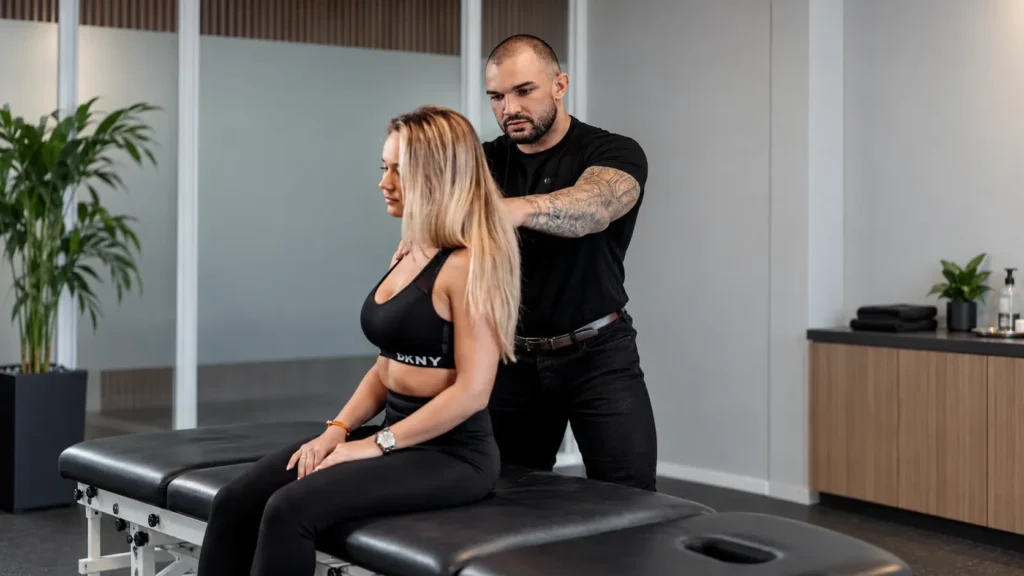
Physiotherapy for desk-related neck and shoulder pain builds the endurance of the holding muscles so the same day at the desk costs less.
A desk-worker neck and shoulder assessment at One Body LDN covers:
- Endurance testing of the deep neck flexors and the lower trapezius. These are the muscles that should hold the head and shoulder blades, and in most desk workers they fatigue in seconds.
- Identifying which of the four drivers is dominant, because the exercise programme is different for a screen-height neck and a mouse-reach shoulder.
- A graded endurance programme. Short holds, built up over four to six weeks, until the holding muscles can carry a full day.
- Load distribution. Teaching the lower trapezius and the deep neck muscles to share the load the upper trapezius has been carrying alone.
- A setup review that matches the body, not a checklist. Monitor height for your sitting height, mouse position for your shoulder width, break timing for your pain pattern.
Most desk workers notice the afternoon peak dropping within three weeks and are managing a full week without pain by six. Private postural physiotherapy in London is a short programme for most, with a maintenance routine that takes a few minutes a day.
Frequently asked questions
Why do my neck and shoulders hurt after working at a computer?
Because the muscles that hold the head forward and the arms out in front are working continuously for hours, and they are built for movement rather than holding. The ache is felt across the neck and the top of the shoulder because the same muscles span both.
Is my desk setup causing my neck and shoulder pain?
If the pain builds through the working day and is gone by morning, the setup and the lack of breaks are the main drivers. If the pain is now present on waking or at weekends, the setup is no longer the whole problem and the muscles need their capacity rebuilt.
How often should I take breaks from the screen for neck pain?
The Health and Safety Executive advises short breaks often rather than long breaks rarely, with 5 to 10 minutes every hour as the example. Standing, moving, and changing posture during the break matters more than its length.
Will a standing desk fix neck and shoulder pain?
A standing desk changes the load on the lower back more than the neck and shoulder. The head is still forward and the arms still out in front. Alternating between sitting and standing helps because it is a change of position, not because standing is better.
When should an office worker see a physio for neck and shoulder pain?
When the pain is present away from the desk, when setup changes have not helped within two weeks, when headache or pins and needles have appeared, or when pain starts within the first hour of work. Each of these means the problem has outgrown the setup.
Book an ergonomic assessment
If your neck and shoulders hurt at the desk, and the chair, screen, and mouse have already been changed, the next change is to the muscles doing the holding. The One Body LDN postural pain team assesses the neck, the shoulder, the shoulder blades, and your setup in one appointment. You can book an ergonomic assessment at any of our London clinics, with no GP referral needed.
Note: desk-related symptoms that need medical review first
Contact NHS 111 or a GP before physiotherapy if neck and shoulder pain comes with:
- Pins and needles or weakness in both arms, clumsy hands, or a change in walking
- A headache that is sudden, severe, or getting steadily worse
- Chest pain, breathlessness, or pain spreading down the left arm
- Fever, unexplained weight loss, or a history of cancer
References
- Health and Safety Executive. Display screen equipment: work routine and breaks.
- Cagnie B, Danneels L, Van Tiggelen D, De Loose V, Cambier D. Individual and work related risk factors for neck pain among office workers: a cross sectional study. European Spine Journal 2007;16(5):679-686.
- NHS. Neck pain and stiff neck.
- NHS. Shoulder pain.
- Chartered Society of Physiotherapy. Neck pain: managing your pain at home.
