



A headache that starts at the base of the skull, creeps forward over one side of the head, and gets worse when you turn your neck is often not a headache problem at all. It is a neck problem. Clinicians call it cervicogenic headache. Patients call it a tension headache from the neck.
Either way, the pain is generated by the joints, muscles, and nerves of the upper cervical spine and referred into the head. Painkillers dull it. Treating the neck removes it. This guide explains how the neck produces a headache, how to tell a cervical-origin headache from other types, and what treatment changes it.
Key takeaways
- A cervicogenic headache is a secondary headache. The pain is felt in the head but generated in the upper neck.
- The C2-3 facet joint accounts for around 70% of cases. The upper three cervical nerves carry the pain into the head via the trigeminocervical nucleus.
- The defining features are side-locked pain, neck symptoms before the headache, provocation by neck movement or sustained posture, and reduced neck rotation.
- Around 15 to 20% of headaches may be cervical in origin. It is four times more common in women and peaks in the early 40s.
- Physiotherapy that combines manual therapy and specific deep neck muscle exercise reduces headache frequency and intensity, with effects lasting at least 12 months.
How the neck produces a headache
The upper three cervical nerves share a processing centre with the trigeminal nerve, so pain from the neck is felt in the head.
The nerves from C1, C2, and C3 feed into a region of the upper spinal cord called the trigeminocervical nucleus. The trigeminal nerve, which carries sensation from the face and front of the head, feeds into the same nucleus. The brain cannot always tell which input is which. Irritation of a neck joint or muscle is therefore read as pain in the forehead, temple, or behind the eye.
The main pain generators are:
- The C2-3 facet joint, responsible for around 70% of cervicogenic headaches.
- The atlanto-axial joint (C1-2) and the C3-4 facet joint.
- The suboccipital muscles at the base of the skull, which tighten and refer pain over the head.
- The greater and lesser occipital nerves, which run from C2 and C3 over the back of the scalp.
Cervicogenic headache is one of the recognised causes within the broader picture of neck pain. It can follow a specific injury, develop from years of forward-head posture, or appear alongside degenerative change in the upper neck.
Who gets it
Cervicogenic headache is around four times more common in women. The average age at presentation is 43. It is especially common after whiplash, where up to half of people with persistent headache have a cervical source. If your headache started after a car collision, the whiplash recovery timeline explains the wider pattern.
How to tell a cervical-origin headache from other headaches
A cervical-origin headache is side-locked, starts in the neck, and changes when the neck moves. Primary headaches do not behave this way.
The International Classification of Headache Disorders lists cervicogenic headache as a secondary headache with a clear cervical cause. In clinic, five features separate it from the rest:
1. The pain stays on one side
Cervicogenic headache is almost always unilateral and does not switch sides between episodes. Migraine can swap sides. Primary tension-type headache is usually a band across both sides.
2. The neck comes first
Neck pain or stiffness precedes the headache, or the two arrive together. The headache then spreads from the back of the head forward, often to the temple or behind the eye on the same side.
3. Neck movement or posture sets it off
Turning the head, looking up, or holding one position for a long time triggers or worsens the pain. A long drive, a day at a laptop, or sleeping with the neck twisted are typical triggers.
4. Pressing on the neck reproduces it
Firm pressure on the muscles at the base of the skull or over the upper neck joints reproduces the familiar head pain. Pressing on the head itself does not.
5. Neck rotation is restricted
People with cervicogenic headache typically have reduced rotation at the top of the neck. In clinic, we measure this with the cervical flexion-rotation test. Rotation under 30 degrees to one side, measured with the neck fully bent forward, correctly identifies cervicogenic headache about 85% of the time in experienced hands.
What it is not
Migraine brings nausea, light sensitivity, and sometimes aura. Cluster headache is short, severe, and comes in bouts. Primary tension-type headache is a dull band on both sides with no neck trigger. Headache from eye strain, jaw problems, or stress has its own pattern and is assessed separately. This blog covers the neck-origin type only.
A simple home check
Three quick observations will tell you whether your headache is likely to have a cervical source.
- Rotation check. Sit upright. Turn your head slowly to the left, then to the right. A clear restriction or pain on one side that matches your headache side points to the neck.
- Pressure check. Press firmly with your thumb into the muscles just below the skull on the painful side. If the pressure reproduces your usual headache, the neck is involved.
- Posture check. Hold your chin forward and down, as if reading a phone, for 60 seconds. If the headache builds, sustained cervical loading is a trigger.
Two or more positives mean a physiotherapy assessment is the right next step. None of these checks confirms a diagnosis on its own.
What treatment changes a cervical-origin headache
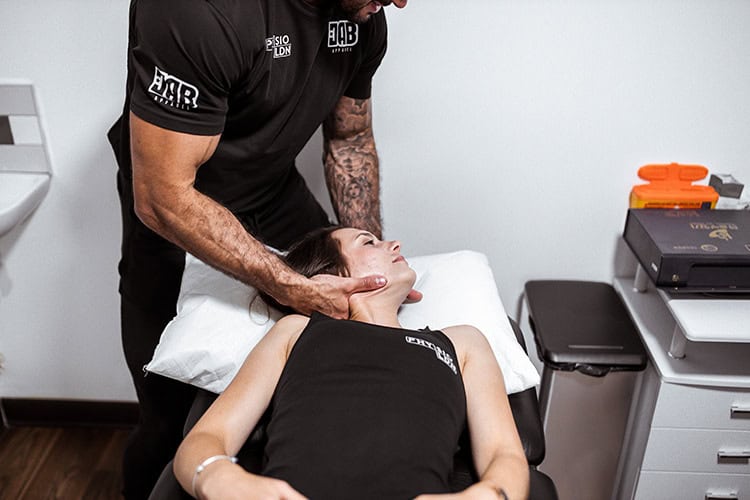
Manual therapy to the upper cervical joints combined with specific deep neck muscle training reduces cervicogenic headache frequency and intensity for at least 12 months.
The strongest trial in this area randomised 200 people with cervicogenic headache to manipulative therapy, a low-load exercise programme, both combined, or no treatment. At 12 months, both manipulative therapy and exercise had significantly reduced headache frequency and intensity. The effects were maintained. The combined group had the highest proportion of people reporting relief.
Our cervical-origin tension headache treatment in London follows this evidence:
- Upper cervical mobilisation to restore movement at C1-2 and C2-3 and reduce joint-driven referral.
- Suboccipital and upper trapezius release to reduce the muscle contribution.
- Deep neck flexor retraining. The longus colli and longus capitis muscles are often weak and slow to switch on in people with cervicogenic headache. Retraining them changes how the neck is loaded through the day.
- Scapular control work so the shoulder blades support the neck rather than hanging from it.
- Posture and load management for the specific trigger, whether that is a desk setup, a driving position, or a pillow.
Most people notice a change in headache frequency within three to four sessions. Cervicogenic headache physiotherapy is a short course for most, not an ongoing commitment.
Frequently asked questions
Can a tension headache really come from the neck?
Yes. When the upper cervical joints or muscles are the source, the headache is called cervicogenic. The pain is referred into the head through shared nerve pathways. It behaves differently from a primary tension-type headache and responds to neck treatment rather than headache medication.
What does a cervicogenic headache feel like?
A steady, non-throbbing ache on one side of the head that starts at the base of the skull and spreads forward. It is worse with neck movement or sustained posture and is usually accompanied by neck stiffness on the same side.
How long does a cervicogenic headache last?
Individual episodes last hours to days and recur as long as the cervical source is untreated. Once the neck joint or muscle driver is addressed, frequency and intensity drop and the effect holds for at least a year in trial data.
Do painkillers work for cervicogenic headache?
Paracetamol or ibuprofen reduce the pain but do not change the cause. Because the source is mechanical, treatment that restores neck movement and muscle control is what reduces recurrence.
Should I see a physio or a GP for a headache from my neck?
A physiotherapist can assess and treat a cervical-origin headache directly. See a GP first if the headache is sudden and severe, follows a head injury, or comes with any of the red flags listed below.
Book a cervical headache assessment
If your headache is one-sided, starts in the neck, and changes when you move, the neck is the place to treat. The One Body LDN cervicogenic headache team assesses the upper cervical joints, muscles, and movement patterns and builds a short treatment plan around what we find. If your neck symptoms are broader than headache, our neck pain physiotherapy in London covers the full picture.
Note: headache symptoms that need urgent medical care
Call 999 or go to A&E if a headache:
- Comes on suddenly and is the worst you have ever had
- Follows a blow to the head
- Comes with a stiff neck, fever, rash, or confusion
- Comes with weakness, slurred speech, vision loss, or a drooping face
See a GP promptly if headaches are new after the age of 50, are getting steadily worse, wake you from sleep, or come with unexplained weight loss. These patterns need medical assessment before physiotherapy.
References
- NHS. Headaches.
- Jull G, Trott P, Potter H, et al. A randomized controlled trial of exercise and manipulative therapy for cervicogenic headache. Spine 2002;27(17):1835-1843.
- Hall TM, Briffa K, Hopper D, Robinson K. Comparative analysis and diagnostic accuracy of the cervical flexion-rotation test. J Headache Pain 2010;11(5):391-397.
- Ogoke BA, et al. Cervicogenic headache. American Academy of Physical Medicine and Rehabilitation, PM&R KnowledgeNow.
- Headache Classification Committee of the International Headache Society. The International Classification of Headache Disorders, 3rd edition (ICHD-3): 11.2.1 Cervicogenic headache.
