



You put a hand out to break a fall, the wrist took the weight, and now it is swollen and sore and you are trying to decide between an ice pack and A&E. A sprained wrist and a broken wrist look alike in the first hours: both swell, both hurt to move and both can be used a little. The differences are in where the tenderness sits, whether the shape has changed and how the pain behaves over the first two days, and one fracture in particular, the scaphoid, hides behind a normal first X-ray and a wrist that still moves.
This guide sets out how a wrist sprain and a wrist fracture differ, the signs that point to a fracture, the scaphoid trap, how to check at home, what to do in the first 72 hours, how each is treated and when a wrist injury needs an X-ray the same day.
Key takeaways
- A wrist sprain is a stretched or torn ligament and a wrist fracture is a broken bone; both follow a fall on the outstretched hand and both swell, so the mechanism alone does not separate them.
- Tenderness directly on a bone, a change in the shape of the wrist, inability to grip a cup, and pain that is no better after 48 hours point to a fracture and need an X-ray.
- A scaphoid fracture causes tenderness in the hollow at the base of the thumb, often with a wrist that moves and a first X-ray that looks normal, and a missed one leads to long-term wrist damage.
- The ability to move the wrist does not rule out a fracture; many broken wrists move, and a fracture is ruled out by examination and imaging, not by movement.
- Most wrist sprains settle in two to six weeks with protection, early movement and progressive strengthening; most fractures need a cast or splint for four to six weeks and rehabilitation afterwards.
How do a sprained wrist and a broken wrist differ?
A sprained wrist is a stretched or torn ligament between the wrist bones and a broken wrist is a crack or break in one of those bones or in the forearm bones that meet them, and the two differ in where the tenderness sits, how the wrist looks, and how the pain behaves over the first 48 hours. Both follow the same fall, so the injury itself does not tell you which you have.
| Feature | Wrist sprain | Wrist fracture |
| Where it is tender | Over the soft tissue between bones, often the back of the wrist | Directly on a bone: the end of the forearm bone, the base of the thumb, or a wrist bone |
| Shape of the wrist | Normal, with swelling | Possible dinner-fork bend, a bump, or the hand sitting at an angle |
| Swelling | Builds over hours, soft | Rapid, often with bruising spreading within a day |
| Movement | Painful but possible through most of the range | Often possible, which is why movement does not rule a fracture out |
| Grip | Weak and sore, improves over days | Painful or impossible to grip a cup; no improvement over 48 hours |
| Pain at rest | Settles with elevation | Persists at rest and at night |
| Pain pattern over 48 hours | Improving | Same or worse |
Our wrist pain causes and treatment guide covers each of these injuries in full.
Which signs point to a broken wrist?
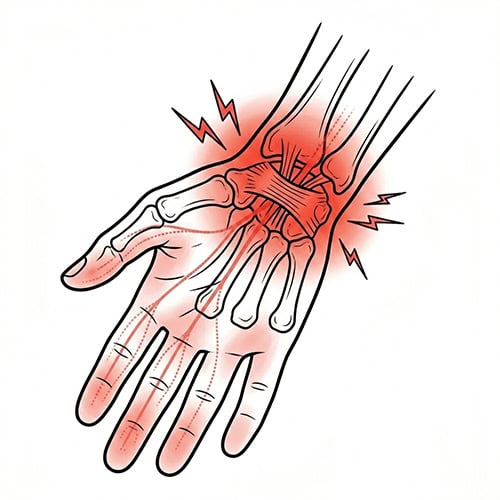
Tenderness directly on a bone, a change in the shape of the wrist, inability to grip, numbness in the fingers, and pain that has not improved after 48 hours are the signs that point to a fracture and need an X-ray. One is enough.
Bone tenderness. Press along the end of the forearm bone on the thumb side, the knob on the little-finger side, and the hollow at the base of the thumb. Sharp pain on a bone, rather than on the soft tissue between bones, is a fracture until an X-ray says otherwise.
Shape. Compare the two wrists from above and from the side. A bend, a bump or a hand that sits at an angle to the forearm is a displaced fracture and needs A&E the same day.
Grip and weight. A wrist that cannot hold a cup of water or take any weight through the hand the day after the fall is more likely to be broken than sprained.
Numbness. Pins and needles or numbness in the thumb, index and middle fingers after a wrist injury suggests swelling or a bone fragment pressing on the median nerve and needs assessment the same day.
The 48-hour rule. A sprain improves from the second day. A fracture does not. A wrist that is the same or worse at 48 hours is X-rayed.
Why is the scaphoid fracture the one that gets missed?
The scaphoid is a small bone at the base of the thumb that breaks in a fall on the outstretched hand, moves enough to be mistaken for a sprain, and often shows nothing on the first X-ray, so a missed scaphoid fracture is the most common serious error in wrist injuries. A scaphoid that does not heal loses its blood supply and leads to wrist arthritis years later.
The sign. Press into the hollow on the back of the wrist at the base of the thumb, the space between the two tendons that stand out when you stretch the thumb away from the hand. Sharp tenderness there after a fall is a scaphoid fracture until proven otherwise.
The trap. The wrist moves, the swelling is modest, and the first X-ray is normal in a meaningful share of true fractures. People go home with a sprain and return weeks later with a bone that has not joined.
What happens next. Tenderness in that hollow after a fall is treated as a fracture: a splint for ten to fourteen days, then a repeat X-ray or an MRI. Our guide on when to see a physiotherapist for wrist pain covers where a physiotherapy assessment fits once a fracture has been ruled out.
How do you check a wrist injury at home?
Four checks in the first hours separate a wrist that can be managed at home for 48 hours from a wrist that needs an X-ray today. Any one positive sends you for imaging.
Look. Compare both wrists from above and from the side for a bend, a bump or an angle.
Press the bones. Press the end of the forearm bone on the thumb side, the knob on the little-finger side, and the hollow at the base of the thumb. Note which spot is sharply tender.
Grip. Pick up a full mug with the injured hand. Inability to do so, or sharp pain in doing so, is a reason for an X-ray.
Feel the fingers. Check sensation in the thumb, index and middle fingers against the other hand. Numbness is a same-day sign.
Then wait 48 hours, if all four are clear. Protect, elevate and ice the wrist, and reassess at 48 hours. Improvement means a sprain; no improvement means an X-ray.
What should you do in the first 72 hours?
The first 72 hours after a wrist injury are spent protecting the wrist, controlling swelling and keeping the fingers, elbow and shoulder moving, whether the injury turns out to be a sprain or a fracture.
Protect. A wrist splint from a pharmacy, or a firm bandage, holds the wrist still for the first days. A wrist with a changed shape is not splinted at home; it goes to A&E.
Elevate and cool. Keep the hand above the heart when resting and apply ice wrapped in a cloth for 15 minutes every two to three hours while awake.
Move what is not injured. Open and close the fingers fully every hour, bend and straighten the elbow, and lift the arm overhead. Stiff fingers after a wrist injury take longer to recover than the wrist.
Pain relief. Paracetamol and, where safe for you, an anti-inflammatory for the first days.
Reassess at 48 hours. The four checks are repeated, and a wrist that has not improved is X-rayed.
How are a wrist sprain and a wrist fracture treated?

A wrist sprain is treated with protection for days to a few weeks, early movement and progressive strengthening over two to six weeks; a wrist fracture is treated with a cast or splint for four to six weeks, or surgery where the bone has moved, followed by rehabilitation to restore range, strength and grip. Both end in physiotherapy; the fracture starts it later.
The sprain. A mild sprain settles in two weeks with a splint for comfort, early range of movement and grip strengthening. A more severe sprain with a torn ligament between the scaphoid and lunate bones is protected longer and is assessed with imaging, because an untreated tear of that ligament leads to instability. Range and grip are rebuilt in stages, and the wrist is loaded through press-up and weight-bearing positions last.
The fracture. A stable fracture of the forearm bone is held in a cast for four to six weeks. A displaced fracture is reset, with or without surgery. A scaphoid fracture is held in a splint or cast for six to twelve weeks depending on the site. Rehabilitation after the cast restores wrist range, forearm rotation and grip, which have all been lost to immobilisation.
What we tell you at the assessment. A wrist that has been X-rayed and cleared is treated as a sprain, with a review at two weeks. A wrist that was never X-rayed and is tender on a bone is sent for an X-ray before treatment begins.
What goes wrong with wrist injuries?
Ruling out a fracture because the wrist moves, treating scaphoid tenderness as a sprain, leaving the fingers still in the first week, and returning to weight-bearing through the hand too early are the four errors that turn a wrist injury into a long-term problem.
Movement as proof. Most broken wrists move. Movement is not the test; bone tenderness, shape and the 48-hour rule are.
The missed scaphoid. Tenderness in the hollow at the base of the thumb is a fracture until a repeat X-ray or MRI says otherwise, however normal the first film looks.
Stiff fingers. Fingers held still in a bandage for a week lose range that takes weeks of rehabilitation to recover. The fingers move from day one.
Early load. Press-ups, planks and lifting through the hand come last in the programme, after range and grip are back. A sprain loaded in week two becomes a sprain that lasts months.
When to get a wrist injury assessed
A wrist injury with no sign of fracture that is still painful, weak or stiff after two weeks, or any wrist that has been X-rayed and cleared and needs its range and grip restored, warrants a physiotherapy assessment, and no GP referral is needed. A wrist with bone tenderness, a changed shape or numbness goes for an X-ray first, at an urgent treatment centre or A&E, and comes to physiotherapy afterwards. Our wrist pain physiotherapy service in London sees new wrist assessments within days across all our clinics, and our hand pain service covers the fingers and grip that recover alongside it.
Note. Some wrist injuries need urgent medical care rather than physiotherapy. A wrist with a visible bend, bump or angle, a wrist you cannot move or grip with at all, numbness or colour change in the fingers, a wound over the injury, sharp tenderness on a bone after a fall, or pain that is unchanged at 48 hours are reasons to go to an urgent treatment centre or A&E for an X-ray the same day.
Book your London wrist assessment
A wrist that has been cleared of fracture, or a cast that has just come off, needs range and grip back before it is used. You can book your first assessment for wrist pain physiotherapy in London at any of our clinics in 60 seconds, with no GP referral needed. Our hand pain physiotherapy in London covers the fingers and grip that recover with it.
Common questions about wrist sprains and fractures
Can you move a broken wrist?
Yes, in many cases. A crack in the forearm bone or a scaphoid fracture often leaves the wrist able to bend and straighten, so movement does not rule out a fracture. Bone tenderness, shape and the 48-hour rule are the signs that matter.
How do I know if my wrist is sprained or broken without an X-ray?
You cannot know for certain without an X-ray. Tenderness on soft tissue rather than bone, a normal shape, the ability to grip a cup and improvement by 48 hours make a sprain likely; any bone tenderness, change in shape, inability to grip, numbness or no improvement at 48 hours needs an X-ray.
What is a FOOSH injury?
FOOSH stands for a fall on the outstretched hand, the mechanism behind most wrist sprains and fractures. The same fall can sprain the ligaments, break the end of the forearm bone or break the scaphoid, which is why the examination after the fall decides the diagnosis.
How long does a sprained wrist take to heal?
A mild sprain settles in two weeks and a more severe sprain in four to six weeks, with range and grip rebuilt through physiotherapy. A sprain that is no better at two weeks is reassessed, because a ligament tear between the wrist bones or a missed fracture presents the same way.
Do I need physiotherapy after a wrist fracture?
Yes, in most cases. Four to six weeks in a cast leaves the wrist stiff, the forearm unable to rotate fully and the grip weak, and a structured programme restores all three faster than leaving them to recover on their own.
References
- NHS. Broken arm or wrist.
- NHS. Sprains and strains.
- National Institute for Health and Care Excellence. Fractures (non-complex): assessment and management. NICE guideline NG38, February 2016.
- Mallee WH, Henny EP, van Dijk CN, Kamminga SP, van Enst WA, Kloen P. Clinical diagnostic evaluation for scaphoid fractures: a systematic review and meta-analysis. Journal of Hand Surgery (American).
- British Society for Surgery of the Hand. Scaphoid fracture.
- Carpenter CR, Pines JM, Schuur JD, Muir M, Calfee RP, Raja AS. Adult scaphoid fracture. Academic Emergency Medicine.
