

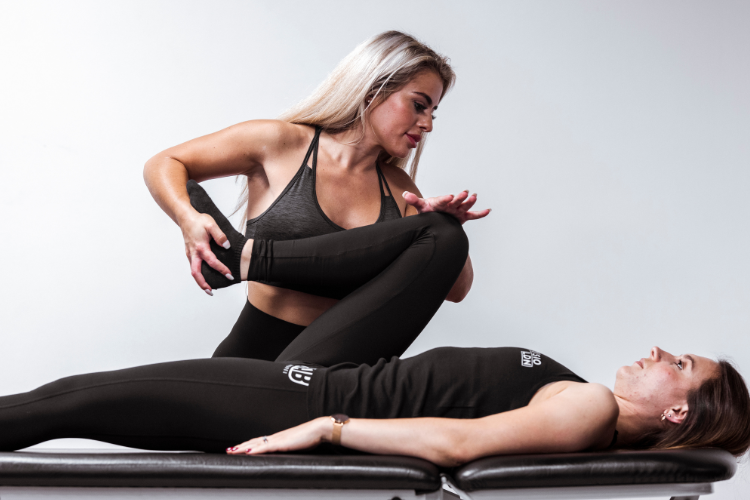

You have booked a physiotherapy appointment for your knee and you are not sure what will happen in the room, whether it will hurt, or whether you should have had a scan first. A knee assessment is a structured 45 to 60 minute examination, and almost every knee diagnosis is made in that hour by history and hands-on testing rather than by imaging.
NICE guideline NG226 states that knee osteoarthritis is diagnosed clinically, without a scan, in most adults over 45. This guide walks through the assessment in the order it happens: the questions, the way the physiotherapist watches you move, the ligament and meniscus tests by name, what is checked beyond the knee, and what you leave with.
Key takeaways
- A knee physiotherapy assessment lasts 45 to 60 minutes and follows a fixed order: history, observation and gait, movement and strength, specific ligament and meniscus tests, then the plan.
- The physiotherapist tests the ACL with the Lachman and anterior drawer tests, the meniscus with the McMurray and Thessaly tests, and the collateral ligaments with valgus and varus stress.
- Gait analysis and a single-leg squat show how the hip and ankle load the knee, which is where most non-traumatic knee pain starts.
- Most knee pain needs no scan before or after the assessment; imaging is requested when a test points to a structural tear that changes management.
- You leave with a working diagnosis, an expected number of sessions and your first two or three exercises.
What happens before the physiotherapist touches your knee?

The first 10 to 15 minutes of a knee assessment are questions, and the answers narrow the diagnosis more than any single test. The physiotherapist is sorting your knee into one of a small number of patterns before standing you up.
What you will be asked. How the pain started, with or without an injury, and what the knee was doing at the time. Where the pain sits: front, inner side, outer side or behind the knee. How the knee behaves over 24 hours, and how long it is stiff in the morning. Whether the knee swells, locks, clicks or gives way. What makes it worse, what settles it, and what you need the knee to do again.
Why the answers matter. A knee that swelled within two hours of a twist suggests bleeding inside the joint and points towards a ligament tear. A knee that swelled overnight points towards the meniscus or the joint lining. Morning stiffness under 30 minutes with activity-related pain in someone over 45 fits osteoarthritis under NICE NG226. The physiotherapist also screens for red flags at this stage, which is why a few questions sound unrelated to your knee.
How does the physiotherapist assess the way you stand and walk?
Observation and gait analysis come next, and they show how the hip, knee and ankle share load before any test is done on the knee itself. Most knee pain without an injury comes from how the leg loads, not from damage inside the joint.
Standing. The physiotherapist looks at knee alignment, swelling around the kneecap and the joint line, and the size of the thigh muscle compared with the other side. A quadriceps that has shrunk tells the clinician how long the knee has been protecting itself.
Walking. You walk the length of the room several times. The physiotherapist watches whether the knee fully straightens at each step, whether the hip drops on the painful side, and whether the foot rolls inwards.
Loaded movements. A single-leg squat, a step-down from a low step and, where relevant, a hop test show what the knee does under load. A knee that drifts inwards during a single-leg squat points to hip weakness, and that finding changes the exercise programme more than any knee test. Our guide on how physiotherapists diagnose explains why movement is examined before structure.
Which tests will the physiotherapist do on your knee?
The physiotherapist measures range of movement, presses along the joint line and then performs specific tests that each load one structure in the knee. Each test takes under a minute and is stopped if it provokes sharp pain.
| Test | Structure tested | What the physiotherapist does |
| Lachman test | Anterior cruciate ligament | Knee bent to about 20 degrees, shin drawn forward on the thigh |
| Anterior drawer test | Anterior cruciate ligament | Knee bent to 90 degrees, shin drawn forward |
| Posterior drawer test | Posterior cruciate ligament | Knee bent to 90 degrees, shin pushed backward |
| McMurray test | Meniscus | Knee bent fully, then straightened while the shin is rotated |
| Thessaly test | Meniscus | Standing on the painful leg with the knee slightly bent, twisting the body |
| Valgus and varus stress tests | Inner and outer collateral ligaments | Sideways pressure on the knee at full extension and at 30 degrees |
| Patellar apprehension and glide | Kneecap stability and tracking | Kneecap pushed gently outward and moved across the thigh bone |
| Sweep test | Joint swelling | Fluid stroked from one side of the knee to the other |
What a positive test means. A positive test raises the probability of a diagnosis; a cluster of findings confirms it. The Lachman test is the most reliable single test for an ACL tear, with sensitivity around 85 per cent and specificity around 94 per cent in a 2006 meta-analysis by Benjaminse and colleagues. The McMurray test is less certain on its own, with sensitivity and specificity both near 70 per cent, which is why the physiotherapist combines it with joint line tenderness and your history before calling it a meniscal tear.
Does it hurt? The tests reproduce your symptom briefly, which is the point. A test that provokes nothing tells the clinician as much as one that does, and no test continues past sharp pain.
What does the physiotherapist check beyond the knee?
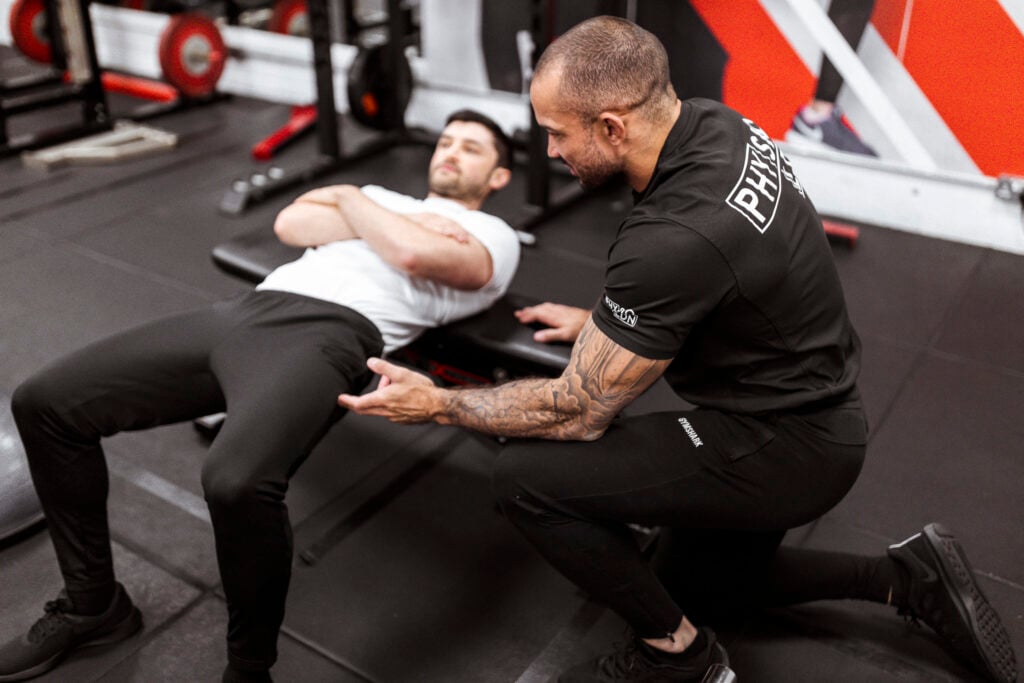
A knee assessment includes the hip, the ankle and the lower back, because each one changes how the knee loads and each one can refer pain to the knee. Pain felt in the knee with a normal knee examination is usually coming from the hip or the spine.
The hip. Hip abductor and rotator strength are tested lying on your side and standing, since weak hip muscles let the knee drift inwards under load. Hip rotation range is checked in anyone over 40, because hip osteoarthritis refers pain to the front of the knee.
The ankle. Ankle dorsiflexion is measured in a lunge against a wall. A stiff ankle pushes the knee forward and inwards during squats and stairs.
The back. A short screen of lumbar movement and nerve tests rules out pain referred from the spine, which can present as a vague ache around or behind the knee.
What do you leave the first appointment with?
You leave a knee assessment with a working diagnosis, an expected number of sessions, two or three exercises and a clear statement of whether any imaging or onward referral is needed. The last 10 minutes of the appointment are spent on this, and treatment usually begins the same day.
The working diagnosis. The physiotherapist names the most likely structure or pattern and says how confident the examination allows them to be. We will tell you if the picture is unclear and what would clarify it.
The plan. You hear how many sessions the problem typically needs and how often. Patellofemoral pain and most meniscal irritations run six to ten sessions over 8 to 12 weeks in our clinics. Our guide to the cost of private physiotherapy for knee pain sets out what each diagnosis tends to cost in total.
Imaging and referral. Most knee pain needs no scan. A scan is requested when the tests point to a ligament rupture, a displaced meniscal tear or a knee that is locked, because those findings change the treatment. A physiotherapist who examines your knee and does not send you for an MRI is following the evidence.
The first exercises. You are shown two or three exercises, you perform them in the room, and you leave with them written down or sent to your phone. Our knee pain causes and treatment guide explains where each diagnosis goes from here.
How should you prepare for a knee assessment?
Wearing shorts, bringing any previous scan reports and arriving with a clear account of how the pain behaves over a day are the three things that make a knee assessment more accurate.
- Wear or bring shorts, so both knees and both hips can be seen and compared.
- Bring previous imaging reports and the names of any medication you take.
- Note when the pain is worst, what sets it off and how long the knee is stiff in the morning.
- Bring the trainers you run or train in, since the physiotherapist may want to see you move in them.
- Avoid taking painkillers in the two hours before the appointment where you safely can, so the tests reproduce the symptom.
Our guide on what happens at a first physiotherapy appointment covers the parts of the visit that are the same for every joint.
When to get your knee assessed
Knee pain that has lasted more than two weeks, that limits stairs or walking, or that followed a twist or fall warrants an assessment, and no GP referral is needed. Our knee pain physiotherapy service in London runs across all our clinics, and the first appointment follows the structure described above.
Note. Some knee symptoms need urgent medical care rather than a physiotherapy assessment. A knee that is hot, red and swollen with a fever, a knee you cannot put weight on after an injury, an obvious deformity, a knee locked and unable to straighten, or calf pain and swelling with shortness of breath are reasons to call NHS 111 or go to A&E.
Common questions about knee physiotherapy assessments
Do I need an MRI before seeing a physiotherapist for knee pain?
No. The assessment identifies whether a scan is needed, and most knee pain is diagnosed and treated without one. A scan is requested when the tests point to a tear that changes the treatment.
Will I get treatment at the first appointment?
Yes. Most knee assessments end with hands-on treatment where the knee is stiff or guarded, and with your first exercises performed in the room.
How long does a knee physiotherapy assessment take?
A first knee assessment takes 45 to 60 minutes. Follow-up sessions take 30 to 45 minutes.
What if the physiotherapist finds something serious?
The physiotherapist explains the finding, writes to your GP or refers you directly to a consultant, and tells you what to avoid in the meantime. Onward referral after one visit saves you sessions that would not have helped.
Can a physiotherapist diagnose a torn meniscus or ACL without a scan?
A physiotherapist can identify a probable ACL or meniscal tear from your history and a cluster of positive tests, with the Lachman test alone correctly identifying most ACL tears. A scan confirms the extent when surgery is being considered.
Book your London knee assessment
A knee assessment done properly gives you the diagnosis and the plan in one visit. You can book your first assessment for knee pain physiotherapy in London at any of our clinics in 60 seconds, with no GP referral needed.
References
- National Institute for Health and Care Excellence. Osteoarthritis in over 16s: diagnosis and management. NICE guideline NG226, October 2022.
- Benjaminse A, Gokeler A, van der Schans CP. Clinical diagnosis of an anterior cruciate ligament rupture: a meta-analysis. Journal of Orthopaedic and Sports Physical Therapy.
- Hegedus EJ, Cook C, Hasselblad V, Goode A, McCrory DC. Physical examination tests for assessing a torn meniscus in the knee: a systematic review with meta-analysis. Journal of Orthopaedic and Sports Physical Therapy.
- NHS. Physiotherapy: how to access.
- Chartered Society of Physiotherapy. What to expect from physiotherapy.
