



Pain on the outer edge of your wrist, the little finger side, has a particular set of triggers. Turning a door handle. Opening a jar. Pushing up out of a chair. Leaning on your hand. If any of those make you wince, you have probably already searched and landed on three letters: TFCC.
It is a reasonable first guess, and it is sometimes right. It is also the most over-applied label in wrist pain. Research on ulnar-sided wrist pain, the clinical term for this area, notes that it is most often misdiagnosed as a TFCC injury, because several different structures sit in that small space. This guide covers what the TFCC is, what its pattern actually looks like, what else produces pain in the same spot, and what to do about it.
Key takeaways
- Pinky-side wrist pain has several possible causes, and TFCC injury is one of them, not all of them
- The TFCC is a cushion and stabiliser on the outer edge of the wrist, loaded by rotation and weight-bearing
- Its signature is pain on twisting and on pushing through the hand, often with clicking or a loose feeling
- “Tear” sounds alarming, but most TFCC problems are managed without surgery
- Pinky-side pain after a fall onto the hand needs assessment, because the bones in that area are involved too
What the TFCC is and what it does
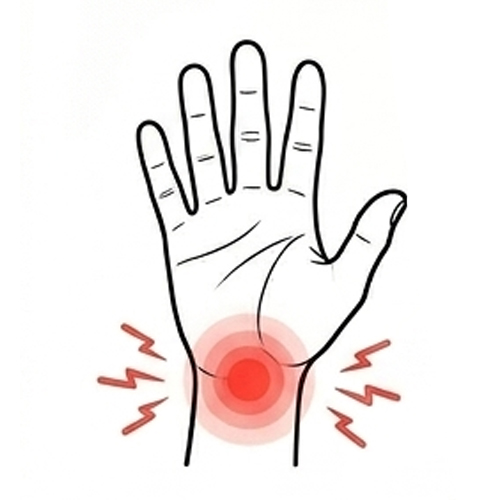
The TFCC is a small complex of cartilage and ligaments on the little finger side of the wrist that cushions load and holds the two forearm bones stable as they rotate.
Think of it as a shock absorber and a stabiliser in one. It sits between the end of the forearm bone on the pinky side and the small bones of the wrist. It has two jobs: absorbing load when you push through your hand, and keeping the wrist stable while your forearm rotates.
That explains its symptom pattern exactly. Rotating your forearm, turning a key, a door handle, a screwdriver, loads it. So does pressing weight through the palm, a push-up, getting up from a chair, leaning on a desk. If a structure that does those two jobs is irritated, those two movements are what hurt.
Where this sits among the other causes of wrist pain is mapped in our wrist pain guide.
What a TFCC problem feels like
TFCC injury produces pain on the outer edge of the wrist that is worse with twisting and weight-bearing, often with clicking and a sense that the wrist is not solid.
The core pattern
- Pain on the little finger side of the wrist, described as a deep ache or a sharp catch
- Worse when turning the forearm, keys, handles, jars, taps
- Worse pushing through the hand, press-ups, pushing up from a chair or bed, yoga positions
- Clicking or popping on rotation
- A feeling of looseness or that the wrist cannot be trusted under load
- Reduced grip strength, sometimes without much pain
How it starts
Two routes, and they behave differently.
Suddenly, after a fall: Landing on an outstretched hand is the classic traumatic mechanism, as is a sudden forceful twist. This version deserves prompt assessment, for reasons covered below.
Gradually, from repetition: Racket sports, golf, gymnastics, climbing, and any work involving repeated rotation or gripping. The TFCC also thins naturally with age, so degenerative changes are common in older wrists and often exist without symptoms.
What else causes pain in the same spot
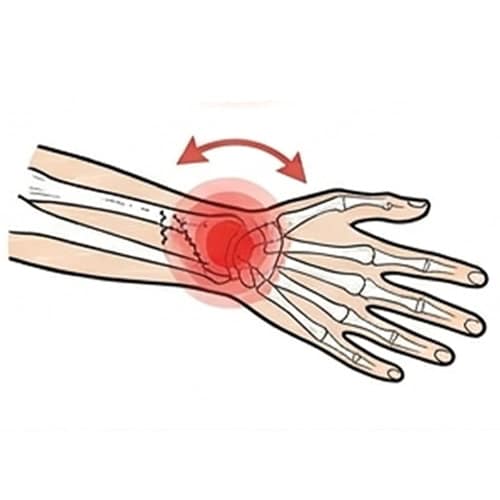
Several structures share the little finger side of the wrist, which is why ulnar-sided wrist pain is so frequently mislabelled as a TFCC injury.
This is the part most pages skip, and it matters because treating the wrong structure wastes months.
The tendons on that side of the wrist: A tendon runs along the outer wrist and can become irritated or unstable in its groove, producing pain in almost the same place, often with a snapping sensation.
The small bones: After a fall onto the hand, a bone injury on that side of the wrist is a real possibility and needs ruling out before anything else proceeds.
The joint between the two forearm bones: Where the forearm bones meet at the wrist, problems produce pain on rotation that mimics the TFCC pattern closely.
The ulnar nerve: If tingling or numbness in the little finger travels with the pain, a nerve is involved, and the source is often higher up. Our guide to numbness and tingling in the fingers maps which fingers point where.
The practical takeaway: pinky-side wrist pain is an area, not a diagnosis. Assessment narrows it by testing each structure, which is what separates a plan that works from one that treats the popular answer.
“Tear” does not mean surgery
Most TFCC problems are managed without an operation, and the word “tear” describes a spectrum from minor irritation to genuine structural damage.
The language causes unnecessary alarm. TFCC problems range from a sprain, through age-related thinning that may be incidental, to a true tear from trauma. Degenerative changes turn up on scans of wrists that have never hurt, which means a scan finding alone does not explain your pain.
Conservative treatment, activity modification, a period of support where needed, and progressive strengthening of the wrist and forearm, resolves the majority. Surgery is reserved for genuine structural tears that stay symptomatic after proper rehabilitation, or for instability that does not settle.
What treatment involves
Settling the irritated tissue comes first, which usually means temporarily reducing the loaded rotation and weight-bearing that flare it. A wrist support can help through that phase, used for a defined period rather than indefinitely.
Then the rebuilding: strengthening the muscles that stabilise the wrist and forearm so the TFCC is not taking load it cannot handle, and a graded return to the rotation and pressing your work or sport demands. Timelines vary with severity, and gradual sprains generally settle faster than traumatic tears.
When to get it assessed
Book an assessment if pinky-side wrist pain has lasted beyond two to three weeks, keeps returning with twisting or pressing, or comes with clicking and a loose feeling. Get it looked at sooner if it followed a fall onto the hand. Our wrist pain physiotherapy in London team assesses ulnar-sided wrist pain, separates these structures, and arranges imaging where the picture calls for it, through direct access, no GP referral needed.
Common questions about pinky-side wrist pain
Is pinky-side wrist pain always a TFCC tear?
No. Several structures sit on that side of the wrist, and ulnar-sided wrist pain is frequently mislabelled as TFCC injury. Tendons, the small wrist bones, the forearm joint, and the ulnar nerve can all produce pain there. Assessment narrows it down.
How do I know if my TFCC is torn?
The pattern is suggestive, not conclusive: pain on the outer wrist that worsens with twisting and pushing through the hand, often with clicking or instability. A clinical assessment, and imaging where needed, is what confirms it, because scan findings are read against symptoms.
Can a TFCC injury heal without surgery?
Yes, most do. Conservative treatment resolves the majority of TFCC problems. Surgery is reserved for genuine tears that remain symptomatic after proper rehabilitation, or for persistent instability.
Why does my wrist hurt when I do push-ups?
Pressing through the palm loads the little finger side of the wrist directly, which is one of the TFCC’s main jobs. Push-up pain on that edge is a recognised presentation, though it can also come from the tendons or joints nearby.
Should I wear a wrist brace for pinky-side wrist pain?
Short-term, for a flare, it can help by limiting the rotation that aggravates it. Worn indefinitely it weakens the wrist it protects, so it works best as a temporary aid alongside the strengthening that actually resolves the problem.
Book your wrist assessment
Pain on the little finger side of your wrist is an area with several possible causes, and knowing which one you have is what makes the treatment work. Book an assessment with our wrist pain physiotherapy in London team in 60 seconds, no GP referral needed.
Note: Wrist pain that needs prompt assessment
Get it checked sooner rather than later if you have:
- Pinky-side wrist pain that started with a fall onto the hand
- Tenderness directly on the wrist bones with an inability to grip
- A wrist that gives way or feels unstable under load
- Numbness or tingling in the little finger alongside the pain
References
- Jain DKA, et al. Ulnar-sided wrist pain management guidelines. Journal of Clinical Orthopaedics and Trauma. 2021.
- Cleveland Clinic. Triangular fibrocartilage complex (TFCC) tear.
- Sachar K. Ulnar-sided wrist pain: evaluation and treatment of triangular fibrocartilage complex tears, ulnocarpal impaction syndrome, and lunotriquetral ligament tears. Journal of Hand Surgery. 2012;37(7):1489-1500.
- NHS. Wrist pain.
- Chartered Society of Physiotherapy. Hand and wrist problems.
