

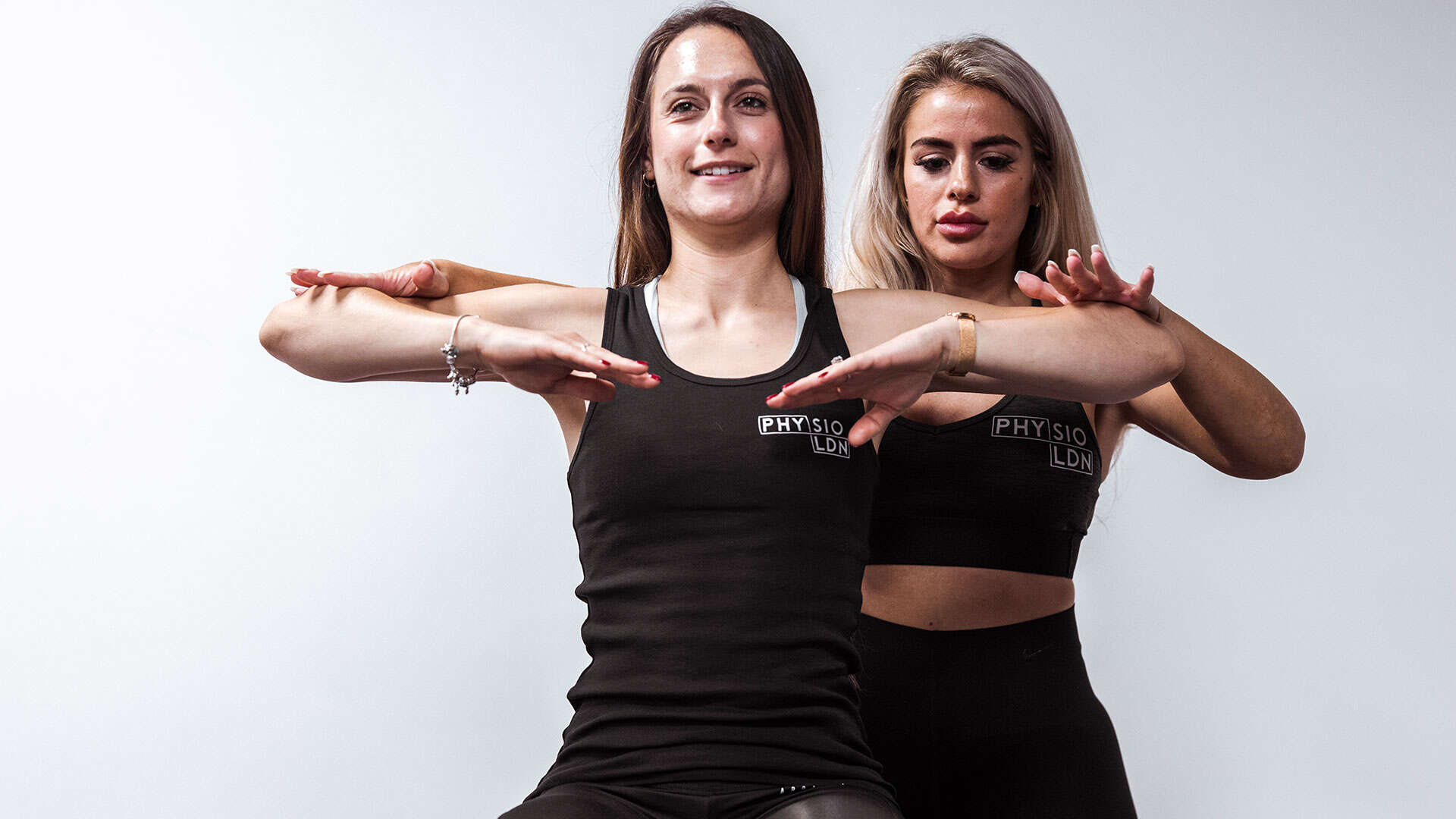

Shoulder impingement is diagnosed by movement, not by a scan. The tests a physiotherapist uses are positional. They load the tendons and bursa under the bony arch of the shoulder and ask whether that reproduces your pain. Three of those tests can be adapted for home use, and a fourth needs only a doorframe.
No single test is reliable on its own. Done together and read correctly, they tell you with reasonable confidence whether impingement is the likely pattern and whether the next step is physiotherapy. This guide walks through the four checks, how to score them, and what a positive result does and does not mean.
Key takeaways
- Shoulder impingement is compression of the rotator cuff tendons and bursa beneath the acromion during arm elevation. It is a mechanical pattern, not a tear.
- Four home checks cover the pattern: painful arc, Hawkins-Kennedy, Neer, and resisted rotation.
- Individual tests are only moderately accurate. Three positives together put the likelihood of impingement above 90%. Three negatives put it below 25%.
- A positive result tells you the pattern. It does not tell you whether the tendon is intact. That needs assessment.
- Impingement responds to physiotherapy that restores the mechanics that caused the compression, usually within 6 to 12 weeks.
What impingement is, in one paragraph
Shoulder impingement is pinching of the rotator cuff tendons or the bursa above them against the underside of the acromion as the arm is raised.
The space between the top of the arm bone and the bony arch above it is small. The supraspinatus tendon and the subacromial bursa pass through it. When the arm is raised, especially forward and inward, that space narrows. If the cuff muscles are not holding the ball of the joint down, or the shoulder blade is not rotating out of the way, the tendon is squeezed. Repeated squeezing irritates it. That irritation is the pain you feel reaching into a cupboard, putting on a jacket, or lying on that side.
It is one of the most common causes of shoulder pain in people under 60, and the most common cause in overhead athletes and manual workers.
Why a self-test is worth doing

Imaging is a poor first step for impingement, because scans show changes in pain-free shoulders too. Movement tests are the primary diagnostic tool.
Ultrasound and MRI regularly show bursal thickening, tendon changes, and small tears in people with no symptoms. A scan cannot tell you whether what it shows is causing your pain. A movement test can, because it either reproduces your pain or it does not.
The tests below are adapted from the standard clinical examination. Read the whole protocol before starting. Stop any test that produces sharp pain. Write down each result as positive, negative, or unclear.
The four-check protocol
Each check loads the subacromial space in a different way. Together they cover the impingement pattern from four directions.
Check 1: The painful arc
Stand with the arm at your side, thumb pointing forward. Slowly raise the arm out to the side until it is straight overhead, then slowly lower it.
Positive: pain appears part way up, roughly between shoulder height and well above it, and eases again as the arm reaches the top. Pain on the way down through the same zone also counts.
Negative: no pain, or pain only at the very top, or pain throughout the whole movement.
Pain confined to the middle of the arc is the classic impingement sign. The reason it sits in that specific zone is covered in our guide to painful arc syndrome.
Check 2: Hawkins-Kennedy
Raise the painful arm straight in front of you to shoulder height. Bend the elbow to 90 degrees so the forearm points across your body. With the other hand, gently push the wrist downward so the forearm rotates toward the floor.
Positive: pain at the front or top of the shoulder as the forearm rotates down.
Negative: stretch or discomfort only, or nothing.
This position drives the greater tuberosity of the arm bone under the acromion. It is one of the most sensitive single tests for impingement.
Check 3: Neer
Stand side-on to a wall with the painful shoulder nearest it. Turn the arm so the thumb points down and back. Keeping the elbow straight, raise the arm forward and up as far as it will go, using the wall to keep the shoulder blade still.
Positive: pain at the front of the shoulder in the top third of the movement.
Negative: no pain, or tightness only.
In clinic, the examiner holds the shoulder blade down. The wall does a rough version of the same job.
Check 4: Resisted external rotation
Stand with the elbow bent to 90 degrees and tucked into your side, forearm pointing forward. Place the back of the wrist against a doorframe. Push outward as if trying to turn the forearm away from your body. Hold for five seconds.
Positive: pain at the shoulder, or weakness compared with the other side.
Negative: strong and pain-free.
This tests the infraspinatus, the cuff muscle most often inhibited in impingement.
How to read your results
Three or more positives make impingement the likely pattern. Zero or one positive makes it unlikely.
Individual shoulder tests are moderately accurate at best. A systematic review of shoulder examination tests found that no single impingement test has both high sensitivity and high specificity. Their value is in combination.
In the most cited study of test combinations, people who were positive on Hawkins-Kennedy, painful arc, and resisted external rotation together had a greater than 90% likelihood of impingement. People negative on all three had less than a 25% likelihood.
| Positives out of four | Interpretation | Next step |
| 0 to 1 | Impingement unlikely | Consider another cause. Assessment if pain persists past two weeks. |
| 2 | Possible | Assessment to clarify. |
| 3 to 4 | Likely impingement pattern | Book a physiotherapy assessment. |
What a positive result does not tell you
A positive protocol identifies the pattern of compression. It does not tell you whether the tendon underneath is irritated or torn. Impingement and partial cuff tears produce the same test results. Separating the two is a clinical judgement, sometimes with imaging, and is covered in our guide to rotator cuff tear vs strain. If your checks are positive and you also noticed weakness in check 4, that question matters.
What it is not
A shoulder that is stiff in every direction, including when someone else moves it for you, is more likely a frozen shoulder. A shoulder that feels loose, slips, or has dislocated is an instability problem. Pain at the very top of the shoulder on the bony point, worst reaching across the body, points to the AC joint. None of these follow the impingement pattern above.
What treatment involves
Impingement is treated by restoring the mechanics that narrowed the space, not by resting the shoulder until it stops hurting.
Rest reduces the irritation but leaves the cause in place. The pain returns when the arm is used. Our shoulder impingement treatment in London addresses the three usual drivers:
- Rotator cuff control. Retraining the cuff to hold the ball of the joint down and back as the arm rises.
- Shoulder blade movement. Restoring the upward rotation of the scapula that opens the space at the top of the arc.
- Posture and thoracic mobility. A rounded upper back tips the acromion forward and narrows the space before the arm has moved.
Load is reduced early, then rebuilt. Most people are reaching and lifting without pain within 6 to 12 weeks. Subacromial impingement physiotherapy is one of the most predictable rehabilitation programmes we run, provided the pattern has been correctly identified.
Frequently asked questions
How do I test myself for shoulder impingement?
Four home checks cover the pattern: raising the arm out to the side and noting pain in the middle of the arc, the Hawkins-Kennedy position, the Neer position against a wall, and resisted outward rotation against a doorframe. Three or more positives make impingement the likely pattern.
Is the painful arc test accurate for impingement?
On its own, moderately. Combined with Hawkins-Kennedy and resisted external rotation, three positives put the likelihood of impingement above 90%. No single shoulder test is reliable alone.
Can shoulder impingement be diagnosed without a scan?
Yes. Impingement is diagnosed by movement tests and history. Scans are used when a tear is suspected or when symptoms do not respond to treatment. Imaging findings are common in pain-free shoulders, so a scan alone cannot confirm the diagnosis.
What does shoulder impingement feel like?
A sharp or catching pain at the front or outside of the shoulder when raising the arm, reaching overhead, or reaching behind the back, with pain lying on that side at night. Movement below shoulder height is usually comfortable.
Does a positive impingement test mean I have a rotator cuff tear?
No. Impingement and partial cuff tears produce the same test results. Weakness on the resisted test raises the possibility of a tear, and that is assessed in clinic, sometimes with imaging.
Book a shoulder impingement assessment
If three or more of your checks were positive, the pattern is clear enough to act on. The One Body LDN shoulder impingement team confirms the pattern, checks the tendon, and builds the programme around the mechanics that caused it. For shoulder pain that did not fit the protocol, our shoulder pain physiotherapy in London covers the wider picture. No GP referral is needed.
Note: shoulder symptoms that need medical review before self-testing
Do not run these checks, and see a GP or contact NHS 111, if you have:
- A shoulder injury with sudden loss of ability to lift the arm
- A visibly deformed or dislocated shoulder
- A hot, red, swollen shoulder, or shoulder pain with fever
- Shoulder pain with chest pain, breathlessness, or pain spreading down the left arm
- Numbness, tingling, or weakness through the whole arm or hand
- Unexplained weight loss or a history of cancer
References
- NHS. Shoulder pain.
- Park HB, Yokota A, Gill HS, El Rassi G, McFarland EG. Diagnostic accuracy of clinical tests for the different degrees of subacromial impingement syndrome. Journal of Bone and Joint Surgery (American) 2005;87(7):1446-1455.
- Hegedus EJ, Goode AP, Cook CE, et al. Which physical examination tests provide clinicians with the most value when examining the shoulder? Update of a systematic review with meta-analysis of individual tests. British Journal of Sports Medicine 2012;46(14):964-978.
- Michener LA, Walsworth MK, Doukas WC, Murphy KP. Reliability and diagnostic accuracy of 5 physical examination tests and combination of tests for subacromial impingement. Archives of Physical Medicine and Rehabilitation 2009;90(11):1898-1903.
- Chartered Society of Physiotherapy. Shoulder pain: managing your pain at home.
