

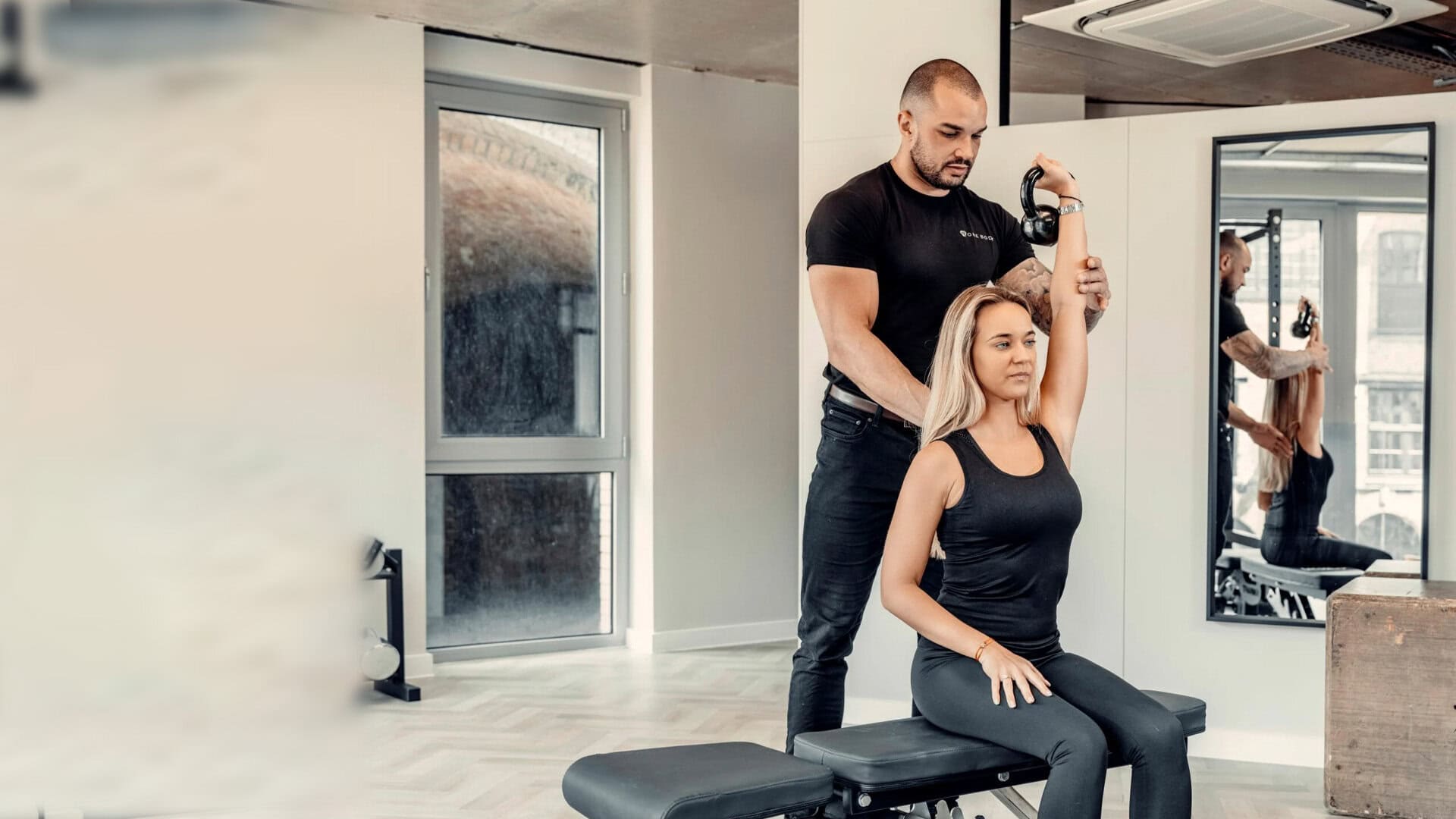

Most shoulders make a noise at some point. A click reaching for a shelf, a pop in the gym, a grinding sound rolling the shoulder after a long day at a desk. Nearly all of it is harmless. The shoulder is the most mobile joint in the body, and mobility means tendons, bursae, and bone moving past each other with every lift.
The noise is not the question. The question is what comes with it. A click on its own is a mechanical event. A click with pain, catching, or a feeling that the joint has shifted is a clinical sign. This guide separates the two.
Key takeaways
- Painless shoulder clicking with no catching, weakness, or instability is almost always benign and needs no treatment.
- Shoulder noise comes from five sources: joint gas release, a tendon flicking over bone, the shoulder blade moving on the ribcage, the AC joint, and worn joint surfaces.
- Sound, location, and repeatability identify the source. A pop you cannot repeat immediately is gas. A click at the same angle every time is a tendon.
- Clicking that comes with pain, catching, or a sense of the joint slipping, particularly after an injury or dislocation, is the one pattern that needs assessment.
- Clicking that has appeared alongside new pain when raising the arm is usually an impingement pattern and responds to physiotherapy.
Five sources of shoulder noise
Shoulder noise comes from gas release in the joint, a tendon moving over bone, the shoulder blade sliding on the ribs, the AC joint, or roughened joint surfaces.
1. Gas release in the joint
The shoulder joint contains fluid under slight negative pressure. A quick stretch of the joint capsule drops the pressure, a gas bubble forms, and the sound is the bubble forming. This is the same event as cracking a knuckle, and it has been imaged in real time. The pop is single, often satisfying, and cannot be repeated for 15 to 20 minutes. It is harmless.
2. A tendon moving over bone
The long head of biceps runs in a groove at the front of the shoulder. The rotator cuff tendons pass under the acromion. A tendon that is slightly thickened, or a groove that is slightly shallow, lets the tendon flick over its edge as the arm rotates. The click is sharp, happens at the same angle every time, and is repeatable. Painless, it is a variation. With pain, it may be a tendon irritation pattern.
3. The shoulder blade on the ribcage
The shoulder blade glides over the ribs on a thin layer of muscle. If the muscles are tight, weak, or thin, the blade grates or thuds as it moves. This is felt at the back, between the shoulder blade and spine, usually on shrugging or rolling the shoulders. Clinicians call it scapulothoracic crepitus. It is common in desk workers and swimmers, and it is rarely serious.
4. The AC joint
The small joint where the collarbone meets the top of the shoulder clicks when its cartilage disc is worn or the joint is slightly loose after an old injury. The click is felt on the bony point at the top of the shoulder, often reaching across the body or lifting overhead. Painless, it needs nothing. With pain and tenderness on that point, it is an AC joint problem.
5. Worn joint surfaces
A continuous grinding or grating sound through the whole movement, rather than a single click, suggests the cartilage surfaces of the joint are roughened. This is more common over 60 and usually comes with stiffness. It is the pattern of early joint arthritis and is managed, not cured.
How to identify your noise
Three questions place the noise: what does it sound like, where is it felt, and can you repeat it?
| Question | Gas release | Tendon | Shoulder blade | AC joint | Joint surfaces |
| Sound | Single pop | Sharp click | Grating or thud | Click or clunk | Continuous grind |
| Where felt | Deep in the joint | Front or top of shoulder | Back, under the shoulder blade | Bony point on top | Throughout the joint |
| Repeatable? | No, not for 15 to 20 minutes | Yes, same angle each time | Yes, on shrugging | Yes, reaching across | Yes, most movements |
Painless noise in any of these categories is a mechanical fact about your shoulder, not a condition. Noise with pain is a different question, and the next section covers it.
When clicking needs assessment

Clicking needs assessment when it comes with pain, catching, weakness, or a sense that the joint has shifted.
Three patterns matter.
Clicking with new pain when raising the arm
If the click appeared at the same time as pain reaching overhead or lying on that side, the two are usually linked. A tendon or bursa under the acromion has thickened enough to click as it passes under the bony arch, and the thickening is what hurts. This is an impingement pattern. It responds well to physiotherapy and is managed through our shoulder impingement service.
Clicking with catching or locking
A click followed by a brief catch, where the arm seems to stick and then release, is different from a clean click. Catching suggests something is interrupting the smooth movement of the joint surfaces. A torn piece of labrum, the cartilage rim around the socket, is the usual cause, particularly after a fall on the arm, a dislocation, or years of overhead sport. This needs assessment, sometimes with imaging.
Clicking with a sense of slipping
A deep clunk with a feeling that the ball of the joint has moved and come back is not a click. It is a subluxation. It is common after a previous dislocation and in people with naturally loose joints. The pattern is assessed for instability before any strengthening starts, because the wrong exercises make it worse.
Clicking in a shoulder that has never been injured, is not painful, and does not catch or slip does not fall into any of these. It is part of the general picture of shoulder pain only when pain is present.
What makes a clicking shoulder quieter
Painless clicking does not need treatment. Painful clicking usually improves when the mechanics that cause the tendon or blade to catch are corrected.
For a tendon click with pain, the aim is to restore the cuff control that keeps the ball of the joint centred so the tendon passes freely. For a shoulder blade grate, the aim is to rebuild the muscles that cushion the blade on the ribcage and correct the posture that pulls it forward. For an AC joint click with pain, the aim is to reduce load on the joint while the surrounding muscles take over.
A shoulder mechanics assessment identifies which of the five sources is producing the noise and whether it needs anything at all. Many people leave with reassurance and no treatment plan. That is a good outcome.
Frequently asked questions
Why does my shoulder click when I raise my arm?
A click when raising the arm is usually a tendon flicking over bone or a bursa passing under the acromion. Painless, it is a mechanical variation. With pain, it is usually an impingement pattern. Gas release in the joint produces a single pop that cannot be repeated immediately.
Is shoulder clicking a sign of arthritis?
Rarely. A single click is not arthritis. A continuous grinding sound through most of the movement, with stiffness, in someone over 60, can be a sign of worn joint surfaces. That pattern is assessed and managed rather than cured.
Should I worry about shoulder clicking with no pain?
No. Painless clicking with no catching, weakness, or sense of the joint slipping is benign and needs no treatment. It does not predict future problems and does not need to be stopped.
Can shoulder clicking be a torn labrum?
Clicking with catching or locking, especially after a fall, a dislocation, or years of overhead sport, can be a labral tear. A clean click without catching is not the labral pattern. Catching needs assessment, sometimes with imaging.
Does physiotherapy stop shoulder clicking?
Physiotherapy addresses the cause of painful clicking, and the noise often reduces as the mechanics improve. Painless clicking does not need physiotherapy and may continue after treatment for an unrelated problem. The aim is a pain-free, stable shoulder, not a silent one.
Book a shoulder assessment
If your shoulder clicks and hurts, catches, or feels as if it slips, the noise has a cause worth finding. The One Body LDN shoulder pain team assesses the tendon, the shoulder blade, the AC joint, and joint stability in one appointment. If the click is painless and you want reassurance, the same assessment gives you that. Private shoulder physiotherapy in London is available same-week with no GP referral.
Note: shoulder symptoms that need urgent medical care
Contact NHS 111 or go to A&E if clicking follows an injury and comes with:
- A visibly deformed shoulder or a joint that has not gone back into place
- Inability to move the arm at all
- Numbness, tingling, or weakness in the arm or hand
- A hot, swollen shoulder with fever
See a GP if a grinding shoulder has become stiff over weeks, or if shoulder symptoms come with unexplained weight loss or a history of cancer.
References
- NHS. Shoulder pain.
- Kawchuk GN, Fryer J, Jaremko JL, Zeng H, Rowe L, Thompson R. Real-time visualization of joint cavitation.
- Gaskill T, Millett PJ. Snapping scapula syndrome: diagnosis and management. Journal of the American Academy of Orthopaedic Surgeons.
- Snyder SJ, Karzel RP, Del Pizzo W, Ferkel RD, Friedman MJ. SLAP lesions of the shoulder.
- Chartered Society of Physiotherapy. Shoulder pain: managing your pain at home.
