


You did not fall, twist or hear a pop, and the knee hurts anyway. Knee pain without an injury is more common than knee pain with one, and it comes from four sources: a change in the load the knee has been asked to carry, wear in the joint surface or meniscus that has reached the point of symptoms, pain referred from the hip or the lower back, or inflammation from a condition that affects the whole body.
The first two account for most cases we see and settle with the right programme; the third is missed when only the knee is examined; the fourth is the one that needs a doctor. This guide sets out the four sources, the common causes by age and by location on the knee, how to check which group you are in, how each is treated and when a knee that hurts for no reason needs to be assessed.
Key takeaways
- Knee pain without injury comes from a change in load, from age-related wear, from pain referred by the hip or back, or from inflammatory and systemic conditions, and the first two account for most cases.
- Under 45, knee pain without injury is most often patellofemoral pain or a tendinopathy after a change in activity; over 45, it is most often early osteoarthritis or a degenerative meniscal tear.
- A knee that hurts with a normal knee examination is usually referred pain from the hip or the lower back.
- Most knee pain without injury settles with load management and progressive strengthening over 6 to 12 weeks, and no scan is needed to start.
- A knee that is hot, red and swollen, that hurts at rest and at night, or that comes with feeling unwell needs a medical review rather than physiotherapy first.
Why does a knee hurt without an injury?
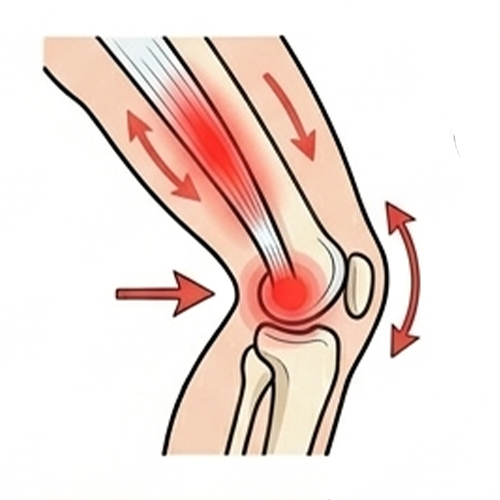
A knee hurts without an injury because the load on it has changed faster than its tissues have adapted, because wear in the joint has reached the point of symptoms, because pain is being referred from the hip or back, or because an inflammatory condition has settled in the joint. The knee rarely fails on its own; one of these four has pushed it.
A change in load. A new running plan, a return to the gym, a new job with stairs, a long walking holiday or a few kilograms of weight gain raise the load on the kneecap joint and the tendons. Tissue adapts to load over weeks; pain appears when the load rises faster than that.
Age-related wear. Cartilage thins and the meniscus frays with age in everyone, and both are painless for years. Pain arrives when a worn surface or a frayed meniscus is loaded past its tolerance, which often follows a small change in activity that would not have troubled a younger knee.
Referred pain. The hip joint and the L3 and L4 nerve roots in the lower back share nerve supply with the front of the knee. Hip osteoarthritis presents as knee pain in a meaningful share of adults over 50, and the knee examination in these people is normal.
Inflammation. Gout, rheumatoid arthritis, psoriatic arthritis and reactive arthritis inflame the joint lining and produce pain at rest, at night and in the morning, with warmth and swelling. Infection does the same, with fever.
Which causes are most common at each age?
Age is the strongest single predictor of the cause of knee pain without injury, because the kneecap and tendons dominate under 45 and the joint surface and meniscus dominate over 45.
| Age group | Most common causes without injury | Typical pattern |
| Under 45 | Patellofemoral pain, patellar tendinopathy, iliotibial band syndrome, fat pad irritation | Front or outer knee, worse on stairs, squats, running or after sitting |
| 45 to 65 | Early osteoarthritis, degenerative meniscal tear, pes anserine bursitis, referred hip pain | Inner knee or whole knee, stiff under 30 minutes in the morning, worse after activity |
| Over 65 | Osteoarthritis, referred hip pain, Baker’s cyst, gout | Whole knee, stiffness, swelling, reduced bend |
| Any age | Inflammatory arthritis, infection, bone stress | Rest and night pain, warmth, feeling unwell |
Our knee pain causes and treatment guide covers each diagnosis in the table in full.
Where on the knee does each cause sit?
The location of knee pain without injury narrows the cause to two or three possibilities before any test is done.
Front of the knee. Patellofemoral pain around or behind the kneecap, patellar tendinopathy just below it, quadriceps tendinopathy just above it, and fat pad irritation either side of the tendon. Our patellofemoral pain symptoms and self-test guide covers the most common of these.
Inner knee. Medial compartment osteoarthritis and degenerative medial meniscal tears on the joint line; pes anserine bursitis 2 to 5 cm below it.
Outer knee. Iliotibial band syndrome in runners and cyclists; lateral meniscal degeneration less often.
Behind the knee. Baker’s cyst, which is swelling driven by a problem inside the joint, and hamstring tendon irritation.
Whole knee or hard to localise. Osteoarthritis, inflammatory arthritis, and pain referred from the hip or back. Referred pain is the one you cannot point to.
How do you check knee pain without injury at home?

Four observations over 48 hours separate load-related, wear-related, referred and inflammatory knee pain.
When is it worst? Pain during and after activity, settling with rest, is load or wear. Pain at rest, at night and first thing in the morning, with stiffness over 30 minutes, is inflammatory.
Is the knee warm or swollen? Compare both knees with the back of your hand and look at the outline of the kneecap. Warmth or swelling without injury needs assessment within days. Our guide on knee swelling and when to worry sets out the thresholds.
Does the hip change it? Sit on a chair and turn the knee of the painful leg inwards and outwards with the foot on the floor, moving the hip. Knee pain reproduced by moving the hip, or groin stiffness on the same side, points to the hip. Our guide on the early warning signs of hip osteoarthritis explains the overlap.
What changed? Write down what you did differently in the four weeks before the pain started: new shoes, new distance, new job, new weight, new sport. A change found here is a change in load, and the treatment is already half-known.
How is knee pain without injury treated?
Knee pain without injury is treated by matching the load to what the knee tolerates today, strengthening the hip and quadriceps, and rebuilding the load in stages over 6 to 12 weeks; referred pain is treated at its source and inflammatory pain is treated medically first.
Load-related pain. Return the provoking activity to a level that produces mild symptoms only, keep everything else going, and strengthen through a comfortable range. The 2018 international consensus on patellofemoral pain and the evidence on tendinopathy both place progressive loading ahead of rest, injections or surgery.
Osteoarthritis and degenerative meniscal tears. NICE guideline NG226 names exercise, weight management and education as the core treatment for osteoarthritis and advises diagnosis without imaging in adults over 45 with activity-related pain and short morning stiffness. The 2016 ESSKA consensus places exercise before arthroscopy for degenerative meniscal tears. A locked knee is the exception.
Referred pain. A knee that hurts because of the hip or back is treated at the hip or back, and the knee programme is secondary. Treating the knee alone in these people wastes weeks.
Inflammatory pain. A hot, swollen knee without injury is reviewed by a GP for blood tests and, where needed, joint fluid analysis before physiotherapy begins. Physiotherapy resumes once the flare has settled.
What we tell you at the assessment. Most knee pain without injury settles inside 12 weeks once the source is named. We will tell you at the first visit if the knee examination is normal and the search belongs at the hip or back, or if the pattern needs a GP review first.
What makes knee pain without injury worse?
Resting completely, searching for an injury that did not happen, and treating a referred or inflammatory knee as an overload problem are the three mistakes that prolong knee pain without injury.
Resting it. A knee that hurts for no clear reason is often rested in the hope the reason passes. The quadriceps weaken within two weeks and the knee tolerates less load on return.
Scanning it. An MRI of a knee over 45 shows meniscal fraying and cartilage thinning in most people with no pain at all. A scan without a clinical reason finds wear, not the cause, and often leads to treatment the knee did not need.
Loading the wrong joint. Six weeks of knee exercises for pain coming from the hip, or squats for a knee that is inflamed, make the pain worse and the diagnosis later.
When to get knee pain without injury assessed
Knee pain without injury that has lasted more than two weeks, that limits stairs or walking, that you cannot link to any change in activity, or that comes with swelling warrants a physiotherapy assessment, and no GP referral is needed. The assessment examines the knee, the hip and the lower back in one visit and tells you which of the four sources is responsible. Our knee pain physiotherapy service in London sees new knee assessments within days across all our clinics.
Note. Some knee pain without injury needs urgent medical care rather than physiotherapy. A knee that is hot, red and swollen with a fever or feeling unwell, sudden severe pain in one joint overnight, a knee you cannot put weight on, unexplained weight loss or night sweats with joint pain, or calf pain and swelling with shortness of breath are reasons to call NHS 111 or go to A&E.
Common questions about knee pain without injury
Why does my knee hurt when I have not done anything?
A knee that hurts without an obvious event has usually had a change in load you did not register, such as more stairs, more standing, a new pair of shoes or a few kilograms gained, or has reached the point where age-related wear becomes symptomatic. Pain with no link to activity at all, at rest and at night, points to referred or inflammatory causes.
Can knee pain without injury be serious?
Most knee pain without injury is not serious and settles with the right programme. A hot, swollen knee, pain at night that wakes you, pain with fever or feeling unwell, or pain that is getting worse week by week needs a medical review.
Should I get an X-ray or MRI for knee pain with no injury?
Not as a first step. NICE guideline NG226 advises diagnosing knee osteoarthritis clinically, and an MRI in adults over 45 shows meniscal and cartilage changes in most people without pain. Imaging follows the examination when a finding would change the treatment.
Can knee pain come from the hip or back?
Yes. The hip joint and the L3 and L4 nerve roots share nerve supply with the front of the knee, and hip osteoarthritis commonly presents as knee pain in adults over 50. A knee that hurts with a normal knee examination is examined at the hip and back next.
How long does knee pain without injury take to go away?
Most load-related and early wear-related knee pain settles over 6 to 12 weeks with load management and progressive strengthening. Pain that is unchanged after four weeks of a sensible programme needs reassessment rather than more of the same.
Book your London knee assessment
A knee that hurts for no clear reason has a reason; the assessment finds it. You can book your first assessment for knee pain physiotherapy in London at any of our clinics in 60 seconds, with no GP referral needed.
References
- National Institute for Health and Care Excellence. Osteoarthritis in over 16s: diagnosis and management. NICE guideline NG226, October 2022.
- Beaufils P, Becker R, Kopf S, et al. Surgical management of degenerative meniscus lesions: the 2016 ESSKA meniscus consensus. Knee Surgery, Sports Traumatology, Arthroscopy.
- Collins NJ, Barton CJ, van Middelkoop M, et al. 2018 consensus statement on exercise therapy and physical interventions to treat patellofemoral pain. British Journal of Sports Medicine.
- Culvenor AG, Øiestad BE, Hart HF, et al. Prevalence of knee osteoarthritis features on magnetic resonance imaging in asymptomatic uninjured adults: a systematic review and meta-analysis. British Journal of Sports Medicine.
- NHS. Knee pain.
- Versus Arthritis. Knee pain: causes and treatment.
