


Your knee clicks when you climb stairs, crouch or straighten it after sitting, and lately the click comes with pain. A clicking knee on its own is normal and is heard in most healthy knees. A clicking knee that hurts is different, because pain means the sound is coming from a structure that is being pinched, rubbed or caught, and the three structures that do this are the kneecap joint, the meniscus and the soft tissue folds inside the joint.
Which one it is shows in where the click is felt, what movement produces it, and whether the knee also catches or locks. This guide sets out why healthy knees click, what changes when the clicking hurts, which cause sits where, how to check it at home, how each cause is treated and when a clicking knee needs to be assessed.
Key takeaways
- Painless knee clicking comes from gas bubbles in the joint fluid and from tendons moving over bone, is heard in most healthy knees, and needs no treatment.
- Painful clicking at the front of the knee on stairs and squats is the kneecap joint; painful clicking at the inner or outer joint line in a deep bend or twist is the meniscus.
- Clicking that comes with catching, a knee that sticks for a moment, or a knee that locks points to a meniscal tear or a loose fragment and needs assessment within days.
- Grinding with pain under the kneecap in adults over 45 points to patellofemoral osteoarthritis, which is treated with exercise and does not need a scan to diagnose.
- Most painful clicking settles with hip and quadriceps strengthening and a staged return to depth over 6 to 12 weeks; the click often remains after the pain has gone, and that is acceptable.
Why do healthy knees click?
Healthy knees click because gas bubbles in the joint fluid collapse when the joint is moved, and because tendons and ligaments snap over bony edges as the knee bends and straightens. Neither sound involves damage, and both are heard in most adults at some point in the day.
Gas in the joint fluid. Joint fluid contains dissolved gas. A quick change in pressure, as when you straighten the knee after sitting, forms and collapses a bubble with a pop. The joint cannot repeat the sound for 20 minutes or so, which is one way to recognise it.
Tendons over bone. The iliotibial band and the hamstring tendons cross bony points at the outer and inner knee, and the kneecap tendon crosses the front. A tendon that flicks over its bony edge makes a click you can often feel under a finger, repeatable every time, without pain.
Surface roughness. Cartilage under the kneecap is rarely perfectly smooth after the age of 30, and a fine grinding sound in a squat, called crepitus, is common and painless in people of all ages. Painless crepitus is not a sign of arthritis and does not predict it.
What changes when the clicking hurts?
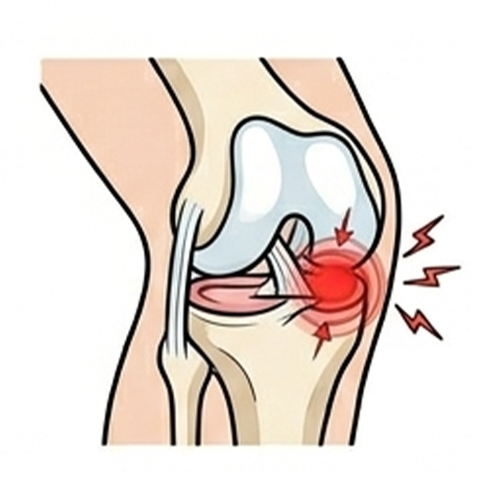
Painful knee clicking means the sound is coming from a structure that is being pinched, rubbed or caught under load, and three structures account for almost all of it.
| Where the painful click is felt | Most likely cause | What else fits |
| Front of the knee, under or around the kneecap, on stairs and squats | Patellofemoral pain or patellofemoral osteoarthritis | Pain after sitting; grinding you can feel with a hand on the kneecap |
| Inner or outer joint line, in a deep bend or on twisting | Meniscal tear or irritation | Catching, a knee that sticks for a second, swelling after activity |
| Inner knee, just beside the kneecap, in the first part of the bend | Synovial plica, a fold of joint lining being pinched | A tender band you can roll under a finger |
| Anywhere, with the knee locking or unable to straighten | Displaced meniscal fragment or loose body | Sudden onset, knee feels blocked rather than stiff |
| Whole knee, with stiffness and reduced bend, over 45 | Knee osteoarthritis | Morning stiffness under 30 minutes, worse after activity |
Our knee pain causes and treatment guide covers each diagnosis in the table.
Which cause of painful clicking sits where?
The front of the knee clicks from the kneecap, the sides click from the meniscus, and a click that turns into a catch or a lock comes from a fragment inside the joint.
The kneecap joint. The kneecap runs in a groove on the thigh bone. A kneecap that tracks slightly off centre rubs one side of the groove, and the rub is felt as a click or grind under the kneecap on stairs, squats and standing from a chair. Over 45 the same sound with pain is usually patellofemoral osteoarthritis. Our patellofemoral pain symptoms and self-test guide covers the kneecap pattern in full.
The meniscus. A torn or frayed edge of the meniscus is squeezed between the bones at the end of the bend and on twisting, and the squeeze is felt as a click on the joint line with pain. A flap of meniscus that moves in and out of place produces a catch, and a flap that lodges between the bones produces a lock. Our meniscus tear symptoms and self-test guide sets out the signs.
The plica. A plica is a fold of joint lining present in most knees. A thickened plica on the inner side of the kneecap is pinched in the first 30 to 60 degrees of bend and gives a click with a sharp, localised pain and a tender band you can feel.
How do you check painful knee clicking at home?
Three checks separate kneecap clicking, meniscal clicking and a knee that is catching, and the third decides how quickly you are assessed.
The hand-on-kneecap squat. Place your palm flat over the kneecap and squat slowly. Grinding or clicking you feel under the palm, with pain at the front, is the kneecap joint.
The deep squat and twist. Squat as low as is comfortable, then turn the body slowly to each side with the feet planted. A click with pain exactly on the inner or outer joint line is the meniscus. Stop if the knee catches.
The straightening test. Sit on the edge of a bed and let the knee hang, then straighten it fully. A knee that straightens with a click and no pain is normal. A knee that stops short of straight, feels blocked, or has to be wriggled to get past a point is catching, and a knee that stays blocked is locked. Both need assessment within days.
How is painful knee clicking treated?

Painful knee clicking is treated by strengthening the hip and quadriceps, by matching the depth of bend to what the knee tolerates today, and by rebuilding depth in stages over 6 to 12 weeks; a knee that locks is the exception and is assessed for surgery. The click itself is not the target, and many knees click after the pain has resolved.
Kneecap clicking. Strengthen the hip abductors and quadriceps through a pain-tolerable range, break long periods of sitting with the knee bent, and reduce squat depth for two to three weeks before adding it back. Taping the kneecap gives short-term relief in some people. The 2018 international consensus on patellofemoral pain places exercise targeting hip and knee ahead of every other treatment.
Meniscal clicking. Avoid deep squats, kneeling and pivoting on the planted foot while the joint line is tender, strengthen the quadriceps and hamstrings in the pain-free range, and add depth as the catching settles. The 2016 ESSKA consensus places exercise before arthroscopy for degenerative tears, and most people over 40 with a clicking meniscus never need surgery. Our meniscus tear physiotherapy in London page explains how we grade and load a torn meniscus.
Plica irritation. Reduce the repeated bend that pinches the fold, settle the local inflammation, strengthen the quadriceps, and mobilise the inner knee. A plica that fails a loading programme is occasionally treated with an injection or arthroscopy.
A locking knee. A knee that locks is referred for imaging and a surgical opinion, because a displaced fragment that stays between the bones damages the joint surface. Physiotherapy follows the procedure.
What we tell you at the assessment. A clicking knee that hurts is treated for the pain, not the sound. We will tell you if the click is coming from a structure that needs imaging, which applies to a knee that catches or locks and very few others.
What makes painful knee clicking worse?
Avoiding every movement that clicks, repeatedly clicking the knee on purpose, and chasing a painless click with treatment are the three habits that prolong a clicking knee.
Avoiding the click. A knee kept out of every position that clicks loses range and strength, and the click returns at a shallower bend with more pain. The range that is comfortable is used daily.
Clicking it on purpose. Forcing the knee to pop for relief loads the irritated structure each time. Relief lasts minutes; the irritation lasts longer.
Treating the sound. A click without pain, catching or swelling needs no scan, no brace and no treatment. Weeks spent treating a harmless sound are weeks not spent on the strength that protects the knee.
When to get a clicking knee assessed
Knee clicking that comes with pain for more than two weeks, with catching, with swelling after activity, or with a knee that sticks or will not fully straighten warrants a physiotherapy assessment, and no GP referral is needed. Painless clicking needs no appointment. The assessment tests the kneecap, the meniscus and the ligaments by hand and names the structure in one visit. Our knee pain physiotherapy service in London sees new knee assessments within days across all our clinics.
Note. Some clicking knees need urgent medical care rather than physiotherapy. A knee that is locked and will not straighten, a knee you cannot put weight on after a twist, a knee that swelled within two hours of an injury, a hot, red and swollen knee with fever, or calf pain and swelling with shortness of breath are reasons to call NHS 111 or go to A&E.
Common questions about knee clicking
Is knee clicking without pain anything to worry about?
No. Painless clicking comes from gas in the joint fluid and from tendons moving over bone, is heard in most healthy knees, and does not predict arthritis or injury. Clicking becomes worth assessing when pain, catching or swelling arrive with it.
Why does my knee click when I climb stairs?
Stairs load the kneecap joint through the part of its range where it presses hardest against the thigh bone, so a kneecap that tracks slightly off centre clicks or grinds on each step. Clicking on stairs with pain at the front is the kneecap pattern; without pain it is normal.
Does a clicking knee mean a torn meniscus?
A clicking knee means a torn meniscus when the click sits exactly on the inner or outer joint line, comes in a deep bend or on twisting, and is joined by pain, catching or swelling after activity. Clicking at the front of the knee or clicking without pain is not a meniscal sign.
Will the clicking go away with physiotherapy?
The pain goes; the click often stays. Strengthening changes how the kneecap and meniscus are loaded, which removes the pain, while the sound from gas or a tendon flick continues and is harmless.
Do I need an MRI for a clicking knee?
Not for clicking alone or clicking with pain that has not been treated. An MRI is requested when the knee catches or locks, or when a loading programme has failed, because those are the findings that change the treatment.
Book your London knee assessment
A clicking knee that hurts is treated for the pain, and the assessment tells you where the pain is coming from. You can book your first assessment for knee pain physiotherapy in London at any of our clinics in 60 seconds, with no GP referral needed.
References
- Collins NJ, Barton CJ, van Middelkoop M, et al. 2018 consensus statement on exercise therapy and physical interventions to treat patellofemoral pain. British Journal of Sports Medicine.
- Beaufils P, Becker R, Kopf S, et al. Surgical management of degenerative meniscus lesions: the 2016 ESSKA meniscus consensus. Knee Surgery, Sports Traumatology, Arthroscopy.
- Pazzinatto MF, de Oliveira Silva D, Faria NC, et al. What are the clinical implications of knee crepitus to individuals with knee osteoarthritis? An observational study with data from the Osteoarthritis Initiative. Brazilian Journal of Physical Therapy.
- National Institute for Health and Care Excellence. Osteoarthritis in over 16s: diagnosis and management. NICE guideline NG226, October 2022.
- NHS. Knee pain.
