


You can put a finger on the exact spot. The pain is on the inside of the knee, or on the outside, and you want to know whether the side matters. The side matters a great deal. The inner and outer knee hold different structures, take different loads and fail in different ways, so pain on the inner side points to the medial meniscus, the medial ligament or the inner joint surface, and pain on the outer side points to the iliotibial band, the lateral meniscus or the outer ligament. Few of these need a scan to identify, and most are separated by where the tenderness sits and which movement provokes it.
This guide sets out the causes of inner knee pain, the causes of outer knee pain, how the two compare, how to check each at home, how each is treated and when side-of-knee pain needs to be assessed.
Key takeaways
- Inner knee pain is most often the medial meniscus, the medial collateral ligament, pes anserine bursitis or medial compartment osteoarthritis; outer knee pain is most often iliotibial band syndrome, the lateral meniscus or the lateral collateral ligament.
- The inner knee carries more load in walking and is injured by a force pushing the knee inwards; the outer knee is irritated by repetition, in particular running, and injured by a force pushing the knee outwards.
- Pain on the joint line with catching or clicking points to the meniscus on that side; pain above or below the joint line points to a ligament, tendon or bursa.
- Outer knee pain that starts at a set running distance and stops when you stop is iliotibial band syndrome and is treated at the hip, not the band.
- Pain on either side with a knee that locks, gives way or swelled within hours of a twist needs assessment within days.
What causes inner knee pain?
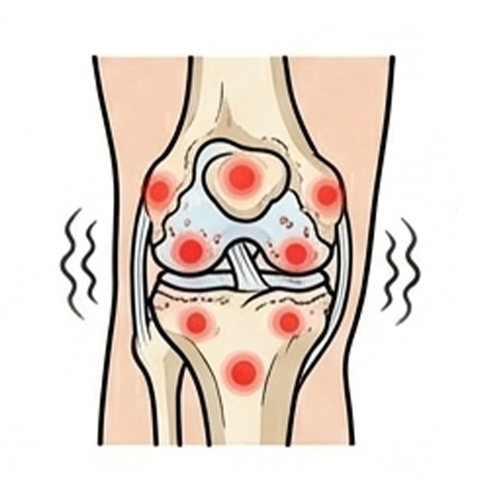
Inner knee pain comes from the medial meniscus, the medial collateral ligament, the pes anserine bursa or the inner joint surface, and the height of the pain on the inner knee separates them. The inner side of the knee carries the greater share of body weight in walking, which is why it wears first and is injured more often.
On the joint line. The medial meniscus sits in the gap you can feel between the thigh bone and the shin bone on the inner side. A tear or irritation gives pain exactly on that line, worse in a deep bend or when twisting on the planted foot, often with clicking or catching. Medial compartment osteoarthritis gives pain on the same line, worse after activity, with morning stiffness under 30 minutes, in adults over 45.
Above and across the joint line. The medial collateral ligament runs from the thigh bone to the shin bone across the inner knee. A sprain follows a blow to the outside of the knee or a fall that pushes the knee inwards, and the pain is felt along the ligament when the knee is pushed sideways.
Below the joint line. The pes anserine bursa sits 2 to 5 cm below the inner joint line on the shin. Bursitis gives a tender spot there, worse on stairs and at night, common in runners and in people with knee osteoarthritis. The saphenous nerve passes the same area and gives burning or numbness rather than tenderness.
What causes outer knee pain?
Outer knee pain comes from the iliotibial band, the lateral meniscus, the lateral collateral ligament or the biceps femoris tendon, and the activity that provokes it separates them. The outer knee is loaded less in walking and more in running and in pivoting sports.
Iliotibial band syndrome. The iliotibial band is a thick strip of connective tissue running down the outside of the thigh to the shin. Irritation where it crosses the outer knee gives a sharp or burning pain that starts at a predictable point in a run, worsens downhill, and stops soon after you stop. The cause sits at the hip, where weak abductors let the thigh drift inwards and tighten the band over the knee.
The lateral meniscus. A lateral meniscal tear gives pain on the outer joint line in a deep squat and on twisting, with clicking or catching. Lateral tears are less common than medial tears and more often follow a sporting twist.
The lateral collateral ligament and hamstring tendon. A sprain of the lateral collateral ligament follows a force pushing the knee outwards and gives pain along the outer ligament under sideways pressure. The biceps femoris tendon attaches just behind and below the outer knee and gives pain in sprinting and in deep hamstring stretches.
How do inner and outer knee pain compare?
Inner and outer knee pain differ in their common causes, their mechanism and the activity that provokes them, and the comparison below is the first filter we apply at assessment.
| Feature | Inner knee pain | Outer knee pain |
| Most common cause under 45 | Medial meniscus irritation | Iliotibial band syndrome |
| Most common cause over 45 | Medial compartment osteoarthritis | Lateral meniscus or iliotibial band |
| Typical injury mechanism | Force pushing the knee inwards, twist on a planted foot | Force pushing the knee outwards, repetitive running |
| Provoking activity | Deep bend, kneeling, twisting, prolonged walking | Running at a set distance, downhill, pivoting |
| Clicking or catching | Common with meniscal cause | Common with meniscal cause, absent in iliotibial band syndrome |
| Swelling | Common in meniscus and osteoarthritis | Uncommon in iliotibial band syndrome |
| Treated at | Knee and hip | Hip, then knee |
Our knee pain causes and treatment guide covers every diagnosis in the table.
How do you check inner or outer knee pain at home?
Pressing along the joint line, squatting slowly and watching the knee in a single-leg squat separate a joint-line problem from a soft-tissue problem on either side. Stop any check that produces sharp pain or catching.
Find the joint line. Sit with the knee bent to 90 degrees and run a thumb along the inner or outer side until you feel the gap between the two bones. Tenderness exactly in that gap points to the meniscus or the joint surface. Tenderness clearly above or below the gap points to a ligament, bursa or tendon.
The slow squat. Squat as low as is comfortable. Joint-line pain at the bottom of the squat, on the side you can point to, is the meniscal pattern. Our meniscus tear symptoms and self-test guide adds the Thessaly test for a fuller check.
The single-leg squat. Stand on the painful leg in front of a mirror and squat a quarter of the way down. A knee that drifts inwards as you squat shows hip weakness, which overloads the iliotibial band on the outer knee and the kneecap at the front. A knee that stays over the foot points the search back to the joint line.
The run test for the outer knee. Outer knee pain that appears at the same distance on every run and fades within minutes of stopping is iliotibial band syndrome in almost every case.
How are inner and outer knee pain treated?
Inner knee pain is treated by settling the irritated structure and strengthening the quadriceps and hip through a comfortable range; outer knee pain is treated primarily at the hip, with the running load rebuilt in stages. Both sides settle inside 6 to 12 weeks in most people, and a scan is reserved for a locked knee or a ligament rupture.
Medial meniscus and medial osteoarthritis. Avoid deep squats, kneeling and pivoting while the joint line is tender, strengthen the quadriceps and hamstrings in the pain-free range, then add depth. NICE guideline NG226 names exercise, weight management and education as the core treatment for osteoarthritis, and the 2016 ESSKA consensus places exercise before surgery for degenerative meniscal tears. Our meniscus tear physiotherapy in London page explains how we grade and load a torn meniscus.
Medial collateral ligament sprain. Protect the knee from sideways force for two to six weeks depending on grade, keep it moving, and strengthen the inner thigh and hip. Most sprains heal without surgery.
Pes anserine bursitis. Reduce stairs and hills, settle the swelling, strengthen the inner thigh and hamstrings, and address any knee drift in the single-leg squat.
Iliotibial band syndrome. Cut running distance to below the point where the pain starts, strengthen the hip abductors and rotators, shorten the stride and raise the cadence, then add distance back weekly. Stretching or rolling the band itself gives short relief and does not treat the cause. Our runner’s knee physiotherapy in London page sets out the return-to-running plan we use.
What we tell you at the assessment. The side of the knee gives us the shortlist; the joint line and the provoking movement give us the diagnosis. We will tell you if the knee needs imaging, which applies to a locked knee, a suspected ligament rupture and very few others.
What makes side-of-knee pain worse?
Stretching the outer knee, resting the inner knee completely and continuing to twist on a tender joint line are the three habits that prolong inner and outer knee pain.
Stretching the band. Iliotibial band syndrome is a hip strength problem at the knee, and stretching a band that is already under tension across a sore bone gives an hour of relief and no change. Strength at the hip changes it.
Resting the inner knee. A tender medial joint line protected by weeks of inactivity loses quadriceps strength, and the joint line hurts more on return. The range you have is used daily, within comfort.
Twisting on it. A meniscus that catches when you pivot is being pinched further each time. Turn with steps rather than on the planted foot until the catching has settled.
When to get inner or outer knee pain assessed
Inner or outer knee pain that has lasted more than two weeks, that followed a twist or a blow to the knee, or that comes with clicking, catching or swelling warrants a physiotherapy assessment, and no GP referral is needed. The assessment presses the joint line, stresses each ligament and tests the meniscus by hand, and names the structure in one visit. Our knee pain physiotherapy service in London sees new knee assessments within days across all our clinics.
Note. Some side-of-knee pain needs urgent medical care rather than physiotherapy. A knee that is locked and will not straighten, a knee you cannot put weight on after an injury, a knee that swelled within two hours of a twist or blow, a hot, red and swollen knee with fever, or calf pain and swelling with shortness of breath are reasons to call NHS 111 or go to A&E.
Common questions about inner and outer knee pain
Why is inner knee pain more common than outer knee pain?
The inner side of the knee carries more of your body weight in walking and standing, so the medial meniscus and the inner joint surface wear sooner and tear more often. The outer side is loaded more in running and pivoting, which is why outer knee pain is concentrated in runners and in sports with cutting.
Is inner knee pain a sign of a meniscus tear?
Inner knee pain is a sign of a medial meniscus tear when the tenderness sits exactly on the joint line and the pain comes with a deep bend, twisting, clicking or catching. Inner knee pain above or below the joint line points to the ligament or the bursa instead.
Why does the outside of my knee hurt when running but not walking?
Outer knee pain in running but not walking is the pattern of iliotibial band syndrome. Running repeats a narrow range of knee bend thousands of times, and the band crosses the outer knee bone at that angle, so friction builds with distance and stops when you stop.
Can inner and outer knee pain come from the hip?
Yes. Weak hip abductors let the knee drift inwards, which overloads the outer knee through the iliotibial band and the inner knee through the medial structures. Hip osteoarthritis also refers pain to the knee, which is why we test the hip in every knee assessment.
Should I wear a knee support for inner or outer knee pain?
A knee support gives a sense of security after a ligament sprain and does no harm for short periods. A support does not treat the cause of either inner or outer knee pain, and a tight sleeve can irritate the saphenous nerve on the inner knee.
Book your London knee assessment
The side of the knee gives the shortlist; the assessment gives the diagnosis. You can book your first assessment for knee pain physiotherapy in London at any of our clinics in 60 seconds, with no GP referral needed.
References
- National Institute for Health and Care Excellence. Osteoarthritis in over 16s: diagnosis and management. NICE guideline NG226, October 2022.
- Beaufils P, Becker R, Kopf S, et al. Surgical management of degenerative meniscus lesions: the 2016 ESSKA meniscus consensus. Knee Surgery, Sports Traumatology, Arthroscopy.
- Fredericson M, Wolf C. Iliotibial band syndrome in runners: innovations in treatment. Sports Medicine.
- NHS. Knee pain.
- Versus Arthritis. Knee pain: causes and treatment.
