

Ankle Pain: Symptoms, Causes, Treatment and When to See a Physio
Ankle pain rarely gets the attention it deserves. People walk on sore ankles for months, assuming they will settle, and often they do. The ones that persist usually have a reason: a sprain that never fully healed, a tendon loaded past its capacity, or a joint quietly stiffening. The ankle carries your entire body weight on a joint the size of a matchbox, thousands of steps a day, so small problems get rehearsed until they become patterns.
Key Takeaways
- Where ankle pain sits usually points to its cause: the outer ankle belongs to sprains and instability, the back to the Achilles, the inner side to the arch-supporting tendon, and the front to impingement or arthritis.
- Ankle pain without an injury usually reflects load exceeding capacity, an old sprain that never retrained, or weakness in the muscles that steer the ankle.
- An ankle that repeatedly gives way adds damage with each episode, so instability is worth treating before it causes the next sprain.
- After an injury, inability to take four steps or tenderness directly on the ankle bones warrants a same-day fracture check.
- Ankle recovery is built through strength and balance retraining, not waited for; tissue heals on its own schedule, but control only returns when trained.
What is Ankle Pain?
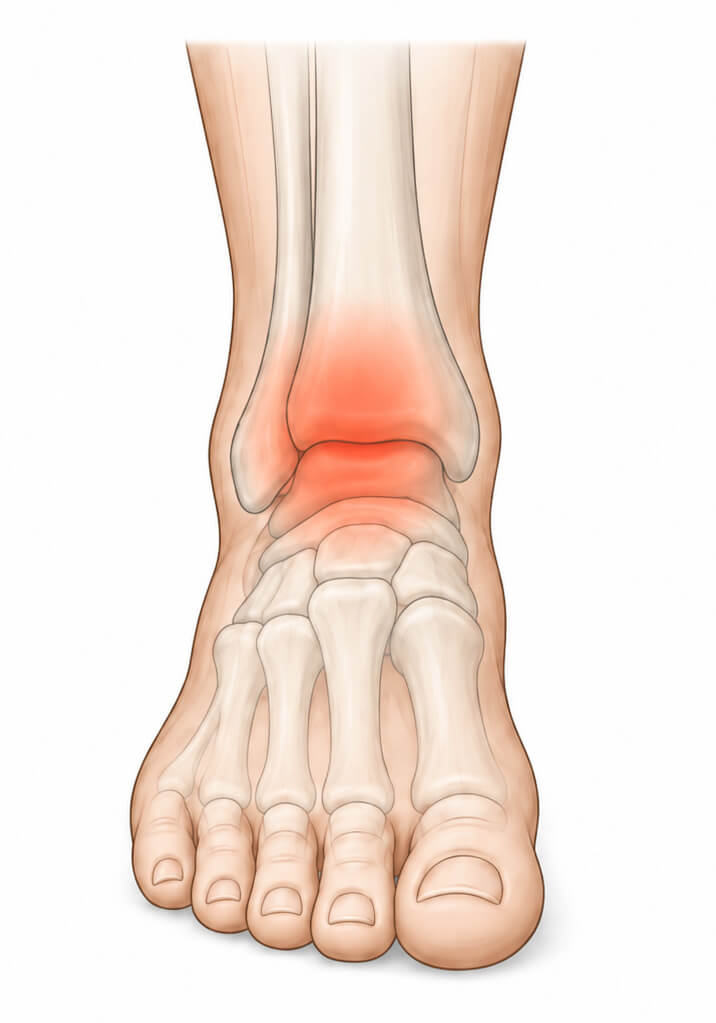
Ankle pain is discomfort, swelling, stiffness, or instability in or around the ankle joint, where the shin bones meet the foot. The joint itself is a hinge, and around it runs everything that steers the foot: ligaments on both sides, the Achilles tendon behind, and the tendons that support the arch on the inner edge.

Where Does Your Ankle Hurt? Location Points To The Cause
Pain At The Front Of The Ankle
A sharp, pinching pain at the front crease, felt in deep squats, lunges, sprinting, or walking uphill, fits ankle impingement, where soft tissue or bone catches at the front of the joint in deep bending. A duller front-of-ankle ache with morning stiffness, swelling, and reduced movement, more common in older ankles or years after fractures, points toward arthritis and degenerative change in the joint itself.
Pain At The Back Of The Ankle
The back of the ankle is Achilles territory. Stiffness and pain above the heel, worst with first steps in the morning and after activity rather than during, fits Achilles tendinopathy, an overload problem of the body’s largest tendon. Our Achilles symptoms and self-test guide maps the pattern. A sudden snap at the back of the ankle during push-off is a different, urgent story, and same-day assessment is the rule.
Pain On The Outside Of The Ankle
The outer ankle belongs to the ligaments most sprains damage. A recent twist or roll points to an ankle sprain, the most common ankle injury there is, and how the first days are handled shapes the whole recovery. Our guide to the first 72 hours after a sprained ankle covers exactly that, our guide to sprain grades helps you read severity, and if you cannot take four steps or the bone itself is tender, read sprained ankle or fracture before anything else.
Outer ankle pain without a fresh injury, an ankle that rolls easily or feels untrustworthy on uneven ground, points instead toward chronic ankle instability, the repeat-sprain cycle where the ankle’s position sensors never retrained after an earlier injury.
Pain On The Inside Of The Ankle
Pain After A Fracture Or Surgery
Ankles that have been immobilised come out of a boot or cast stiff, weak, and short on confidence. Post-fracture and post-surgical pain is less about damage and more about deconditioning, and structured rehabilitation is what restores the strength, movement, and trust the immobilisation cost.
What Causes Ankle Pain?
- A previous sprain that never fully rehabilitated, leaving weakness and poor balance control
- A jump in activity: new running programme, more walking, a return to sport
- Weakness in the calf, foot, or hip muscles that steer the ankle
- Unsupportive footwear, or a sudden change in what you wear
- Flat feet or high arches changing how load travels through the joint
- Limited calf flexibility or a stiff joint restricting normal movement
- Reduced balance and position sense, particularly after earlier injuries
Ankle Pain Symptoms And What They Mean
Symptoms vary with the structure involved, and the character of the pain carries information of its own. A sharp or shooting pain with specific movements usually points to something being caught or stretched: a ligament, an impingement, an irritated tendon. A burning sensation around the ankle can involve a nerve rather than the joint.
A deep, constant ache with stiffness leans toward the joint surfaces. Swelling and bruising after an injury mark tissue damage and deserve the fracture check above. Clicking with pain, catching, or an ankle that gives way signals a mechanical or control problem worth assessing rather than watching.
Two patterns matter more than most people realise. Morning stiffness that eases with movement is a classic joint signature. And an ankle that repeatedly gives way, even painlessly, is not a quirk. Each episode adds damage to the position sensors that prevent the next one, which is why instability is worth treating before it writes its next sprain.
Clinical insight from One Body LDN
"The ankles that concern us are rarely the freshly sprained ones. They are the ones that gave way months ago, stopped hurting, and were never retrained. Pain settling is not the same as control returning, and the gap between those two is where the next sprain comes from."Rebecca Bossick — Chartered Physiotherapist & Clinical Director
How Long Does Ankle Pain Last?
Recovery depends on the structure and the severity, but three broad windows hold. Acute pain, under six weeks, covers most fresh sprains and new overload problems, and these settle well with structured early care. Sub-acute pain, six to twelve weeks, usually means the tissue has healed but strength, balance, and control have not caught up, and this is where guided rehabilitation earns its keep.
Persistent pain beyond twelve weeks rarely resolves on its own, because by then the problem is usually a pattern, weakness, instability, compensation, rather than injured tissue, and patterns need retraining, not rest. For sprains specifically, our guide to how long a sprained ankle takes to heal gives honest ranges by severity, and the short version is that milestones matter more than dates.
When Ankle Pain Needs Urgent Attention (Red Flags)
- Sudden severe swelling or visible deformity after injury
- Inability to bear weight or walk more than a few steps
- Tenderness directly on the ankle bones rather than the soft tissue
- Persistent numbness, tingling, or a foot turning cold or pale
- Signs of infection: redness, warmth, fever, feeling unwell
- Calf swelling and tenderness during recovery, which can signal a clot
- Unexplained night pain or rapid worsening without cause
How Physiotherapists Diagnose Ankle Pain
A proper ankle assessment works through layers. Your physiotherapist takes the history first: the injury, the load, the footwear, the sports, because the story usually narrows the diagnosis before any test. Then the examination: joint range and swelling, how the ankle behaves in standing and walking, strength and balance testing against the other side, and specific tests for the ligaments, tendons, and joint surfaces, including the screening rules that catch fractures and significant ruptures.
Physiotherapy Treatment for
Ankle Pain
Treatment follows the diagnosis, not a menu. For most ankle problems, the plan blends four elements in different proportions. Hands-on treatment, joint mobilisation and soft-tissue work restore movement and settle symptoms so the active work can start. Exercise therapy rebuilds the strength of the calf, foot, and ankle muscles, the engine of every lasting recovery.
How Physiotherapy Helps Long Term
- Restoring normal joint mobility and alignment
- Strengthening key stabilising muscles
- Strengthening key stabilising muscles
- Reducing swelling and stiffness
- Enhancing performance and preventing long‑term recurrence
When To See A Physio About Your Ankle
The full decision rules, time, severity, and recurrence, are set out in our guide to when to see a physio for ankle pain, and if you want to know how to verify and choose the right clinician, how to find a private physio for ankle pain covers the checks. Early treatment consistently beats late treatment for ankles, because every week of instability or compensation is a week of rehearsing the problem.
Take The Next Step
Our physiotherapists at One Body LDN treat the full range of ankle problems, from fresh sprains and Achilles tendinopathy to instability, arthritis, and post-surgical rehabilitation, through assessment-led plans built around your life and goals. Direct access applies: no GP referral needed, with appointments available within days.
Learn more about ankle pain
Frequently Asked Questions
Should I use ice or heat on a painful ankle?
Should I wear an ankle brace or support?
Can I keep running or training with ankle pain?
Why does my ankle click or pop?
Why is my ankle swollen at the end of the day without any injury?
Mild end-of-day puffiness around both ankles often reflects circulation and gravity, especially after long standing or sitting. Persistent swelling in one ankle, or swelling with pain, heat, or skin changes, deserves proper review rather than watching.
Why do both my ankles hurt at the same time?
Can ankle pain come from somewhere other than the ankle?
Do old ankle sprains cause arthritis later in life?
Why does my ankle ache at night after a normal day?
How do I strengthen weak ankles?
What footwear helps ankle pain?
Can physiotherapy help ankle arthritis?
References
- Vuurberg G, Hoorntje A, Wink LM, et al. Diagnosis, treatment and prevention of ankle sprains: update of an evidence-based clinical guideline. British Journal of Sports Medicine. 2018;52(15):956
- Gribble PA, Bleakley CM, Caulfield BM, et al. Evidence review for the 2016 International Ankle Consortium consensus statement on the prevalence, impact and long-term consequences of lateral ankle sprains. British Journal of Sports Medicine. 2016;50(24):1496-1505
- Doherty C, Bleakley C, Delahunt E, Holden S. Treatment and prevention of acute and recurrent ankle sprain: an overview of systematic reviews with meta-analysis. British Journal of Sports Medicine. 2017;51(2):113-125
- Bachmann LM, Kolb E, Koller MT, Steurer J, ter Riet G. Accuracy of Ottawa ankle rules to exclude fractures of the ankle and mid-foot: systematic review. BMJ. 2003;326(7386):417
- Martin RL, Chimenti R, Cuddeford T, et al. Achilles Pain, Stiffness, and Muscle Power Deficits: Midportion Achilles Tendinopathy Revision 2018. Journal of Orthopaedic & Sports Physical Therapy. 2018;48(5):A1-A38
- Kohls-Gatzoulis J, Angel JC, Singh D, Haddad F, Livingstone J, Berry G. Tibialis posterior dysfunction: a common and treatable cause of adult acquired flatfoot. BMJ. 2004;329(7478):1328-1333
- NHS. Sprains and strains

Reviewed by Rebecca Bossick, Co-Founder & Clinical Director, HCPC-registered Physiotherapist.
Last reviewed: October 2026