


Pain on the thumb side of your wrist that flares when you lift a kettle, pick up your baby, or scroll your phone has a name, and it is one of the most recognisable problems in the hand. It is called De Quervain’s tenosynovitis, and it is an irritation of the two tendons that run from your thumb into your wrist.
It has picked up nicknames over the years, mother’s thumb and texting thumb, both of which describe real triggers. This guide covers what it feels like, a simple check you can do at home, what causes it, and when to get it looked at. No jargon required.
Key takeaways
- De Quervain’s causes pain on the thumb side of the wrist, at the base of the thumb
- Lifting, gripping, wringing, and phone use are the classic aggravators
- A simple home check, tucking the thumb into a fist and tilting the wrist down, usually reproduces it
- A positive check supports the diagnosis; a negative one does not rule it out
- It responds well to load changes and treatment, and it rarely needs anything invasive
What De Quervain’s actually is
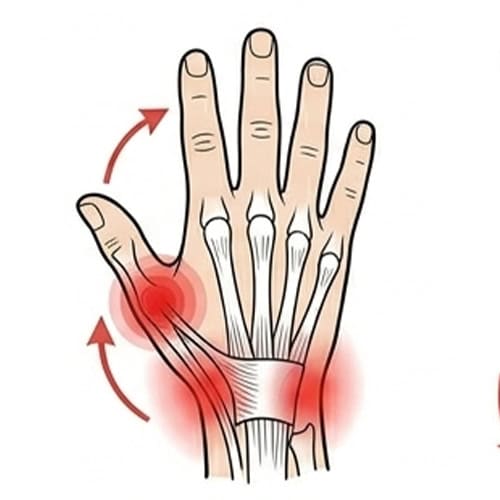
De Quervain’s tenosynovitis is irritation of the two thumb tendons where they pass through a narrow tunnel on the thumb side of the wrist.
Two tendons run from your thumb, down the side of your wrist, and into your forearm. They travel together through a snug sheath at the wrist. When those tendons are overused, the sheath and the tendons inside it become irritated and thickened, and the tunnel becomes a tight fit.
Every time you move your thumb, those tendons glide through that tunnel. When the fit is tight and inflamed, that gliding hurts. That is the whole mechanism, and it explains why thumb movements and wrist positions both set it off.
Clinicians call the tunnel the first dorsal compartment, which is the only anatomical term you need for this page. Where this sits among the other causes of wrist pain is mapped in our wrist pain guide.
What it feels like
De Quervain’s produces pain and tenderness on the thumb side of the wrist, worse with gripping, lifting, and twisting movements of the thumb and wrist.
The core symptoms
- Pain at the base of the thumb, on the thumb side of the wrist, not in the palm or the other fingers
- Tenderness when you press that spot, often sharp
- Pain that can travel up the forearm or down into the thumb
- Some swelling over the area, sometimes a thickening you can feel
- A catching, snapping, or squeaking sensation when you move the thumb
- Grip and pinch that hurt, so jars, kettles, and door handles announce themselves
The movements that set it off
The aggravators are consistent, and recognising yours helps confirm the picture:
- Lifting with the thumb out, especially picking up a baby under the arms, which is why it is so common in new parents
- Wringing a cloth, opening jars, turning keys
- Phone use, particularly long stretches of one-handed scrolling and typing with the thumb
- Any strong pinch grip, holding a mug by the handle, gripping tools, carrying bags by a handle
What it is not
Pain that sits in the palm, or tingling and numbness in the fingers, points elsewhere. Numbness in particular is a nerve sign and does not belong to De Quervain’s, which is a tendon problem. Our guide to typing and desk-related wrist and hand pain covers the overlapping load-related patterns that can affect the same hand.
The self-test: how to check at home

Tucking your thumb into a fist and gently tilting your wrist downward reproduces the pain of De Quervain’s in most people who have it.
This is the check clinicians use, adapted for home. Do it gently.
How to do it
- Hold your affected hand out in front of you, palm facing down.
- Fold your thumb into your palm.
- Close your fingers loosely over the thumb, making a fist around it.
- Slowly tilt your wrist downward, toward your little finger side.
- Stop at the first sign of sharp pain. Do not push further.
What the result means
Sharp pain on the thumb side of the wrist during that movement supports De Quervain’s. It is the classic response, and it usually reproduces the exact pain you already recognise.
No pain, or mild general discomfort, does not rule it out. Milder cases sometimes do not respond to the test, and other conditions can produce a positive. This is a useful clue, not a diagnosis.
One honest instruction: stop at the first sharp pain rather than pushing to see how bad it gets. Forcing the position on an already irritated tendon can leave it sore for a day or two and tells you nothing extra.
Why it happens
De Quervain’s develops when the thumb tendons are loaded more than they are conditioned for, usually through a sustained change in how the hand is used.
The pattern is almost always a change rather than a single injury:
- A new baby: Repeatedly lifting a growing child under the arms, with thumbs out, dozens of times a day. It is so common in new parents that the condition carries their name.
- Phone and device use: Long periods of one-handed thumb typing and scrolling load the same tendons in a sustained, repetitive way.
- A new job or hobby: Anything that introduces repeated gripping, pinching, or wringing that the hand had not been doing.
- A jump in manual work or training: Racket sports, gardening, DIY, or gym work involving heavy grip.
The underlying story is the same one that produces most tendon problems: load went up, capacity did not, and the tissue is reporting the gap. That is also why the fix is not simply rest.
What to do about it
De Quervain’s responds well to reducing the aggravating load, supporting the thumb where needed, and rebuilding the tendon’s capacity, and most cases settle without anything invasive.
The first step is changing what caused it. That means adjusting the lifting technique, switching to two-handed phone use, and modifying the specific grips that flare it. A thumb splint can help settle a sharp flare in the short term, worn for a defined period rather than indefinitely, since long-term splinting weakens what it protects.
Alongside that, treatment works on settling the irritated tendon and then progressively loading it, which is what restores its ability to handle daily use. Hands-on work and activity modification support that, but the loading is what changes the outcome.
Most people improve over a course of weeks with the right combination. Where symptoms are severe or stubborn, a steroid injection is a recognised option, and it works best as a way to settle an irritable tendon so rehabilitation can proceed, not as a standalone fix.
When to get it assessed
Book an assessment if thumb-side wrist pain has lasted beyond two to three weeks, keeps returning, or is stopping you lifting, gripping, or caring for a child comfortably. Our wrist pain physiotherapy in London team assesses thumb and wrist tendon problems through direct access, no GP referral needed.
Common questions about De Quervain’s tenosynovitis
Can I test for De Quervain’s at home?
Yes, with the thumb-in-fist test described above. Sharp pain on the thumb side of the wrist supports the diagnosis. A negative result does not rule it out, so persistent pain still deserves assessment.
Will De Quervain’s go away on its own?
Sometimes, if the activity that caused it stops or changes. Often it persists while the loading continues, which is why new parents and heavy phone users tend to find it lingers. Treatment shortens it considerably.
Is De Quervain’s the same as carpal tunnel?
No. De Quervain’s is a tendon problem on the thumb side of the wrist, with pain and tenderness but no numbness. Carpal tunnel is a nerve problem causing tingling and numbness in the thumb, index, and middle fingers. Numbness is the quickest separator.
How long does De Quervain’s take to settle?
Most cases improve over several weeks once the aggravating load changes and treatment starts. Long-standing cases take longer, and still respond. The biggest factor is whether the activity that caused it has actually been modified.
Should I wear a thumb splint?
Short-term, for a sharp flare, yes. A splint rests the tendons while symptoms settle. Worn indefinitely it weakens the thumb and wrist, so it works best as a temporary aid alongside the strengthening that resolves the problem.
Book your wrist assessment
Thumb-side wrist pain that flares every time you lift or scroll has a clear cause and a clear route out. Book an assessment with our wrist pain physiotherapy in London team in 60 seconds, no GP referral needed.
References
- NHS. De Quervain’s tenosynovitis.
- Challoumas D, Ramasubbu R, Rooney E, Seymour-Jackson E, Putti A, Millar NL. Management of de Quervain tenosynovitis: a systematic review and network meta-analysis. JAMA Network Open. 2023;6(10):e2337001.
- Goel R, Abzug JM. de Quervain’s tenosynovitis: a review of the rehabilitative options. Hand. 2015;10(1):1-5.
- National Institute for Health and Care Excellence. Clinical Knowledge Summary: De Quervain’s tenosynovitis.
- Chartered Society of Physiotherapy. Hand and wrist problems.
