



Everyone knows the funny bone. You knock the inside of your elbow, a jolt of electricity shoots down to your little finger, and thirty seconds later it has passed. That sensation is your ulnar nerve being briefly compressed, and it is harmless.
Cubital tunnel syndrome is what happens when that same nerve is compressed not for thirty seconds but for hours at a time, day after day. The symptoms are recognisably related: tingling and numbness in the same two fingers, aching on the inside of the elbow.
The difference is that they do not pass. It is one of the most commonly missed elbow problems, largely because people assume nerve symptoms in the hand must be carpal tunnel. In the ring and little fingers, they are not.
Key takeaways
- Cubital tunnel syndrome is compression of the ulnar nerve at the inside of the elbow, the funny bone nerve
- It affects the little finger and the half of the ring finger nearest it, and nothing else
- That distribution is the mirror image of carpal tunnel, which affects the thumb side of the hand
- Symptoms are typically worse with the elbow bent for long periods, such as phone calls and sleep
- Constant numbness, hand weakness, or muscle wasting needs prompt assessment, not a wait-and-see
Where the ulnar nerve runs, and why the elbow squeezes it
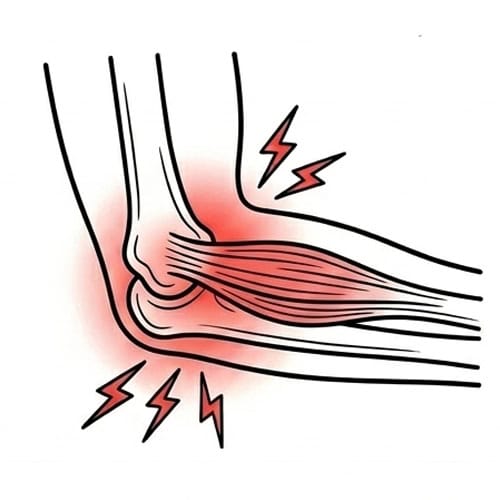
The ulnar nerve passes through a narrow tunnel on the inside of the elbow, directly behind the bony point, where it sits close to the surface with little protection.
That tunnel is the cubital tunnel, and the nerve’s position there is why a knock produces such a dramatic jolt: there is almost nothing between the bone and the nerve. It is also why sustained elbow positions cause trouble.
When you bend your elbow, the tunnel narrows and the nerve stretches around the joint. Hold that position for a long time, on a phone call, leaning on a desk, sleeping with your arms curled, and the nerve is compressed and stretched for hours. Do that night after night and the nerve becomes irritated. The symptoms follow.
This is the elbow-side explanation for nerve symptoms in the hand, and it sits within the wider set of causes covered in our elbow pain guide.
The symptoms: what cubital tunnel actually feels like
Cubital tunnel syndrome produces tingling, numbness, and sometimes pain in the little finger and the adjacent half of the ring finger, often with aching on the inside of the elbow.
The finger distribution
This is the single most useful recognition sign, and it is precise. The ulnar nerve supplies the little finger and the half of the ring finger closest to it. That is its territory, and symptoms outside it belong to a different nerve.
If your tingling sits in the thumb, index, and middle fingers, that is the median nerve and a different condition entirely. The full map of which fingers point to which nerve is set out in our guide to numbness and tingling in the fingers. Here, we are describing only the ulnar side.
The elbow symptoms
Alongside the finger symptoms, most people notice something at the elbow itself:
- An ache or tenderness on the inside of the elbow, behind the bony point
- A sensation of the funny bone being easily set off, or feeling generally sensitive
- Occasional electric shocks down the forearm to the fingers with certain movements
When symptoms are worst
The timing pattern is distinctive and worth recognising:
- At night: Many people sleep with elbows bent, which compresses the nerve for hours. Waking with numb ring and little fingers is one of the most common presentations.
- On long phone calls: Holding a phone to your ear keeps the elbow at its most bent for extended periods.
- Leaning on the elbow: Resting the inside of the elbow on a desk, armrest, or car door presses directly on the nerve.
- After sustained bending: Driving, reading, and computer work in certain positions all contribute.
Symptoms that come and go with position, and ease when you straighten the arm, fit this picture well.
Why it gets missed
Cubital tunnel is frequently mistaken for carpal tunnel syndrome, a trapped nerve in the neck, or simply a persistent funny bone, which delays the right treatment.
The confusion has three common sources. People assume any hand tingling is carpal tunnel, which is far better known. The neck can also refer symptoms into the arm, so nerve symptoms sometimes get attributed upward. And because everyone recognises the funny bone sensation as harmless, an ongoing version of it gets dismissed rather than assessed.
The distribution usually settles it: two fingers on the little-finger side, with elbow symptoms, and worse with the elbow bent. That combination points to the elbow, not the wrist and not the neck. An assessment confirms it by testing the nerve along its path and ruling out the alternatives.
When cubital tunnel needs prompt attention

Intermittent tingling that comes and goes with position is very treatable. Constant numbness, hand weakness, or muscle wasting signals a nerve under sustained pressure and needs prompt assessment.
This is the part that matters most, because the condition can progress if left long enough. Escalate rather than wait if you notice:
- Numbness in the ring and little fingers that is now constant rather than coming and going
- Weakness in the hand, difficulty with grip, or dropping things
- Trouble with fine tasks such as buttons, keys, or separating the fingers
- Any visible hollowing or wasting of the muscle between the thumb and index finger
Prolonged, severe compression of the ulnar nerve can cause changes that do not fully recover, which is why these signs move someone toward a specialist opinion rather than another few months of adjusting their pillow. Early symptoms respond well to conservative treatment; advanced ones are the group where waiting costs the most.
What treatment looks like
Most cubital tunnel syndrome responds to reducing the compression on the nerve, through position changes, activity adjustment, and physiotherapy to restore the nerve’s mobility.
The first priority is taking the pressure off. That means addressing the positions doing the damage: keeping the elbow straighter at night, which some people manage by loosely wrapping a towel around the elbow to limit bending, avoiding leaning on the inside of the elbow, and using a headset instead of holding a phone.
Alongside that, physiotherapy works on the nerve’s ability to glide freely along its path, addresses the surrounding muscle and joint contributors, and rebuilds grip and forearm strength where it has been lost. Most people improve well with this approach when the condition is caught while symptoms are still intermittent.
Where symptoms are constant or weakness has appeared, the assessment includes arranging the right onward referral, because that group sometimes needs a surgical opinion to release the nerve.
When to get it assessed
Book an assessment if tingling or numbness in your ring and little fingers has lasted beyond two to three weeks, keeps waking you, or is joined by any hand weakness. Our elbow pain physiotherapy in London team assesses nerve-related elbow symptoms through direct access, no GP referral needed.
Common questions about cubital tunnel syndrome
Which fingers does cubital tunnel syndrome affect?
The little finger and the half of the ring finger nearest it. That is the ulnar nerve’s territory. Tingling in the thumb, index, or middle fingers points to a different nerve and a different condition.
Is cubital tunnel the same as carpal tunnel?
No. They are different nerves compressed at different places, and they affect opposite sides of the hand. Cubital tunnel is the ulnar nerve at the elbow, affecting the little-finger side. Carpal tunnel is the median nerve at the wrist, affecting the thumb side.
Why do my fingers go numb at night?
Most people sleep with their elbows bent, which compresses and stretches the ulnar nerve for hours at a time. Waking with numb ring and little fingers is one of the most common ways cubital tunnel presents. Keeping the arm straighter at night often helps noticeably.
Can cubital tunnel syndrome go away on its own?
Early, intermittent symptoms often settle once the positions causing the compression change. Symptoms that are constant, or that come with weakness, are less likely to resolve alone and need prompt assessment.
Do I need surgery for cubital tunnel syndrome?
Most people do not. Conservative treatment works well when the condition is caught while symptoms still come and go. Constant numbness, hand weakness, or muscle wasting are the signs that move the conversation toward a surgical opinion.
Book your elbow assessment
If the funny bone feeling in your ring and little fingers has stopped passing, that is a nerve asking for attention, and it responds best while symptoms are still intermittent. Book an assessment with our elbow pain physiotherapy in London team in 60 seconds, no GP referral needed.
Note: Symptoms that need prompt assessment
Do not wait if you notice:
- Constant numbness in the ring and little fingers
- Weakness in the hand or dropping things
- Difficulty with buttons, keys, or fine hand tasks
- Visible wasting of the muscle between thumb and index finger
References
- NHS. Cubital tunnel syndrome.
- Andrews K, Rowland A, Pranjal A, Ebraheim N. Cubital tunnel syndrome: anatomy, clinical presentation, and management. Journal of Orthopaedics. 2018;15(3):832-836.
- Staples JR, Calfee R. Cubital tunnel syndrome: current concepts. Journal of the American Academy of Orthopaedic Surgeons. 2017;25(10):e215-e224.
- National Institute for Health and Care Excellence. Clinical Knowledge Summary: Ulnar nerve entrapment.
- Chartered Society of Physiotherapy. Elbow problems.
