



A stiff neck usually frees up within a few days. Sleep awkwardly, wake up unable to look over one shoulder, and by the end of the week it is gone. When the stiffness is still there after seven days, something is maintaining it. Stiffness is not the same as pain. It has its own causes and its own pattern.
The direction that is limited, the time of day it is worst, and whether movement eases or worsens it tell us what that something is. This guide walks through the four patterns we see in persistent neck stiffness and the point at which each one needs assessment.
Key takeaways
- Most neck stiffness resolves within a few days to a few weeks. Stiffness that persists past a week has a maintaining cause.
- Stiffness limited in one direction usually comes from a facet joint. Stiffness in all directions that fluctuates through the day usually comes from muscle guarding.
- Morning stiffness that eases within 30 minutes of moving is mechanical. Morning stiffness lasting longer than 45 minutes in someone over 50 needs a GP review.
- A neck collar, prolonged rest, and avoiding the stiff direction all prolong stiffness.
- Stiff neck with fever, severe headache, or light sensitivity is a 999 call, not a physiotherapy question.
Why a stiff neck should have gone by now
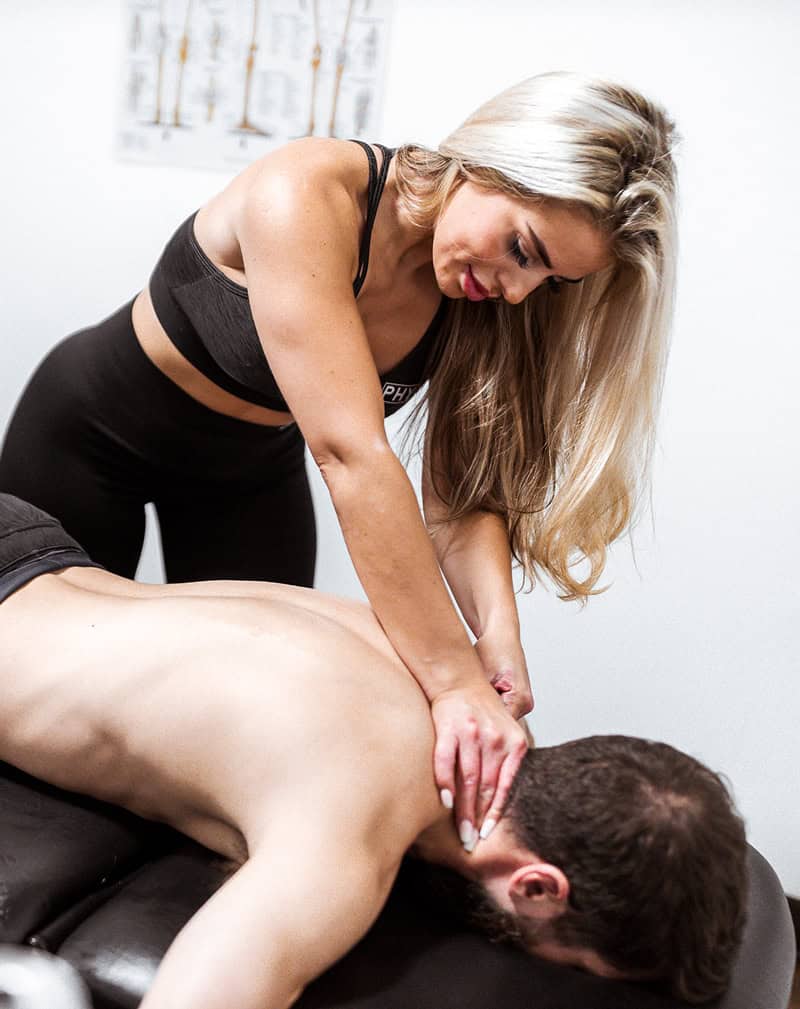
Simple neck stiffness is a short-term protective response. When it persists past a week, the protection has become the problem.
Acute neck stiffness, sometimes called wry neck, is the neck’s reaction to a minor joint strain or an awkward sustained position. The muscles tighten to guard the joint. Movement is limited in one or more directions. The NHS notes that most neck pain lasts only a few weeks, and uncomplicated stiffness is usually at the shorter end of that.
The guarding is supposed to switch off as the irritation settles. In persistent stiffness, one of four things is keeping it switched on. Identifying which one is the first step in neck pain assessment.
The four patterns of persistent neck stiffness
Persistent neck stiffness follows one of four patterns, and each pattern points to a different maintaining cause.
Pattern 1: One direction is blocked
You can turn freely to one side but hit a hard stop on the other. Looking up may be limited while looking down is fine. The restriction feels like a block rather than a stretch.
This is a facet joint pattern. The small joints on either side of each vertebra guide neck movement, and one of them has stiffened or is being held by its surrounding muscles. It often starts as a wry neck that was never fully restored. The person adapted around the limited direction, the joint stayed stiff, and the stiffness became normal.
Facet joint stiffness responds well to mobilisation and specific movement retraining. It rarely improves on its own once established, because the body has already stopped using the lost range.
Pattern 2: Stiff in all directions, worse through the day
Every direction feels tight. The stiffness is mild on waking, builds through the morning, and is worst by late afternoon. A hot shower or a weekend eases it. Monday brings it back.
This is a load pattern. Sustained posture, usually at a screen, keeps the neck muscles working at low intensity for hours. They tighten, shorten the available range, and fatigue. Nothing in the neck is damaged. The stiffness is the cost of the load.
Load-pattern stiffness responds to changing the load first and treating the muscles second. Mobilisation without a change to the day’s demands gives temporary relief only.
Pattern 3: Stiff in all directions, worst in the morning, eases with movement
The neck is at its most stiff on waking and loosens over 15 to 30 minutes of moving about. By mid-morning it is manageable. The stiffness is broad rather than directional and tends to come and go over months.
In people over 40, this is the typical pattern of cervical spondylosis, the age-related change in the discs and joints of the neck. The NHS describes it as common after 40, often without symptoms, and advises staying active and continuing usual activities. Physiotherapy is recommended when symptoms have not improved within a few weeks.
Spondylosis stiffness is managed, not cured. The aim is to keep range, build the deep neck and shoulder girdle muscles that support the degenerating joints, and reduce flare frequency.
Pattern 4: Guarding that fluctuates with stress or sleep
Stiffness that is bad one day and gone the next, with no clear mechanical trigger. It tracks with poor sleep, stress, or clenching. Range is limited in all directions but changes from hour to hour.
This is protective muscle guarding with no joint driver. The muscles of the neck respond to the nervous system’s state as much as to local load. Treatment is movement, breathing, and reassurance that the neck is not damaged, not repeated manual treatment.
A 60-second self-check
Three observations will tell you which pattern you have.
- Direction. Turn slowly left, then right. Look up, then down. Tilt each ear to its shoulder. Is one direction clearly worse than the rest? If so, Pattern 1. If all directions are equally tight, Patterns 2 to 4.
- Timing. Is the stiffness worst on waking or worst by evening? Morning points to Pattern 3. Evening points to Pattern 2.
- Response to movement. After five minutes of gentle movement, is the stiffness better, the same, or worse? Better suggests mechanical stiffness of any pattern. Worse, or stiffness with increasing pain, needs assessment before more movement.
Write down the answers. They shorten the assessment and point the treatment.
What makes neck stiffness last longer
The three things people do to protect a stiff neck are the three things that keep it stiff.
- Wearing a collar. The NHS advises against it. A collar removes the movement the joint needs to recover its range.
- Avoiding the stiff direction. Every day you do not turn to the stiff side, the joint and muscles accept the new limit as normal.
- Resting. Short rest in the first 48 hours is reasonable. Beyond that, inactivity is the main driver of persistent stiffness.
Heat, over-the-counter pain relief, and gentle repeated movement into the stiff direction, stopping short of sharp pain, are the opposite of these habits and are what the NHS recommends.
When persistent stiffness needs assessment

A stiff neck that has not improved after one week of self-care, or that has a clear directional block, is ready for physiotherapy.
The NHS threshold for seeing a GP is stiffness that has not gone after a few weeks. In our experience, waiting that long with a directional block makes the block harder to clear. We assess at the one-week mark for the following:
- Stiffness with a clear block in one direction
- Stiffness that is unchanged or worse after seven days of movement and heat
- Stiffness that limits driving, work, or sleep
- Stiffness that keeps returning in the same pattern
A persistent neck pain assessment identifies the pattern, checks for a nerve or joint driver, and sets a plan. Pattern 1 usually needs three to five sessions. Patterns 2 and 4 need fewer sessions and more change outside the clinic. Pattern 3 needs a maintenance programme.
If stiffness comes with pins and needles, numbness, or weakness in the arm, the driver may be a nerve root rather than a joint. That presentation is assessed through our cervical radiculopathy pathway.
Frequently asked questions
Why won’t my stiff neck go away?
A stiff neck that persists past a week is being maintained by a stiff facet joint, sustained postural load, age-related joint change, or ongoing muscle guarding. Each has a recognisable pattern and a different fix. Rest and avoiding the stiff direction make all four last longer.
How long is too long for a stiff neck?
Simple neck stiffness should ease within a few days and resolve within a few weeks. Stiffness that is unchanged after one week has a maintaining cause and is worth assessing. A clear block in one direction is worth assessing sooner.
Can a stiff neck be a sign of something serious?
Rarely. A stiff neck with fever, severe headache, a rash, or light sensitivity can be a sign of meningitis and needs a 999 call. Morning stiffness lasting more than 45 minutes in someone over 50, especially with shoulder and hip stiffness, needs a GP review.
Should I keep moving a stiff neck or rest it?
Keep moving it. The NHS advises against neck collars and prolonged rest because movement is what restores range. Move gently into the stiff direction several times a day, stopping short of sharp pain.
Does a stiff neck need physiotherapy?
A stiff neck that has not improved after a week, or that has a hard block in one direction, usually does. A facet joint that has stiffened rarely frees itself once the body has adapted around the lost range.
Book your neck pain assessment
A stiff neck that is still there after a week is not going to loosen because you waited longer. The One Body LDN neck pain team identifies which of the four patterns you have and treats the cause rather than the stiffness. Our private neck pain physiotherapy in London is available same-week with no GP referral.
Note: stiff neck symptoms that need urgent medical care
Call 999 or go to A&E if a stiff neck comes with any of:
- A high temperature
- A severe headache that is getting worse
- Eye pain in bright light
- A rash that does not fade when pressed with a glass
- Confusion or drowsiness
See a GP within a few days if a stiff neck comes with morning stiffness lasting more than 45 minutes, stiffness in the shoulders and hips as well, unexplained weight loss, or if you are over 50 and the stiffness started suddenly with no mechanical cause.
