



Your fingers are stiff when you wake, a knuckle has started to ache when you turn a key, and one joint looks a little larger than it did a year ago. Hand arthritis begins quietly, and the early signs are easy to put down to age, cold weather or a busy week. Osteoarthritis of the hand affects the joints nearest the fingertips, the middle finger joints and the base of the thumb, and shows itself first as morning stiffness that eases within half an hour, an ache after gripping and a firm swelling on the side of a joint.
Inflammatory arthritis starts differently, in the knuckles and wrists, with stiffness that lasts over an hour and joints that are warm and soft. The distinction matters in the first months, because one is managed with hand therapy and the other needs a rheumatologist early. This guide sets out the early signs of hand arthritis, how osteoarthritis and inflammatory arthritis differ at the start, which joints each affects, how to check your hands, how early hand arthritis is treated and when stiff fingers need to be assessed.
Key takeaways
- The early signs of hand osteoarthritis are morning stiffness in the fingers that eases within 30 minutes, an ache in a joint after gripping or pinching, and a firm bony swelling at the side of a finger joint or the base of the thumb.
- Osteoarthritis affects the joints nearest the fingertips, the middle finger joints and the base of the thumb, and usually spares the knuckles; inflammatory arthritis starts in the knuckles and wrists on both sides.
- Morning stiffness lasting over an hour, warm soft swelling across the knuckles, and fatigue point to inflammatory arthritis and need a GP review within weeks, not months.
- Hand osteoarthritis is treated with joint protection, grip and pinch strengthening, a thumb splint for the base of the thumb and heat, and most people keep full function for years.
- An X-ray is not needed to start treating hand osteoarthritis; blood tests and a rheumatology referral are needed to confirm inflammatory arthritis.
What are the early signs of hand and finger arthritis?
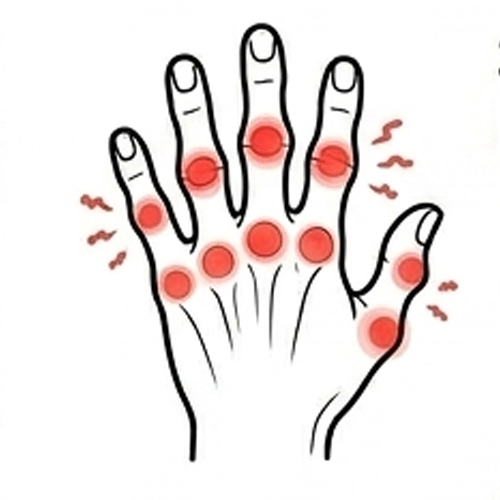
The early signs of hand osteoarthritis are morning stiffness in the fingers that eases within 30 minutes, an ache in one or two joints after gripping, pinching or a day of hand use, a firm swelling on the side of a finger joint, and a loss of the last few degrees of bend in a finger. The signs arrive one joint at a time over months rather than across the whole hand at once.
Stiffness. The fingers feel thick and slow to bend on waking and after a period of rest, and loosen with use. The stiffness lasts minutes, not hours.
Ache after use. A joint aches in the evening after gardening, typing, knitting or a day of gripping, and settles overnight. Pain at rest comes later, if at all.
Bony swelling. A firm, non-tender enlargement on the side of the joint nearest the fingertip or the middle joint, often first noticed when a ring no longer fits or a finger looks crooked. The swelling is bone, not fluid, and does not come and go.
Loss of range. A finger that no longer straightens or bends fully, a thumb that no longer opens wide to grip a jar, and a weaker pinch between thumb and index finger.
Thumb base pain. An ache at the base of the thumb on turning a key, opening a jar or writing, which is the single most common early site of hand osteoarthritis in women over 50. Our hand pain causes and treatment guide covers the other causes of thumb base pain.
How do osteoarthritis and inflammatory arthritis differ at the start?
Hand osteoarthritis and inflammatory arthritis differ in which joints they start in, how long the morning stiffness lasts, what the swelling feels like, and whether the whole person feels unwell, and the differences are clearest in the first months. The distinction decides whether you need hand therapy or a rheumatologist.
| Feature | Hand osteoarthritis | Inflammatory arthritis (rheumatoid, psoriatic) |
| First joints affected | Joints nearest the fingertips, middle finger joints, base of the thumb | Knuckles, wrists, middle finger joints; usually both hands |
| Morning stiffness | Under 30 minutes | Over an hour, often much longer |
| Swelling | Firm, bony, on the side of the joint, fixed | Soft, warm, across the whole joint, comes and goes |
| Pain pattern | After use, settles with rest | At rest and at night, eases with movement |
| Symmetry | Often one hand or a few joints first | Both hands, same joints |
| Whole body | Well | Fatigue, feeling unwell, sometimes weight loss, skin or nail changes in psoriatic arthritis |
| Age | Usually over 45, peaks after 50 | Any age, often 30 to 60 |
| Needs | Hand therapy, joint protection, splints | GP review and rheumatology referral within weeks; blood tests |
Which joints does hand osteoarthritis affect first?
Hand osteoarthritis affects three sites first: the joints nearest the fingertips, the middle joints of the fingers, and the joint at the base of the thumb, and it usually spares the knuckles where the fingers meet the hand. The pattern itself is diagnostic.
The joints nearest the fingertips. The most common site. Bony swellings here are called Heberden’s nodes, and they run in families. The joint stiffens and may drift sideways, and pain settles once the node has formed.
The middle finger joints. Bony swellings here are called Bouchard’s nodes. Stiffness here affects grip more, because these joints do most of the bending in a fist.
The base of the thumb. The joint between the thumb and the wrist, where pinch and grip are generated. Arthritis here is painful early, limits opening jars and turning keys, and produces a squared-off look at the base of the thumb over time. Our guide on when to see a physiotherapist for hand pain covers the timing for thumb base pain.
The knuckles. Swelling and pain across the knuckles are not typical of osteoarthritis and point towards inflammatory arthritis until a GP has checked.
How do you check your hands at home?
Four observations over a week separate early osteoarthritis from inflammatory arthritis and from the tendon and nerve problems that mimic them.
Time the stiffness. Note how long the fingers take to loosen each morning for seven days. Under 30 minutes fits osteoarthritis; over an hour on most days needs a GP review.
Feel the swelling. Press a swollen joint. Firm and bone-like on the side of the joint is osteoarthritis. Soft, warm and spread across the whole joint is inflammation.
Map the joints. Mark which joints hurt or are swollen on a sketch of both hands. Fingertip and middle joints with a thumb base, mostly one side, is osteoarthritis. Knuckles and wrists on both sides is inflammatory until proven otherwise.
Test grip and pinch. Open a jar, turn a key, pinch a sheet of paper between thumb and index finger and have someone pull it away. Weakness or pain at the base of the thumb on these tasks points to thumb base arthritis.
Exclude the mimics. Tingling or numbness is a nerve problem, not arthritis. A finger that clicks or locks when straightening is a trigger finger. Pain on the thumb side of the wrist on lifting is a tendon problem.
How is early hand arthritis treated?

Early hand osteoarthritis is treated with joint protection, grip and pinch strengthening, a splint for the base of the thumb, heat for stiffness and advice on adapting tasks, and most people keep full function for many years; inflammatory arthritis is treated by a rheumatologist with medication, with hand therapy alongside.
Joint protection. Spread load across larger joints and both hands: lift a pan with two hands, open a jar with a gripper, use a thicker pen, and avoid sustained pinching. Protection does not mean rest; it means loading the hand in ways the joints tolerate.
Strengthening. Grip and pinch strengthening with putty or a soft ball, and thumb stability exercises, three times a week. Research on hand osteoarthritis shows that strengthening reduces pain and improves function over 12 weeks, and NICE guideline NG226 names exercise as the core treatment for osteoarthritis at every joint.
Splinting. A splint that supports the base of the thumb during provoking tasks reduces pain and improves pinch strength. Finger splints are used short-term for a painful fingertip joint.
Heat and movement. Warm water or a heat pack for morning stiffness, followed by a full range of finger movement. Cold is used for a joint that is hot after use.
Pain relief. Topical anti-inflammatory gel on the painful joints, which NICE recommends before oral medication for hand osteoarthritis. Injection into the thumb base joint is an option for a flare that does not settle; surgery is reserved for a thumb base joint that has failed everything else.
What we tell you at the assessment. Early hand osteoarthritis is confirmed by the pattern of joints and does not need an X-ray to start treatment. We will tell you if the pattern suggests inflammatory arthritis, and refer you to your GP for blood tests the same week, because early treatment of inflammatory arthritis protects the joints for life. Our hand pain physiotherapy in London page sets out the programme we use.
What makes early hand arthritis worse?
Resting the hands, sustained pinching, and waiting months with inflammatory signs are the three mistakes that let early hand arthritis progress faster than it needs to.
Resting. Hands that are rested to protect the joints lose grip strength and range within weeks, and the joints become stiffer and more painful under the same loads. The joints are moved and strengthened daily.
Sustained pinching. Holding a phone, a pen or a knife in a tight pinch for long periods loads the thumb base joint more than any other task. Pinch is spread, shortened and supported.
Waiting. Warm, soft swelling across the knuckles, stiffness over an hour and fatigue are not managed with hand exercises alone. Inflammatory arthritis treated within three months of onset has a far better outcome than inflammatory arthritis treated after a year.
When to get stiff or aching fingers assessed
Finger stiffness or joint ache that has lasted more than four weeks, a joint that has changed shape, a thumb base that hurts on opening jars or turning keys, or a weaker grip warrants a physiotherapy assessment, and no GP referral is needed. The assessment maps the joints, tests grip and pinch and separates osteoarthritis from inflammatory arthritis and from the tendon and nerve problems that mimic it. Our hand pain physiotherapy service in London sees new hand assessments within days across all our clinics.
Note. Some hand symptoms need a GP review within days rather than a physiotherapy appointment. Warm, soft swelling across the knuckles of both hands, morning stiffness lasting over an hour for more than two weeks, joint pain with fatigue, fever, unexplained weight loss, a new rash or nail changes, or a single hot, red, swollen joint are reasons to see a GP urgently or call NHS 111.
Book your London hand assessment
The pattern of joints tells us which arthritis you have, and the assessment confirms it in one visit. You can book your first assessment for hand pain physiotherapy in London at any of our clinics in 60 seconds, with no GP referral needed. Our wrist pain physiotherapy in London covers the wrist joints that are assessed alongside the hand.
Common questions about early hand arthritis
What does early arthritis in the fingers feel like?
Early osteoarthritis in the fingers feels like stiffness on waking that eases within half an hour, an ache in one or two joints after a day of gripping, and a firm swelling at the side of a joint that does not go down. Early inflammatory arthritis feels like stiffness that lasts over an hour, with warm, soft swelling across the knuckles and a general sense of being unwell.
Why are my finger joints stiff in the morning?
Joint fluid thickens overnight and the lining of an arthritic joint stiffens with rest, so the first movements of the day are slow and thick. Stiffness that clears within 30 minutes fits osteoarthritis; stiffness that lasts an hour or more points to inflammation.
Can hand arthritis be stopped from getting worse?
Osteoarthritis in the hand progresses slowly and most people keep full function for years with joint protection, strengthening and splints. Inflammatory arthritis is slowed substantially by medication started within the first months, which is why early referral matters.
Do I need an X-ray to diagnose hand arthritis?
No. Hand osteoarthritis is diagnosed from the pattern of joints affected, the type of swelling and the timing of stiffness. An X-ray is requested when the diagnosis is unclear or surgery is being considered, and blood tests are requested when inflammatory arthritis is suspected.
Does cracking my knuckles cause arthritis?
No. Studies comparing habitual knuckle crackers with non-crackers over decades found no difference in hand arthritis. The sound is gas releasing in the joint fluid and does not damage the joint.
References
- National Institute for Health and Care Excellence. Osteoarthritis in over 16s: diagnosis and management. NICE guideline NG226, October 2022.
- National Institute for Health and Care Excellence. Rheumatoid arthritis in adults: management. NICE guideline NG100, July 2018, updated 2020.
- Kloppenburg M, Kroon FP, Blanco FJ, et al. 2018 update of the EULAR recommendations for the management of hand osteoarthritis. Annals of the Rheumatic Diseases. 2019;78(1):16-24.
- Østerås N, Hagen KB, Grotle M, et al. Exercise for hand osteoarthritis. Cochrane Database of Systematic Reviews. 2017;(1):CD010388.
- Versus Arthritis. Osteoarthritis of the hand and wrist.
- NHS. Osteoarthritis.
