


Jars that will not open. A mug that slips. Shopping bags you have to keep swapping hands with. A grip that gives out halfway through a task it used to manage easily.
Search this and you will find a lot about frailty and long-term health risk. That research is real, but it answers a different question from the one most people are asking. If your grip has weakened, the useful question is what is causing it in your hand, and the fastest way to narrow that down is to ask whether it hurts. This guide sorts weak grip by cause, and covers the versions that need urgent attention rather than a strengthening plan.
Key takeaways
- Whether the weakness hurts is the fastest way to narrow the cause
- Painful weakness usually means a joint or tendon problem; painless weakness points to a nerve
- Which hand matters: one-sided weakness suggests a local or nerve cause, both hands suggests something more general
- Sudden weakness, especially with face or speech changes, is a 999 call
- Progressive weakness, or visible muscle wasting, needs urgent assessment and not a wait-and-see
First: the weakness that needs urgent care
Sudden hand weakness, particularly with drooping on one side of the face, speech difficulty, or weakness elsewhere on the same side, is a medical emergency and needs 999.
Grip that has faded over weeks or months is what the rest of this page covers. Weakness that arrives suddenly is different. Call 999 if hand weakness appears abruptly alongside a drooping face, slurred or confused speech, weakness in the arm or leg on the same side, or a sudden severe headache. Those are stroke signs.
Separately, book urgent assessment rather than waiting if your weakness is getting progressively worse week by week, or if you can see muscle wasting, a visible hollowing or flattening where the muscle used to be full, particularly at the base of the thumb or between the thumb and index finger. Wasting means a nerve has been under pressure long enough to cause changes, and those are the cases where delay costs the most.
Everything below assumes neither picture applies.
The question that narrows it fastest: does it hurt?
Painful grip weakness usually points to a joint or tendon problem; weakness without much pain points to a nerve.
This single split is more useful than any list of causes, because the two groups behave differently and are treated differently.
Painful weakness: the hand will not, rather than cannot
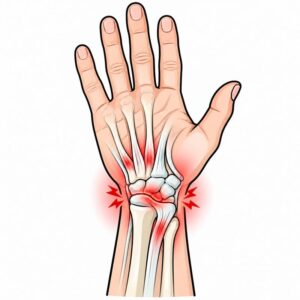
When gripping hurts, the hand holds back. The muscles and nerves are working; the grip fails because something in the chain is painful and the body reduces its effort to protect it. Common sources:
- Tennis or golfer’s elbow, where the forearm tendons that power your grip are irritated at the elbow. Grip strength drops measurably, and it is one of the markers we track through recovery.
- Thumb base arthritis, which undermines pinch and grip and is the most commonly arthritic joint in the hand.
- Finger or wrist joint problems, including arthritis and post-injury stiffness.
- Tendon problems in the hand or wrist, including trigger finger and thumb-side tendon irritation.
The tell: strength returns when the painful movement is avoided or supported. The muscle is there; the pain is limiting it.
Painless weakness: the signal is not getting through
When grip fails without much pain, the more likely issue is the nerve supply. The muscle cannot fire properly because the message is not arriving. Common sources:
- Carpal tunnel syndrome, compressing the median nerve at the wrist, typically with numbness in the thumb, index and middle fingers, and weakness in thumb movements.
- Cubital tunnel syndrome, compressing the ulnar nerve at the elbow, typically with numbness in the little and ring fingers and weakness in the small hand muscles.
- A nerve issue in the neck, which can weaken specific muscle groups in the arm and hand.
The tell: numbness or tingling usually travels with it, and which fingers are affected points to which nerve. The full map sits in our guide to numbness and tingling in the fingers.
Painless, progressive weakness is the combination that matters most. It is the one to escalate rather than strengthen.
One hand or both?
Weakness in one hand points to a local problem or a nerve; weakness in both hands more often reflects something systemic or general.
One hand: A local joint, tendon, or nerve cause in that arm. This is the commonest presentation and usually the most straightforward to identify.
Both hands: Consider general causes. Inflammatory arthritis affecting both hands. General deconditioning after illness, injury or inactivity. Age-related muscle loss, which is real but happens gradually over years rather than weeks. Some medical conditions and medications also affect muscle strength.
Your dominant hand feeling stronger is normal, not a finding. A meaningful difference is one that has changed, not one that has always been there.
Where grip weakness sits among the other hand problems is mapped in our hand pain guide.
What about the frailty research?
Grip strength is a well-established marker of general health across populations, but that research is about groups over time, not about diagnosing why your hand weakened last month.
You will have seen the headlines. Grip strength is genuinely associated with broader health outcomes, and researchers have proposed it as a vital sign for that reason. It is a good marker of overall muscle strength and physical capacity.
What it is not is an explanation for a specific hand. If your grip weakened over a few months, or on one side, the cause is almost certainly local, mechanical or neurological, not a statement about your long-term health. Those studies describe averages across large groups, not individual diagnoses.
The practical version: if your grip has declined alongside general strength, activity and energy, that is worth discussing with your GP. If your grip has declined on its own, and particularly on one side, that is a hand, wrist, elbow or neck question.
What can be done about it
Grip weakness responds well to treatment once the cause is identified, and the treatment differs completely depending on which cause it is.
Painful weakness is treated by addressing the painful structure. Settle the tendon or joint, then load it progressively, and the grip returns as the pain allows. Grip strength measured against the other hand is one of the clearest markers of real progress, and it often improves before the pain fully resolves.
Nerve-related weakness is treated by reducing the compression, addressing the position and load factors causing it, and restoring the nerve’s mobility. Here, timing matters more. Nerves recover well when treated early and less completely when compression has been prolonged.
General deconditioning responds to progressive grip and forearm strengthening, staged sensibly. Grip is trainable at any age.
The common thread: strengthening a weak grip without knowing why it is weak can waste months, or in nerve cases, delay treatment that works better early.
When to get it assessed
Book an assessment if your grip has weakened over weeks, if you are dropping things, if the weakness is affecting work or daily tasks, or if numbness travels with it. Escalate promptly for progressive weakness or any visible muscle wasting.
Our hand physiotherapy in London team assesses grip weakness, identifies whether the cause is joint, tendon or nerve, and arranges onward referral where needed, through direct access, no GP referral required.
Common questions about weak grip strength
What does weak grip strength mean?
It means the hand is either being limited by pain, or is not receiving full nerve supply, or has lost general conditioning. Whether it hurts and whether it affects one hand or both narrows it quickly.
Why do I keep dropping things?
Dropping objects usually points to either weakness or altered sensation, and often both. Nerve compression at the wrist, elbow or neck is a common cause, particularly when numbness travels with it. It deserves assessment rather than adaptation.
Is weak grip strength serious?
Gradual weakness with a clear painful cause is usually straightforward and treatable. Painless, progressive weakness, or visible muscle wasting, is the version that needs prompt assessment. Sudden weakness with face or speech changes needs 999.
Can grip strength be improved?
Yes, at any age, provided the cause is addressed first. Nerve-related weakness needs the compression treated; painful weakness needs the painful structure settled. Strengthening then works well.
Why is my grip weak in the morning?
Morning stiffness from joint problems is the usual explanation, and it typically eases within the first half hour. Stiffness in both hands lasting well over an hour, particularly with swelling, points more toward an inflammatory cause and deserves a GP review.
Book your hand assessment
Weak grip is a symptom with several very different causes, and the treatment only works once you know which one you have. Book an assessment with our hand physiotherapy in London team in 60 seconds, no GP referral needed.
Note: Grip weakness that needs urgent care
Call 999 for sudden hand weakness alongside:
- Drooping on one side of the face
- Difficulty speaking or understanding speech
- Weakness in the arm or leg on the same side
Seek prompt assessment for weakness getting worse week by week, or any visible wasting of the muscle at the base of the thumb.
References
- NHS. Hand pain.
- NHS. Stroke symptoms: act FAST.
- Vaishya R, Misra A, Vaish A, Ursino N, D’Ambrosi R. Hand grip strength as a proposed new vital sign of health: a narrative review of evidence. Journal of Health, Population and Nutrition. 2024;43:7.
- Padua L, Coraci D, Erra C, et al. Carpal tunnel syndrome: clinical features, diagnosis, and management. The Lancet Neurology. 2016;15(12):1273-1284.
- Andrews K, Rowland A, Pranjal A, Ebraheim N. Cubital tunnel syndrome: anatomy, clinical presentation, and management.
- Coombes BK, Bisset L, Brooks P, Khan A, Vicenzino B. Effect of corticosteroid injection, physiotherapy, or both on clinical outcomes in patients with unilateral lateral epicondylalgia.
- National Institute for Health and Care Excellence. Clinical Knowledge Summary: Carpal tunnel syndrome.
- Chartered Society of Physiotherapy. Hand and wrist problems.
