

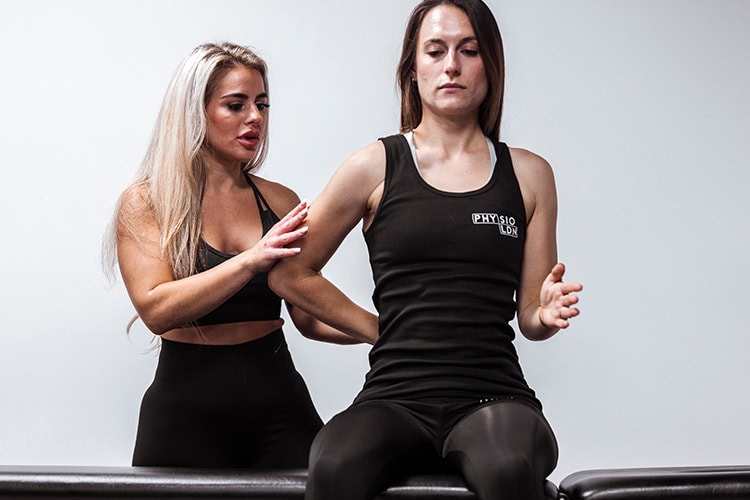

The elbow is fine when it is bent, and then you straighten the arm fully, to lock out a press-up, to reach for something on a high shelf, to hang from a bar or to throw, and it hurts at the end of the movement, sometimes with a block that stops the last few degrees.
Elbow pain when straightening the arm comes from the structures that are compressed or stretched at full extension: the back of the joint where the bone enters its socket, the triceps tendon that pulls the arm straight, the tendon on the outside of the elbow when it is stretched, the biceps when it is lengthened, and the nerve that runs around the inner elbow.
Where the pain sits and whether the arm straightens fully narrow the cause before any test is done. This guide sets out why straightening hurts, which cause sits where, how to check at home, how each cause is treated and when an elbow that will not straighten needs to be assessed.
Key takeaways
- Elbow pain when straightening the arm comes most often from the back of the joint being pinched at full extension, from triceps tendinopathy, from tennis elbow stretched at the end of range, or from a stiff joint after injury.
- Pain at the back of the elbow on locking out, in people who press, throw or do dips, is posterior impingement or triceps tendinopathy; pain on the outside of the elbow that is worse with the arm straight and the wrist bent is tennis elbow.
- An elbow that stops short of straight and feels blocked, rather than painful, has a mechanical cause such as a loose body, a bone spur or stiffness after a fracture, and needs imaging.
- Most elbow pain when straightening settles with load changes and progressive strengthening over 6 to 12 weeks; a blocked elbow is the exception.
- An elbow that cannot straighten after a fall, that is swollen and hot, or that has numbness into the hand needs assessment within days.
Why does the elbow hurt when straightening the arm?
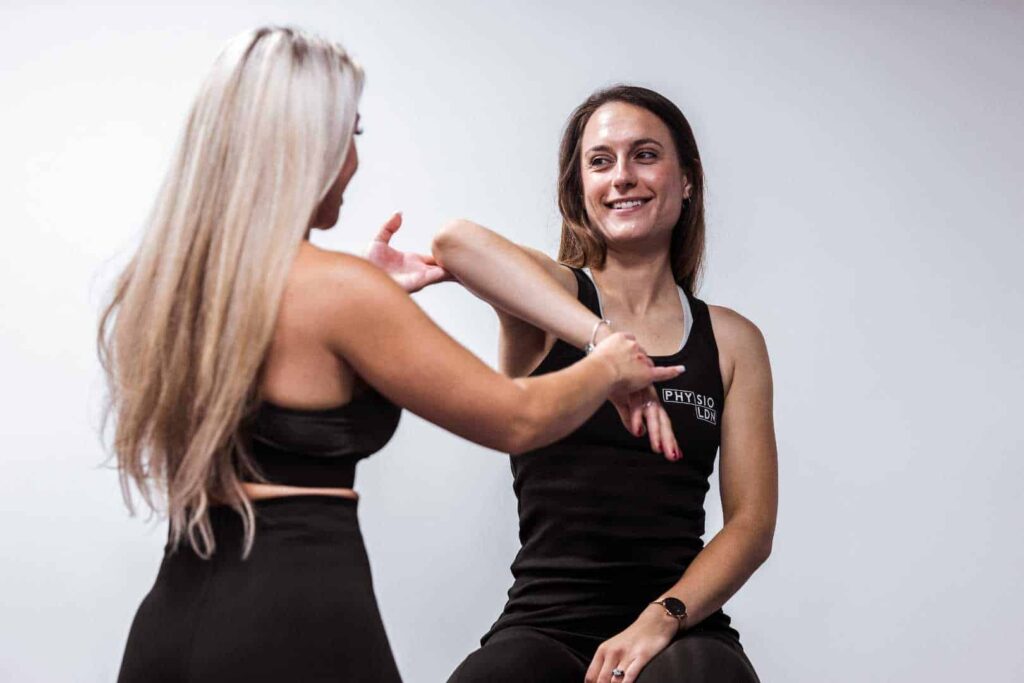
The elbow hurts when straightening the arm because full extension drives the point of the forearm bone into its socket at the back of the joint, pulls the triceps tendon to its tightest, and stretches the tendons on the outside and front of the elbow to their longest, so any one of those structures that has lost tolerance hurts at the end of the movement. Bending unloads them; straightening loads them all at once.
The back of the joint. The hook of the forearm bone, the olecranon, slots into a hollow at the back of the upper arm bone at full extension. Repeated forceful straightening, as in pressing, dips and throwing, thickens the lining and can grow a spur, and the two pinch at lock-out.
The triceps. The triceps tendon attaches to the point of the elbow and is under its greatest load at the end of a press or a dip. A tendon loaded past its tolerance hurts at that point.
The outer and front tendons. The tendons of tennis elbow and the biceps are stretched longest at full extension, so a tendon that is already irritated hurts more when the arm is straight, and the wrist is bent down.
The joint itself. Stiffness after a fracture or dislocation, a loose fragment of cartilage, or arthritis stops the last degrees of straightening with a block rather than pain alone.
Which cause of pain on straightening sits where?
The location of elbow pain when straightening the arm narrows the cause to two or three possibilities, and the table sets them out around the joint.
| Where it hurts on straightening | Most likely cause | What else fits |
| Back of the elbow, deep, at the last degrees | Posterior impingement | Pressing, dips, throwing, gymnastics; pinch at lock-out, sometimes a click |
| Point of the elbow, on the tendon | Triceps tendinopathy | Pain pushing up from a chair, press-ups, bench press; tender to press on the tip |
| Outside of the elbow, worse with the wrist bent down | Tennis elbow | Pain gripping and lifting; tender on the outer bony point |
| Front of the elbow, in the crease | Biceps tendinopathy or anterior capsule strain | Pain after heavy curls, pull-ups or carrying; worse with the palm turned down and the arm straight |
| Inside of the elbow, with tingling into the little finger | Ulnar nerve irritation | Worse with the elbow bent for long periods, then painful to straighten after |
| Whole elbow, blocked rather than painful, stops short of straight | Loose body, bone spur, stiffness after fracture or dislocation, arthritis | Grinding, locking, swelling; a past injury |
| Whole elbow, hot and swollen | Olecranon bursitis or infection | Soft swelling over the point of the elbow; redness and fever point to infection |
Our elbow pain causes and treatment guide covers each diagnosis in the table.
How do you check elbow pain when straightening at home?
Three checks separate a joint that is pinched, a tendon that is overloaded and an elbow that is blocked. Stop any check that produces sharp pain.
Compare the straightening. Stand with both arms by your sides, palms forward, and straighten both elbows fully. An elbow that straightens as far as the other side but hurts at the end has a pain problem. An elbow that stops short of the other side, with a firm or bony end feel, has a block and needs assessment.
The lock-out press. Press your hands into a wall with the elbows straight and lean in, then push away to full extension. Pain deep at the back of the elbow at the moment of lock-out is posterior impingement. Pain on the point of the elbow on the push is triceps tendinopathy.
The straight-arm wrist test. Hold the arm straight out in front, palm down, and bend the wrist down with the other hand. Pain on the outside of the elbow is tennis elbow, and our tennis elbow symptoms and self-test guide takes the check further. Pain at the front of the elbow is the biceps or the front of the capsule.
Then check sensation. Tingling in the ring and little finger with the elbow bent for a minute points to the ulnar nerve rather than a joint or tendon.
How is elbow pain when straightening treated?
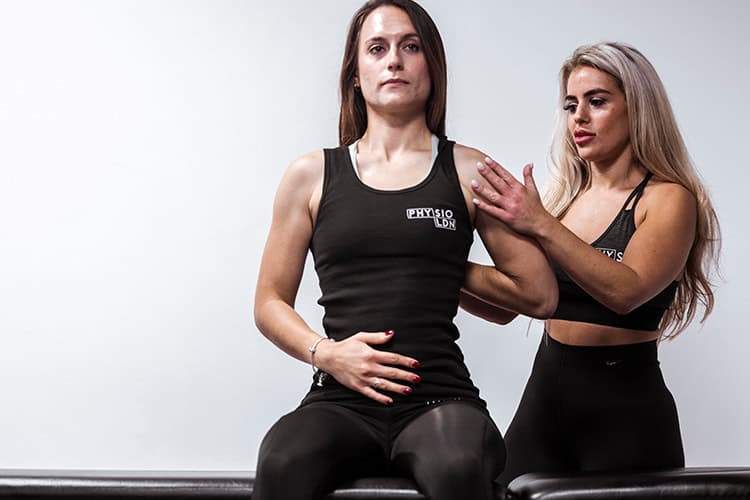
Elbow pain when straightening the arm is treated by reducing the end-range load that provokes it, strengthening the triceps, forearm and shoulder through a comfortable range, and restoring full extension in stages over 6 to 12 weeks, with imaging reserved for an elbow that is blocked. The programme differs by cause.
Posterior impingement. Stop short of full lock-out in presses and dips for two to three weeks, reduce throwing volume, strengthen the triceps in the mid-range, and mobilise the joint. A spur that keeps pinching after a loading programme is assessed for removal.
Triceps tendinopathy. Reduce pressing volume to a level that produces mild symptoms only, load the tendon with slow, heavy triceps work through a pain-tolerable range, and add full lock-out back last. Tendons adapt over months, and rest alone weakens them.
Tennis elbow. Reduce gripping and lifting with the palm down, strengthen the wrist extensors with slow, heavy resistance, and rebuild grip over 8 to 12 weeks. Our tennis elbow physiotherapy in London page sets out the programme we use.
Biceps and the front of the elbow. Reduce heavy curls, pull-ups and carrying for two to three weeks, strengthen the biceps through a comfortable range, and restore full extension with gentle end-range holds.
Ulnar nerve irritation. Avoid sustained elbow bending and leaning on the elbow, pad the inner elbow at the desk, and glide the nerve. Persistent numbness or weakness is graded and referred.
A blocked elbow. An elbow that stops short with a firm block is X-rayed and, where needed, scanned for a loose body, a spur or post-injury stiffness. A loose body is removed; stiffness is treated with a structured extension programme and, where it fails, a surgical release.
What we tell you at the assessment. Most elbow pain on straightening settles inside 12 weeks once the structure is named and the end-range load is managed. We will tell you if the elbow needs imaging, which applies to a block, a past fracture or dislocation, and very few others.
What makes elbow pain when straightening worse?
Forcing the elbow straight, locking out every repetition through pain, and resting the arm until it stiffens are the three habits that prolong elbow pain when straightening.
Forcing it. Pushing an elbow that stops short into full extension with the other hand or with weight compresses the structure that is already pinched. Extension is restored with gentle, sustained holds, not force.
Locking out through pain. Finishing every press and dip at full lock-out through a pinch at the back of the elbow drives the bone into the socket hundreds of times a week. Stopping a few degrees short for three weeks lets the joint settle.
Resting it bent. An elbow held bent in a sling or at a desk for weeks tightens the front of the joint, and the last degrees of extension are lost. The elbow is straightened fully, gently, several times a day.
When to get elbow pain when straightening assessed
Elbow pain when straightening the arm that has lasted more than two weeks, an elbow that stops short of straight compared with the other side, pain that stops you pressing, lifting or working, or pain with clicking, locking or tingling warrants a physiotherapy assessment, and no GP referral is needed. The assessment measures the range, tests each tendon and the nerve, and names the structure in one visit.
Note. Some elbow pain needs urgent medical care rather than physiotherapy. An elbow that cannot straighten or bend after a fall, an obvious deformity, a hot, red and swollen elbow with fever, sudden weakness or numbness in the hand, or a swelling over the point of the elbow that is red and spreading are reasons to call NHS 111 or go to A&E.
Book your London elbow assessment
An elbow that hurts at the end of straightening is telling you which structure is loaded there, and the assessment confirms it. You can book your first assessment for elbow pain physiotherapy in London, with no GP referral needed.
Common questions about elbow pain when straightening the arm
Why does my elbow hurt when I fully extend it?
Full extension drives the point of the forearm bone into its socket at the back of the elbow and pulls the triceps and the outer tendons to their tightest, so a structure that has lost tolerance hurts at that moment. Deep pain at the back on lock-out is posterior impingement; pain on the point is the triceps tendon; pain on the outside is tennis elbow.
Why can I not straighten my elbow fully?
An elbow that stops short with a firm or bony block has a mechanical cause, such as stiffness after a fracture or dislocation, a bone spur, a loose fragment of cartilage or arthritis. An elbow that stops short because of pain alone, with a soft end, is usually a tendon or an irritated joint lining and recovers with treatment.
Is elbow pain when locking out a sign of tennis elbow? T
ennis elbow hurts on the outside of the elbow when gripping and lifting, and is worse with the arm straight and the wrist bent down. Pain deep at the back of the elbow at lock-out, without outer elbow tenderness, is more likely to be posterior impingement or the triceps tendon.
Should I stop pressing if my elbow hurts at lock-out?
No, in most cases. Stop a few degrees short of full lock-out for two to three weeks, reduce the pressing volume, and strengthen the triceps in the mid-range, then add lock-out back in stages. Pain that stays mild and settles within a day is acceptable.
Can a stiff elbow after a fracture be straightened again?
Yes, in most cases, with a structured extension programme using sustained holds, strengthening and, where needed, a splint worn for periods during the day. Stiffness that does not respond over three months is reviewed for a surgical release.
References
- NHS. Elbow pain.
- Coombes BK, Bisset L, Vicenzino B. Management of lateral elbow tendinopathy: one size does not fit all. Journal of Orthopaedic and Sports Physical Therapy.
- Paraskevas G, Ioannidis O, Papaziogas B, et al. Posterior elbow impingement: a review. Acta Orthopaedica Belgica.
- Nandi S, Maschke S, Evans PJ, Lawton JN. The stiff elbow. Hand.
- Lindenhovius AL, Jupiter JB. The posttraumatic stiff elbow: a review of the literature. Journal of Hand Surgery (American).
- British Elbow and Shoulder Society. Patient information: elbow conditions.
