



A small firm lump in the palm, usually near the base of the ring or little finger. Skin that looks slightly puckered above it. A finger that has started to sit a touch bent, and will not quite flatten against a table.
That progression is Dupuytren’s contracture, and it is worth recognising early for one reason: the pathway for it is different from almost every other hand condition. This is not a tendon problem you can strengthen your way out of, and stretching does not reverse it. This guide covers the early signs, a simple check you can do at home, what it is commonly confused with, and the honest treatment route including where physiotherapy does and does not help.
Key takeaways
- The first sign is usually a firm lump in the palm, most often at the base of the ring or little finger
- Skin puckering or dimpling over the lump is the next stage, before any finger bending
- The tabletop test, laying your palm flat on a table, is the standard home check
- Dupuytren’s is frequently confused with trigger finger, and the two need completely different care
- Physiotherapy does not reverse Dupuytren’s, and honest early recognition means getting into the right pathway sooner
What Dupuytren’s contracture is
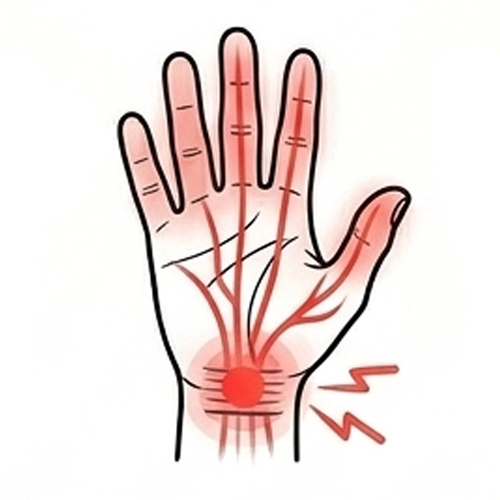
Dupuytren’s contracture is a gradual thickening and tightening of the layer of tissue just beneath the skin of the palm, which can slowly pull one or more fingers toward the palm.
Under the skin of your palm sits a sheet of connective tissue called the palmar fascia. In Dupuytren’s, parts of that sheet thicken and gradually contract, forming first nodules, then rope-like cords that run toward the fingers. As those cords shorten, they draw the finger in.
Two things make this distinct from other hand problems. First, it involves the fascia, not the tendons, so the finger’s bending mechanism is fine; something outside it is pulling. Second, it progresses slowly, usually over years, and often painlessly. Many people notice a lump long before anything affects their hand function.
Where this sits among the other causes of hand problems is mapped in our hand pain guide.
The early signs, in the order they appear
Dupuytren’s typically progresses from a painless palm lump, to skin puckering, to a cord, to a finger that will not straighten fully.
A lump in the palm
The first thing most people notice. A firm nodule under the skin, usually at the base of the ring or little finger, occasionally the middle finger or thumb. It does not slide around under the skin the way a cyst would, because it is part of the tissue layer itself. It may be slightly tender, or sometimes feel like a callus, but often it is painless.
Skin puckering or dimpling
As the tissue underneath tightens, the skin above it gets pulled down. You may see a dimple, a pit, or a slightly gathered look in the palm. This is a specific sign and not something most other hand conditions produce.
Cords running toward the finger
Over time the nodule can extend into a firm, rope-like band running from the palm toward the finger. You can often feel it as a taut line under the skin when you try to straighten the finger.
The finger stops straightening
The point at which it becomes functional. The finger sits slightly bent and cannot be fully straightened, even passively with the other hand. Everyday things start to catch: putting on gloves, reaching into a pocket, washing your face, shaking hands.
Progression is usually slow and varies enormously. Some people have a nodule for years with no change at all.
The tabletop test
Placing your palm flat on a table is the standard home check for Dupuytren’s: if you cannot flatten it completely, that is a positive result worth acting on.
- Sit at a table with your hand in front of you.
- Place your palm face down on the surface.
- Try to flatten the whole hand, palm and all fingers, against the table.
- Note whether any finger lifts away and will not press flat.
A hand that lies completely flat is a negative result. A finger that will not flatten, particularly the ring or little finger, is a positive one.
This test matters beyond simple recognition. Hand surgeons use an inability to lay the hand flat as one of the markers for when intervention becomes worth considering, so a positive tabletop test is a reasonable trigger to seek assessment rather than continue watching.
What it is commonly confused with

Dupuytren’s is most often mistaken for trigger finger, and telling them apart matters because their treatments have nothing in common.
Both produce a lump in the palm and a finger that does not move normally. The differences are clear once you know them.
Trigger finger produces a finger that catches or snaps. It bends and straightens, but not smoothly, and it can often be forced straight with a click. It is a tendon problem, it frequently hurts, and physiotherapy, splinting and injections treat it well. Our guide to trigger finger symptoms and self-tests covers it in full.
Dupuytren’s produces a finger that will not straighten at all, smoothly or otherwise. There is no catching and no snap. The finger bends fine; it simply cannot go back. It is often painless, and it involves the tissue layer rather than the tendon.
The quick separator: a catching finger is trigger finger; a finger that will not straighten is more likely Dupuytren’s. Other possibilities include a ganglion, a simple callus, or joint stiffness after injury, all of which an assessment distinguishes.
Who gets it, and what raises the risk
Dupuytren’s is strongly influenced by genetics and is more common in men, in people over 50, and in those of Northern European descent.
The recognised associations:
- Family history, which is the strongest factor; it often runs through families
- Age, with onset usually after 50
- Sex, being considerably more common in men, and often more aggressive when it occurs
- Northern European ancestry, which is why it is sometimes called Viking disease
- Diabetes, alcohol intake and smoking, each linked to higher rates
- Epilepsy medication in some cases
It is not caused by manual work or hand use, which is a common assumption. You did not bring it on by gripping things.
The honest treatment picture
Physiotherapy does not reverse Dupuytren’s contracture, and no stretching or exercise programme has been shown to undo the tightening. The effective treatments are procedural, and knowing that early saves wasted time.
This is the part worth being direct about, because plenty of content implies otherwise.
Early stage, a nodule with no contracture. The standard approach is monitoring. Many nodules never progress far. There is no evidence that any exercise, stretch, splint or massage prevents progression, so intervention at this stage is usually not recommended.
Established contracture affecting function. The options are needle procedures, injections to break down the cord, or surgery to remove the thickened tissue. These are delivered by hand surgeons, and the tabletop test is one of the markers used to decide timing.
After a procedure. This is where hand therapy genuinely matters. Restoring movement, managing scar tissue, and rebuilding grip after surgery or needling is well-established therapy work, and it affects the outcome meaningfully.
Where we fit
Our role with Dupuytren’s is threefold and we are clear about the limits of it: recognising it correctly and distinguishing it from the conditions it mimics, routing you into the right specialist pathway when contracture is progressing, and providing hand therapy after any procedure. We also treat the other hand and wrist problems Dupuytren’s patients frequently have alongside it, which are often the ones actually causing pain.
When to get it assessed
Book an assessment if you have a lump in your palm you cannot identify, if a finger has started to lose full straightening, or if you cannot lay your hand flat on a table. Get seen sooner if the change has been rapid over weeks rather than years, or if hand function is deteriorating noticeably, as faster progression warrants prompt specialist referral.
Our hand physiotherapy in London team assesses palm lumps and finger contractures, separates them from the conditions they mimic, and arranges onward referral where it is needed, through direct access, no GP referral required.
Common questions about Dupuytren’s contracture
What is the first sign of Dupuytren’s contracture?
A firm lump in the palm, usually at the base of the ring or little finger, often painless. Skin puckering over it typically follows, before any finger bending appears.
Can Dupuytren’s contracture be reversed with exercises?
No. There is no evidence that stretching, exercises, massage or splinting reverses the tightening or prevents progression. The effective treatments are needle procedures, injections and surgery. Hand therapy matters after those, not instead of them.
What can be mistaken for Dupuytren’s contracture?
Trigger finger is the most common confusion, along with ganglions, calluses and joint stiffness. The key difference: trigger finger catches and snaps but straightens; Dupuytren’s produces a finger that will not straighten at all.
How quickly does Dupuytren’s progress?
Usually slowly, over years, and it varies enormously. Some nodules never progress. Rapid change over weeks or months is less typical and warrants prompt specialist assessment.
Do I need surgery for Dupuytren’s contracture?
Not necessarily, and not early. Nodules without contracture are usually monitored. Intervention is considered when the finger can no longer straighten enough to affect daily function, with the tabletop test as one of the markers.
Book your hand assessment
A lump in the palm is worth identifying properly, because what it turns out to be decides whether you need treatment now, monitoring, or a specialist referral. Book an assessment with our hand physiotherapy in London team in 60 seconds, no GP referral needed.
Note: Signs that warrant prompt referral
Seek assessment without waiting if you notice:
- Rapid progression over weeks or months rather than years
- A finger losing straightening quickly enough to affect daily tasks
- A hand you can no longer lay flat on a table
- Loss of function affecting work or self-care
References
- NHS. Dupuytren’s contracture.
- Shih B, Bayat A. Scientific understanding and clinical management of Dupuytren disease. Nature Reviews Rheumatology. 2010;6(12):715-726.
- Ball C, Pratt AL, Nanchahal J. Optimal functional outcome measures for assessing treatment for Dupuytren’s disease: a systematic review. BMC Musculoskeletal Disorders. 2013;14:131.
- National Institute for Health and Care Excellence. Clinical Knowledge Summary: Dupuytren’s disease.
- British Society for Surgery of the Hand. Dupuytren’s disease.
