

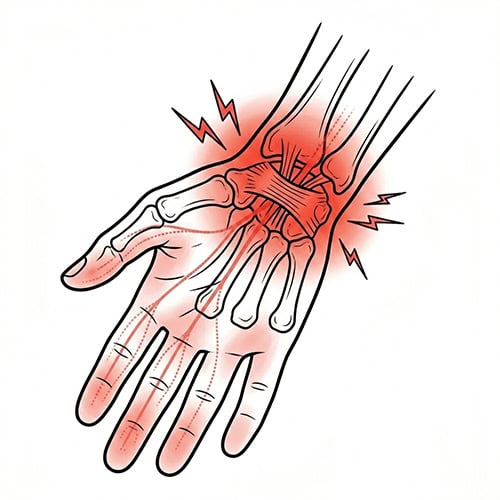

You have been told you have carpal tunnel syndrome, someone has mentioned surgery, and you want to know whether you can avoid it. The answer depends on how severe the compression is, not on how long you have had it or how much it bothers you. Mild to moderate carpal tunnel syndrome, with tingling that comes and goes and no loss of feeling or strength, improves without surgery in most people within three months of night splinting, nerve gliding and changes to how the wrist is used.
Severe carpal tunnel syndrome, with constant numbness, weakness or wasting of the thumb muscle, needs surgical release, because a nerve compressed at that level does not recover on its own and loses function the longer it waits. This guide sets out who needs surgery and who does not, what non-surgical treatment involves, what the evidence shows, how long to try it before deciding, what surgery involves and what goes wrong on both sides of the decision.
Key takeaways
- Mild to moderate carpal tunnel syndrome, with intermittent tingling and normal strength and feeling, does not need surgery first; night splinting, nerve gliding and activity changes improve most cases within 6 to 12 weeks.
- Severe carpal tunnel syndrome, with constant numbness, weakness of thumb movement or wasting of the muscle at the base of the thumb, needs a surgical opinion without delay, because nerve damage at that stage is partly permanent.
- A corticosteroid injection sits between the two: it relieves symptoms for weeks to months and is useful in pregnancy and as a bridge, but most people who need it more than once go on to surgery.
- Three months of correctly done non-surgical treatment is the usual trial; symptoms that are unchanged at that point, or that return quickly after it, are the signal to consider release.
- Carpal tunnel release is a short procedure with a high success rate, and physiotherapy afterwards restores grip, scar mobility and nerve movement.
Who needs carpal tunnel surgery and who does not?
Carpal tunnel surgery is needed when the median nerve shows signs of damage, which means constant numbness, weakness of the thumb, wasting of the muscle at the base of the thumb or a nerve conduction study graded severe; it is not needed first for intermittent tingling with normal feeling and strength. The severity of the compression decides, not the duration of the symptoms or the strength of the wish to be rid of them.
| Severity | What you notice | What the nerve test shows | Usual route |
| Mild | Tingling at night and with sustained grip, settles with shaking the hand, normal feeling and strength by day | Mild slowing of the sensory nerve | Non-surgical treatment for 3 months |
| Moderate | Tingling most days, some numbness after activity, dropping small objects at times, pain into the forearm | Slowing of sensory and motor conduction | Non-surgical treatment for 3 months; injection or surgery if unchanged |
| Severe | Constant numbness, loss of fine touch, weak thumb pinch, visible wasting at the base of the thumb | Marked slowing or absent response | Surgical release without a prolonged trial |
Why severity matters. A nerve that is intermittently compressed recovers when the pressure is reduced. A nerve that has been compressed hard enough and long enough to lose its sensory and motor fibres recovers slowly and incompletely, and each month of delay reduces what returns. Our carpal tunnel syndrome symptoms and self-test guide shows how to place yourself on this scale before an assessment.
What does non-surgical treatment for carpal tunnel involve?
Non-surgical treatment for carpal tunnel syndrome combines a wrist splint worn at night, nerve and tendon gliding exercises, changes to the wrist positions and activities that compress the tunnel, and treatment of any condition that raises fluid in the wrist, over a period of 6 to 12 weeks. Each part reduces the pressure on the nerve in a different way.
Night splinting. A splint that holds the wrist straight is worn in bed for six to eight weeks. The wrist bends during sleep, which raises the pressure in the tunnel, and the splint prevents it. Night splinting is the single most effective non-surgical measure and reduces night waking within two weeks in most people.
Nerve and tendon gliding. Six positions of the fingers and wrist, repeated several times a day, slide the median nerve and the tendons through the tunnel and reduce the adhesion and swelling that hold the nerve in place.
Activity and position changes. The wrist is kept neutral at the keyboard, on the phone, on the bike and on the steering wheel. Sustained gripping with the wrist bent is broken up. Vibrating tools are used with anti-vibration gloves and breaks.
Hands-on treatment. Mobilisation of the wrist bones and the soft tissue over the tunnel, and treatment of the neck and shoulder where the median nerve is also being irritated higher up, which is common in desk workers.
Treating the cause. Fluid retention from an underactive thyroid, diabetes, pregnancy or weight gain raises the pressure in the tunnel, and treating the cause reduces it. Carpal tunnel in pregnancy resolves after birth in most women.
Injection. A corticosteroid injection into the tunnel reduces swelling around the nerve and relieves symptoms for weeks to months. The injection is useful as a bridge in pregnancy, for a severe flare, or to confirm the diagnosis, and most people who need a second injection go on to surgery. Our carpal tunnel syndrome physiotherapy in London page sets out the programme we use.
What does the evidence show?
The evidence shows that night splinting and exercise improve mild to moderate carpal tunnel syndrome in most people, that surgery produces better long-term results than splinting for moderate to severe cases, and that a corticosteroid injection gives short-term relief that fades over months. The decision between the routes follows the severity, and the trials support that approach.
Splinting. A Cochrane review of splinting found improvement in symptoms at short-term follow-up compared with no treatment. Splinting works best in people with symptoms under a year and no nerve damage.
Surgery versus splinting. A trial comparing surgery with splinting found surgery produced better results at 18 months, with about 90 per cent of the surgical group improved compared with about 75 per cent of the splinted group, many of whom later had surgery. The difference favours surgery most in moderate to severe cases.
Injection. Trials show a corticosteroid injection relieves symptoms for up to three months and that benefit declines after that. A single injection does not change the long-term outcome for most people with moderate to severe compression.
Exercise and hands-on treatment. Trials of nerve gliding and manual treatment show benefit in mild to moderate cases comparable to splinting at short-term follow-up, and the two are combined in practice.
How long should you try non-surgical treatment?
Three months of correctly done non-surgical treatment is the standard trial for mild to moderate carpal tunnel syndrome, with a review at six weeks, and symptoms that are unchanged at three months or that return within weeks of stopping are the signal to consider surgical release. A trial that is not done correctly, with the splint worn some nights and the exercises done some weeks, does not count as a trial.
At six weeks. Night waking is reduced or gone in most people who are going to respond. A person with no change at six weeks is reviewed for severity and for a cause that has been missed, such as a neck problem or a thyroid condition.
At three months. Symptoms that are mild, intermittent and manageable are maintained with the splint and the exercises as needed. Symptoms that are unchanged, or that have worsened, are referred for nerve conduction studies and a surgical opinion.
Severe at any point. New numbness that is constant, new weakness or wasting at any point in the trial ends the trial and triggers referral. We will tell you when a trial has run its course rather than extend it.
What does carpal tunnel surgery involve?
Carpal tunnel release is a 15 to 20 minute procedure under local anaesthetic in which the band of tissue over the tunnel is cut to make room for the nerve, and most people use the hand for light tasks within days and return to full use within six weeks. The success rate is high and the complication rate low.
The procedure. An open release through a small cut in the palm, or an endoscopic release through one or two smaller cuts. Both cut the same band. The endoscopic route recovers slightly faster in the first weeks; the long-term results are the same.
Recovery. The hand is used for light tasks from the first days. Night tingling resolves within days in most people; numbness that was constant before surgery recovers over months and may not fully return. Grip strength dips for six to twelve weeks and then recovers. Scar tenderness in the palm, called pillar pain, settles over months.
Physiotherapy afterwards. Scar mobilisation, nerve gliding to prevent the nerve adhering to the healing tissue, grip strengthening and a graded return to work and sport. Our wrist pain causes and treatment guide covers the other wrist conditions that are assessed alongside carpal tunnel when symptoms persist after surgery.
Who it does not help. Surgery does not help numbness that is coming from the neck, from diabetes affecting the nerves generally, or from a second site of compression in the forearm. A surgical opinion includes nerve conduction studies to confirm that the tunnel is the site.
What goes wrong on both sides of the decision?
Delaying surgery for a nerve that is already damaged, operating on tingling that would have settled with a splint, and splinting a hand without doing the rest of the programme are the three errors that produce poor outcomes in carpal tunnel syndrome.
Waiting too long. Constant numbness and thumb weakness managed with splints and injections for a year lose nerve function that surgery done at the start would have preserved.
Operating too early. Night tingling in a person who has never worn a splint or changed a wrist position is operated on with a scar and six weeks of reduced grip for a problem that three months of conservative care would have resolved in most cases.
Half a programme. A splint without the exercises, the position changes and the treatment of the cause reduces night symptoms and leaves the daytime compression untouched, and the trial fails for the wrong reason.
When to get carpal tunnel assessed

Tingling or numbness in the thumb and first three fingers that has lasted more than two weeks, that wakes you at night, or that has not responded to a splint warrants a physiotherapy assessment, and no GP referral is needed. The assessment grades the severity, tests the neck and forearm as other sources of the symptoms, and starts the non-surgical programme or refers for nerve conduction studies and a surgical opinion where the signs are severe.
Note. Some hand symptoms need a GP review within days rather than a physiotherapy trial. Constant numbness that does not vary through the day, weakness in pinching or in lifting the thumb away from the palm, visible wasting of the muscle at the base of the thumb, numbness in both hands with unsteady walking, or sudden numbness after an injury are reasons to see a GP urgently or call NHS 111.
Book your London carpal tunnel assessment
The severity of the compression decides between physiotherapy and surgery, and the assessment grades it in one visit. You can book your first assessment for wrist pain physiotherapy in London in 60 seconds, with no GP referral needed.
Common questions about carpal tunnel surgery and physiotherapy
Can carpal tunnel go away without surgery?
Yes, in mild to moderate cases. Night splinting, nerve gliding and changes to wrist use improve symptoms in most people within 6 to 12 weeks, and carpal tunnel in pregnancy usually resolves after birth. Severe compression with constant numbness or weakness does not resolve without release.
How do I know if my carpal tunnel is bad enough for surgery?
Constant numbness rather than tingling that comes and goes, weakness in the thumb, wasting at the base of the thumb, or a nerve conduction study graded severe are the signs. Symptoms that have not changed after three months of correct non-surgical treatment are the other route to a surgical opinion.
Does a wrist splint cure carpal tunnel?
A night splint reduces the pressure on the nerve while you sleep and improves symptoms in most mild to moderate cases, with the best results in people whose symptoms started within the last year. The splint is part of a programme that also includes exercises and activity changes, not a cure on its own.
Is a steroid injection a good alternative to carpal tunnel surgery?
An injection relieves symptoms for up to three months and is useful in pregnancy, for a flare, or as a bridge while waiting for surgery. Most people with moderate to severe compression who need a second injection go on to surgery, so the injection delays the decision rather than replacing it.
How long is the recovery from carpal tunnel surgery?
Light use of the hand within days, night tingling gone within the first week in most people, and full grip strength back by six to twelve weeks. Numbness that was constant before surgery recovers over months and may not fully return.
References
- NHS. Carpal tunnel syndrome.
- Page MJ, Massy-Westropp N, O’Connor D, Pitt V. Splinting for carpal tunnel syndrome. Cochrane Database of Systematic Reviews.
- Gerritsen AA, de Vet HC, Scholten RJ, Bertelsmann FW, de Krom MC, Bouter LM. Splinting vs surgery in the treatment of carpal tunnel syndrome: a randomized controlled trial. JAMA.
- Marshall SC, Tardif G, Ashworth NL. Local corticosteroid injection for carpal tunnel syndrome. Cochrane Database of Systematic Reviews.
- Padua L, Coraci D, Erra C, et al. Carpal tunnel syndrome: clinical features, diagnosis, and management. Lancet Neurology.
- British Society for Surgery of the Hand. Carpal tunnel syndrome patient information.
