



Your wrist and thumb hurt, the hand tingles at times, and two names keep coming up when you search: carpal tunnel syndrome and De Quervain’s tenosynovitis. Both affect the thumb side of the wrist, both are common in people who use their hands all day, and both are often worse at night or first thing in the morning, which is why they are confused. They are different problems.
Carpal tunnel syndrome is a nerve being compressed at the front of the wrist and produces numbness and tingling in the thumb and first three fingers. De Quervain’s is two tendons being irritated at the thumb side of the wrist and produces a sharp pain on gripping and lifting with the thumb, without numbness.
One question separates them: does the hand go numb? This guide explains what each condition is, how they compare side by side, two self-tests, who gets each one, how each is treated and when wrist and thumb pain needs to be assessed.
Key takeaways
- Carpal tunnel syndrome is compression of the median nerve at the front of the wrist and causes numbness, tingling and night waking in the thumb, index and middle fingers.
- De Quervain’s tenosynovitis is irritation of the two thumb tendons on the thumb side of the wrist and causes sharp pain on gripping, lifting and twisting with the thumb, without numbness.
- Numbness or tingling points to carpal tunnel; pain on a specific spot at the thumb side of the wrist when lifting a kettle or a baby points to De Quervain’s.
- Carpal tunnel is treated with night splinting, nerve gliding and activity changes, with surgery for persistent or severe cases; De Quervain’s is treated with a thumb splint, load management and progressive tendon loading, with an injection where it persists.
- The two can occur together, in pregnancy and after childbirth in particular, which is why an assessment tests both.
What is carpal tunnel syndrome?
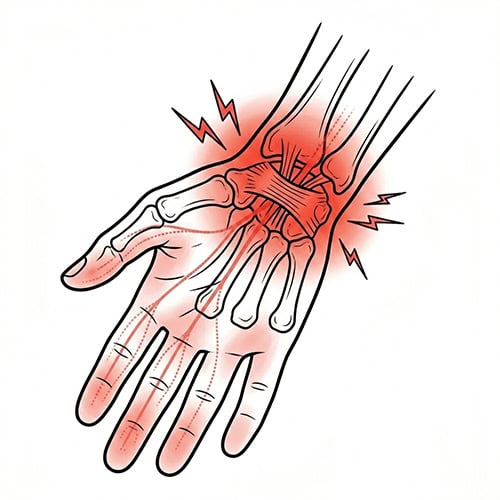
Carpal tunnel syndrome is compression of the median nerve where it passes through a narrow tunnel at the front of the wrist, under a tight band of tissue, and it produces numbness, tingling and pain in the thumb, index finger, middle finger and half of the ring finger. The nerve, not a tendon, is the problem, which is why the main symptom is altered sensation rather than pain on a spot.
The pattern. Tingling or numbness in the first three and a half fingers, worst at night and on waking, with shaking the hand bringing relief. Pain can spread up the forearm. Over months, the hand drops objects and the muscle at the base of the thumb weakens. Our carpal tunnel syndrome symptoms and self-test guide covers the full picture.
What raises the pressure. Swelling in the tunnel from fluid retention, as in pregnancy or an underactive thyroid, wrist positions held bent for long periods, repetitive gripping with the wrist flexed, diabetes, and rheumatoid arthritis.
What is De Quervain’s tenosynovitis?
De Quervain’s tenosynovitis is irritation of the sheath around the two tendons that lift the thumb away from the hand, where they pass through a tunnel at the thumb side of the wrist, and it produces a sharp, localised pain on gripping, lifting and twisting with the thumb. The tendons, not a nerve, are the problem, so there is no numbness.
The pattern. Pain on the thumb side of the wrist, about 2 cm above the wrist crease, worse when lifting a kettle, a child or a pan, wringing a cloth, texting or turning a key. A tender swelling on the spot. Pain on moving the thumb away from the hand against resistance. Normal sensation.
What irritates the tendons. Repeated lifting with the thumb held out and the wrist bent sideways, which is the position of lifting a baby under the arms, hence the common name of mother’s thumb. Texting, gaming, racket sports and gardening produce the same load.
How do carpal tunnel and De Quervain’s compare?
Carpal tunnel syndrome and De Quervain’s tenosynovitis differ in the structure involved, the main symptom, the location, the timing and the test that provokes them, and the table sets the two side by side.
| Feature | Carpal tunnel syndrome | De Quervain’s tenosynovitis |
| Structure | Median nerve, front of the wrist | Two thumb tendons and their sheath, thumb side of the wrist |
| Main symptom | Numbness, tingling, pins and needles | Sharp pain on a spot |
| Where | Thumb, index, middle and half the ring finger; palm side | Thumb side of the wrist, 2 cm above the crease, spreading into the thumb and forearm |
| Worst when | At night, on waking, holding a phone or steering wheel | Lifting, gripping, wringing, texting, turning a key |
| Relieved by | Shaking the hand, changing wrist position | Resting the thumb, a thumb splint |
| Weakness | Dropping objects; thumb muscle wasting in late cases | Weak grip from pain, no wasting |
| Swelling | Rarely visible | Tender swelling over the tendons at the thumb side |
| Provoking test | Phalen’s test, Tinel’s tap | Finkelstein’s test |
Our wrist pain causes and treatment guide covers both alongside the other causes of wrist pain.
Which self-tests separate the two?
Phalen’s test provokes carpal tunnel symptoms and Finkelstein’s test provokes De Quervain’s pain, and doing both at home tells you which condition is more likely before an assessment.
Phalen’s test for carpal tunnel. Hold the backs of your hands together with the wrists fully bent and the fingers pointing down, elbows level, for 60 seconds. Tingling or numbness in the thumb, index or middle finger within that minute is a positive test. Tapping over the front of the wrist crease and feeling a tingle into the fingers is a second sign.
Finkelstein’s test for De Quervain’s. Make a loose fist with the thumb tucked inside the fingers, then bend the wrist towards the little finger. Sharp pain at the thumb side of the wrist is a positive test, and the test is uncomfortable enough that one attempt is sufficient.
Reading the results. A positive Phalen’s with a negative Finkelstein’s is carpal tunnel. A positive Finkelstein’s with normal sensation is De Quervain’s. Both positive happens, in pregnancy and after childbirth most often, and both are then treated. Both negative with ongoing wrist pain means the cause is elsewhere, and the assessment looks at the thumb joint, the wrist ligaments and the neck.
Who gets each condition?
Carpal tunnel syndrome affects about 3 to 6 per cent of adults and peaks between 40 and 60, with women affected about three times more often than men; De Quervain’s is most common in women between 30 and 50, in the months after childbirth, and in anyone whose work or sport loads the thumb repeatedly.
Carpal tunnel. Pregnancy, menopause, an underactive thyroid, diabetes, rheumatoid arthritis, obesity and work with sustained wrist flexion or vibration all raise the risk. Office work alone is a weaker risk than commonly believed.
De Quervain’s. New parents lifting a baby, people who text and game for hours, racket sports players, gardeners and anyone whose job involves repeated lifting with the thumb out. The condition is common enough after childbirth that it is assessed routinely in new mothers with wrist pain.
Both at once. Fluid retention in pregnancy raises the pressure in the carpal tunnel while the lifting that follows birth irritates the thumb tendons, which is why the two appear together in the first year of a child’s life.
How is each condition treated?
Carpal tunnel syndrome is treated with a night splint, nerve and tendon gliding exercises and changes to wrist position, with a corticosteroid injection or surgical release for cases that persist or show nerve damage; De Quervain’s is treated with a thumb splint, load management and progressive loading of the thumb tendons, with an injection for cases that do not settle.
Carpal tunnel. A splint that holds the wrist straight is worn at night for six to eight weeks, which reduces the pressure in the tunnel while you sleep. Nerve gliding exercises keep the median nerve moving. Wrist positions at the desk, on the phone and on the bike are changed to keep the wrist neutral.
Mild to moderate cases improve with this programme in most people. Cases with constant numbness, weakness or muscle wasting are referred for nerve conduction studies and a surgical opinion, because a nerve that is compressed for too long does not recover fully. Our carpal tunnel syndrome physiotherapy in London page sets out the programme we use.
De Quervain’s. A splint that holds the thumb and wrist still is worn for two to four weeks during the activities that provoke it. The lifting technique is changed so the thumb stays close to the hand and the forearm does the work. The tendons are loaded progressively once the sharp pain has settled, with resisted thumb movements building over six to eight weeks. A corticosteroid injection into the sheath resolves most cases that have not settled with this, and surgical release is reserved for the few that persist.
What we tell you at the assessment. The two conditions are separated in one visit by the pattern, the sensation test and the two provoking tests. We will tell you if the pattern suggests nerve damage that needs testing, which applies to constant numbness or weakness and to very few others.
What makes wrist and thumb pain worse?
Treating numbness as a tendon problem, treating a tendon as a nerve problem, and continuing the lifting position that provokes De Quervain’s are the three mistakes that prolong both conditions.
Stretching a nerve. Carpal tunnel treated with thumb stretches and tendon loading leaves the nerve compressed and the numbness unchanged. A night splint and nerve gliding treat the nerve.
Splinting a tendon for months. De Quervain’s held still in a splint for months loses the tendon’s tolerance to load, and the pain returns on the first lift. The splint is short-term, and loading follows.
The same lift. Lifting a child under the arms with the thumbs out, hundreds of times a day, re-irritates the tendons however well they are treated. The lift is changed to a scoop with the forearms, and the thumbs stay close to the hand.
When to get wrist and thumb pain assessed

Wrist or thumb pain that has lasted more than two weeks, numbness or tingling that wakes you, a hand that drops objects, or pain that stops you lifting, gripping or caring for a child warrants a physiotherapy assessment, and no GP referral is needed. The assessment tests sensation, the median nerve and the thumb tendons in one visit and separates the two conditions. Our wrist pain physiotherapy service in London sees new wrist assessments within days across all our clinics.
Note. Some wrist and hand symptoms need urgent medical care rather than physiotherapy. Constant numbness with visible wasting of the muscle at the base of the thumb, sudden weakness in the hand, numbness spreading up the arm with neck pain, a hot, red and swollen wrist with fever, or numbness and weakness in both hands with unsteadiness are reasons to see a GP urgently or call NHS 111.
Book your London wrist assessment
Numbness points to the nerve and pain on a spot points to the tendon, and the assessment confirms which. You can book your first assessment for wrist pain physiotherapy in London at any of our clinics in 60 seconds, with no GP referral needed.
Common questions about carpal tunnel and De Quervain’s
Can carpal tunnel cause thumb pain?
Yes. Carpal tunnel syndrome causes aching in the thumb and the base of the thumb alongside tingling and numbness, because the median nerve supplies both. Thumb pain without any numbness or tingling is more likely to be De Quervain’s or arthritis at the base of the thumb.
Can you have carpal tunnel and De Quervain’s at the same time?
Yes. The two occur together most often in pregnancy and in the months after childbirth, when fluid retention compresses the median nerve and repeated lifting irritates the thumb tendons. Both are then treated at once.
Does De Quervain’s cause numbness?
No. De Quervain’s is a tendon condition and sensation stays normal. Numbness or tingling in the thumb and fingers points to carpal tunnel syndrome or to a nerve problem higher up, and is tested separately.
How do I know if I have carpal tunnel without a nerve test?
Tingling or numbness in the thumb, index and middle fingers, worst at night and relieved by shaking the hand, with a positive Phalen’s test, makes carpal tunnel syndrome likely. Nerve conduction studies confirm the diagnosis and grade the severity when surgery is being considered.
Which is worse, carpal tunnel or De Quervain’s?
Carpal tunnel syndrome carries the greater long-term risk, because a nerve compressed for too long loses function that does not fully return. De Quervain’s is more painful day to day but does not damage the nerve, and almost always resolves with treatment.
References
- NHS. Carpal tunnel syndrome.
- NHS. De Quervain’s tenosynovitis.
- Padua L, Coraci D, Erra C, et al. Carpal tunnel syndrome: clinical features, diagnosis, and management. Lancet Neurology.
- Page MJ, Massy-Westropp N, O’Connor D, Pitt V. Splinting for carpal tunnel syndrome. Cochrane Database of Systematic Reviews.
- Huisstede BM, Coert JH, Friden J, Hoogvliet P. Consensus on a multidisciplinary treatment guideline for de Quervain disease: results from the European HANDGUIDE study. Physical Therapy.
- British Society for Surgery of the Hand. Carpal tunnel syndrome and De Quervain’s syndrome patient information.
