



Your knee does not ache the way a sore knee usually does. The pain burns, sometimes at rest, sometimes only on stairs or after sitting, and the word itself is what worries you. Burning in a knee comes from one of three sources: inflammation in a tendon, bursa or joint lining, friction and heat in a tissue that is being overloaded, or an irritated nerve that supplies the skin and front of the knee.
Each source has its own location, its own pattern over the day and its own treatment, and most are treated without a scan. This guide sets out what burning knee pain means, which cause sits where, how to tell the three sources apart at home, how each is treated, and when a burning knee needs to be seen quickly.
Key takeaways
- Burning knee pain comes from inflammation, from overload friction, or from an irritated nerve, and the location and timing of the burning point to which one.
- Burning at the front of the knee on stairs and after sitting is most often patellofemoral pain or patellar tendinopathy; burning on the outer side in runners is usually iliotibial band irritation.
- Burning on the inner knee just below the joint line points to pes anserine bursitis or the saphenous nerve; burning across the kneecap skin after surgery or a knock points to a nerve branch.
- A hot, red, swollen knee that burns at rest, with or without fever, is gout, infection or inflammatory arthritis until proven otherwise and needs same-day medical care.
- Most burning knee pain settles with load management and progressive strengthening over 6 to 12 weeks; nerve-related burning needs the pressure on the nerve removed first.
What does burning knee pain mean?
Burning knee pain means a tissue in or around the knee is inflamed, is being overloaded to the point of friction heat, or has an irritated nerve running through it. Burning is a quality of pain, not a diagnosis, and the same word is used by people with three different problems.
Inflammatory burning. An inflamed bursa, tendon sheath or joint lining produces a hot, burning ache that is worse at rest and in the morning, often with visible swelling. Gout, septic arthritis and inflammatory arthritis sit at the severe end of this group.
Overload burning. A tendon or fat pad loaded beyond its tolerance produces burning during and after the activity that loads it, which eases with rest and returns when the load returns. Patellofemoral pain, patellar tendinopathy and iliotibial band irritation sit here.
Nerve burning. An irritated nerve produces burning, tingling or numbness in the skin it supplies, often in a strip or patch, with light touch or clothing making it worse. The saphenous nerve on the inner knee, its infrapatellar branch across the front of the kneecap, and the L3 and L4 nerve roots in the lower back are the usual sources.
Which cause sits where on the knee?
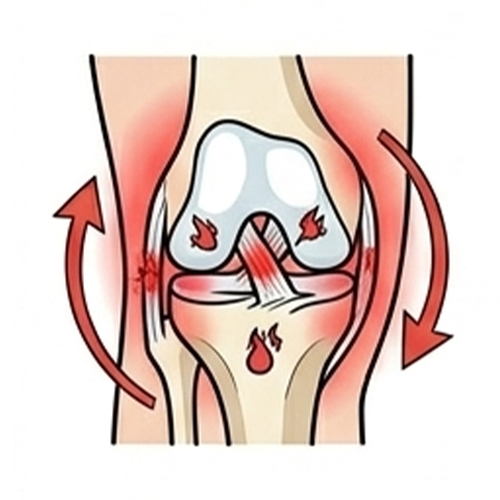
The location of burning on the knee narrows the cause more than any other single feature.
| Where it burns | Most likely cause | What else fits the pattern |
| Front of the knee, around or under the kneecap | Patellofemoral pain | Worse on stairs, squats and after sitting; grinding or clicking |
| Front, just below the kneecap | Patellar tendinopathy or fat pad irritation | Worse jumping, landing, straightening the knee fully |
| Outer side of the knee | Iliotibial band irritation | Burning after a set distance of running, eases when you stop |
| Inner side, 2 to 5 cm below the joint line | Pes anserine bursitis or saphenous nerve irritation | Tender spot on the shin bone; worse climbing stairs or at night |
| Across the kneecap skin, numb or burning to touch | Infrapatellar nerve branch irritation | After knee surgery, a knock, or kneeling on hard floors |
| Behind the knee | Baker’s cyst or hamstring tendon irritation | Tightness when bending fully; a lump you can feel |
| Whole knee, hot, red and swollen | Gout, infection or inflammatory arthritis | Burning at rest, cannot bear weight, fever |
| Front of the thigh and knee with back stiffness | L3 or L4 nerve root irritation | Knee examination normal; burning changes with back position |
Our knee pain causes and treatment guide covers each of these diagnoses in full.
How do you tell the three sources of burning apart at home?
Three questions separate inflammatory, overload and nerve-related burning: when it burns, whether the skin is involved, and whether the knee is hot.
When does it burn? Burning that appears during an activity and fades within an hour of stopping is overload. Burning that is worst at rest, at night and first thing in the morning, with stiffness, is inflammatory. Burning that comes and goes without a clear link to activity, or that changes with how you sit or bend your back, is nerve-related.
Is the skin involved? Run a fingertip lightly across the painful area and compare with the other knee. Skin that feels numb, oversensitive or tingly under light touch points to a nerve. Tendons and bursae hurt when pressed, not when stroked.
Is the knee hot? Place the back of your hand on both knees. A knee that is warmer than the other, red, or swollen so the kneecap outline is lost is inflamed and needs assessment within days, or same day if there is fever. Our guide on knee swelling and when to worry sets out the thresholds.
One self-test for the front of the knee. Sit with the knee bent for 20 minutes, then stand and take the stairs. Burning that peaks on standing from the chair and on the way down the stairs is the classic pattern of patellofemoral pain, and our patellofemoral pain symptoms and self-test guide takes the check further.
How is burning knee pain treated?
Burning knee pain is treated according to its source: overload burning with load management and progressive strengthening, inflammatory burning with settling the inflammation first, and nerve burning with removing the pressure on the nerve. A programme built for the wrong source makes the burning worse, which is why the first step is a diagnosis.
Overload burning. Reduce the load that provokes it to a level that produces mild symptoms only, then rebuild it. Patellofemoral pain responds to hip and quadriceps strengthening over 6 to 12 weeks, with taping or a change in step width where it helps.
Patellar tendinopathy responds to heavy, slow loading of the tendon, starting with isometric holds and progressing to slow squats. Iliotibial band irritation responds to a short reduction in running distance, hip abductor strengthening and cadence changes, not to stretching the band itself.
Inflammatory burning. Pes anserine bursitis settles with a reduction in stairs and hills, ice, and strengthening of the inner thigh and hamstrings, and occasionally a corticosteroid injection where it persists.
Knee osteoarthritis with an inflamed lining responds to the exercise, weight management and education programme that NICE guideline NG226 sets as core treatment. Gout follows NICE guideline NG219 and is treated medically, with physiotherapy resuming once the flare has settled.
Nerve burning. Saphenous nerve irritation at the inner knee often follows pressure from a knee brace, a tight sleeve or a surgical scar, and settles once the pressure is removed and the surrounding tissue is mobilised.
Infrapatellar branch irritation after surgery settles over months and responds to desensitisation and scar mobilisation. Burning referred from the L3 or L4 nerve root is treated at the back, not the knee.
What we tell you at the assessment. Most burning knee pain settles inside 12 weeks once the source is correct. We will tell you if the pattern does not fit a musculoskeletal cause and refer you to your GP for blood tests or imaging.
What makes burning knee pain worse?
Complete rest, stretching an irritated nerve, and treating a hot knee as an overload problem are the three mistakes that prolong burning knee pain.
Complete rest. Overload burning needs less load, not none. Two weeks off stairs and training weakens the quadriceps and hip, and the burning returns at a lower threshold.
Stretching into the burn. Stretching reduces overload pain in a tight muscle but increases nerve burning, because the nerve is already under tension. A stretch that makes the burning or tingling spread is a stretch to stop.
Misreading inflammation. A hot, swollen knee loaded with squats and lunges in the hope of strengthening it through the pain gets worse. Inflammation is settled first, then loaded.
When to get a burning knee assessed
Burning knee pain that has lasted more than two weeks, that wakes you at night, that comes with numbness or tingling, or that limits stairs and walking warrants a physiotherapy assessment, and no GP referral is needed.
The assessment identifies which of the three sources is responsible and whether a GP review for blood tests is needed first. Our knee pain physiotherapy service in London sees new knee assessments within days across all our clinics.
Note. Some burning knees need urgent medical care rather than physiotherapy. A knee that is hot, red and swollen with a fever or feeling unwell, a knee you cannot put weight on, sudden severe burning in one joint overnight, burning with calf pain and swelling, or numbness spreading down the leg with weakness are reasons to call NHS 111 or go to A&E.
Common questions about burning knee pain
Why does my knee burn when I sit for a long time?
Burning after sitting with the knee bent is the classic sign of patellofemoral pain, because the kneecap is pressed against the thigh bone for the whole period. Standing up and the first few stairs are the worst moments, and the burning eases with movement.
Why does my knee burn at night?
Burning at night with stiffness points to inflammation in the joint lining or a bursa, and in people over 45 most often to knee osteoarthritis. Burning at night with tingling or numbness points to a nerve, and the position of your back and hip in bed changes it.
Can a nerve cause burning in the knee?
Yes. The saphenous nerve and its infrapatellar branch supply the skin on the inner and front of the knee, and the L3 and L4 nerve roots in the lower back refer burning to the front of the thigh and knee. Nerve burning comes with numbness or oversensitivity to light touch.
Is a burning knee a sign of arthritis?
A burning knee can be a sign of osteoarthritis when the burning is worst at rest and in the morning, with stiffness under 30 minutes, in someone over 45. Burning during activity only, in a younger knee, is more often a tendon or kneecap problem.
Should I use ice or heat for burning knee pain?
Ice suits a knee that is warm, swollen or burning after activity. Heat suits a stiff knee that burns in the morning without swelling. Neither replaces finding the cause, and a hot, red knee needs assessment rather than either.
Book your London knee assessment
Burning knee pain settles once the source is named and the load is matched to it. You can book your first assessment for knee pain physiotherapy in London at any of our clinics in 60 seconds, with no GP referral needed.
References
- National Institute for Health and Care Excellence. Osteoarthritis in over 16s: diagnosis and management. NICE guideline NG226, October 2022.
- National Institute for Health and Care Excellence. Gout: diagnosis and management. NICE guideline NG219, June 2022.
- NHS. Knee pain.
- NHS. Bursitis.
- Versus Arthritis. Knee pain: causes and treatment.
- Collins NJ, Barton CJ, van Middelkoop M, et al. 2018 consensus statement on exercise therapy and physical interventions to treat patellofemoral pain.
