



Your ankle clicks when you walk, pops when you roll it in circles, or snaps over the outer bone when you push off, and you want to know whether the sound means damage. An ankle that clicks without pain is normal and is heard in most adults, because the joint fluid releases gas and tendons flick over bone as the ankle moves. An ankle that clicks with pain, catching or a feeling of giving way is different, because the sound is then coming from a tendon that has slipped out of its groove, a fragment of cartilage inside the joint, or a joint that is unstable after a sprain.
Which one it is shows in where the sound comes from and what else comes with it. This guide sets out why healthy ankles click, what changes when the clicking hurts, which cause sits where, how to check it at home, how each cause is treated and when a clicking ankle needs to be assessed.
Key takeaways
- Painless ankle clicking comes from gas in the joint fluid and from tendons moving over bone, is common in healthy ankles, and needs no treatment.
- A snap or pop over the outer ankle bone on pushing off or turning the foot out is the peroneal tendons slipping out of their groove, and it is the most common cause of a painful, repeatable ankle click.
- Clicking inside the joint with pain, catching or locking after a past sprain points to a cartilage lesion or a loose fragment on the talus and is assessed with imaging.
- Clicking with a sense of the ankle giving way is chronic ankle instability, which is treated with balance and strength work rather than for the sound.
- Most painful ankle clicking is treated without surgery, and the click often remains once the pain and instability have gone.
Why do healthy ankles click?
Healthy ankles click because gas bubbles in the joint fluid collapse when the joint is moved quickly, and because the tendons that run around the ankle bones flick over their edges as the foot moves. Neither sound involves damage, and both are heard in most adults.
Gas in the joint. The ankle joint contains fluid with dissolved gas. Rolling the ankle in a circle or pointing the foot hard changes the pressure and releases a bubble with a pop. The joint cannot repeat the pop for 15 to 20 minutes, which is the easiest way to recognise it.
Tendons over bone. Four tendons run behind the inner ankle bone and two behind the outer one. A tendon that catches briefly on a bony edge and releases makes a click you can feel under a finger, repeatable every time, without pain.
Scar after a sprain. An ankle that was sprained in the past often clicks more than the other, because thickened ligament and capsule flick over bone. A painless click on a stable ankle after an old sprain is a leftover, not a problem.
What changes when ankle clicking hurts?
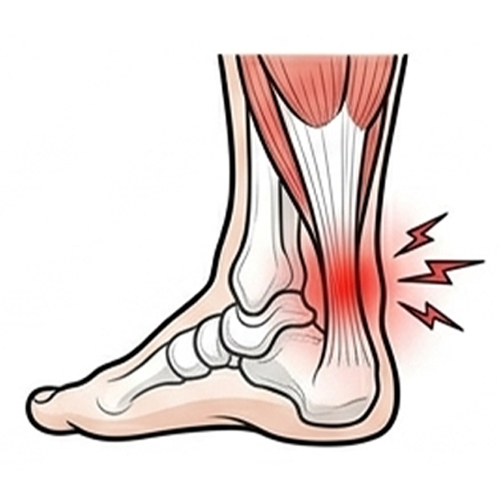
Painful ankle clicking means the sound is coming from a tendon that is slipping out of place, from a fragment of cartilage or bone inside the joint, or from a joint that is unstable, and each has its own location and signs.
| Where the sound comes from | What else comes with it | Most likely cause |
| Behind or over the outer ankle bone, on pushing off or turning the foot outward | A visible snap, pain and sometimes swelling behind the bone | Peroneal tendon subluxation |
| Behind the inner ankle bone, with pain along the arch | Flattening of the arch, pain standing on tiptoe | Posterior tibial tendon dysfunction |
| Deep inside the joint, at the front | Catching, locking, swelling after activity, a past sprain | Osteochondral lesion of the talus or a loose body |
| Front of the ankle when pulling the foot up | Pinching pain at the front, reduced bend in a lunge | Anterior ankle impingement |
| Whole joint, with a sense of giving way on uneven ground | Repeated sprains, wobble on one leg | Chronic ankle instability |
| Behind the heel, a creak when moving the foot up and down | Tender, thickened Achilles, stiff in the morning | Achilles tendinopathy with paratendon crepitus |
| Whole joint, stiff in the morning, over 50 or after a fracture | Grinding, reduced range, swelling after walking | Ankle osteoarthritis |
Our ankle pain causes and treatment guide covers each diagnosis in the table.
Which cause of painful clicking sits where?
The outer ankle snaps from the peroneal tendons, the inside of the joint clicks from cartilage, and a click that comes with giving way comes from the ligaments.
The peroneal tendons. Two tendons run in a groove behind the outer ankle bone, held in by a band of tissue. A sprain that tears the band, or a shallow groove, lets the tendons slip forward over the bone when the foot turns outward or pushes off. The snap is visible, repeatable, and painful at first; over time the pain fades and the snap remains. Our sprained ankle grades guide explains the injury that most often starts it.
The joint surface. A sprain or a twist can bruise or chip the cartilage on the talus, the bone that sits inside the ankle joint. A loose fragment clicks and catches as the joint moves, and the ankle swells after activity. The click is deep, felt rather than seen, and comes with a sense of something moving inside.
The ligaments. An ankle whose outer ligaments have stretched after one or more sprains moves further than it should, and the extra movement clicks. The click comes with a wobble on one leg, repeated rolls on uneven ground and a lack of trust in the ankle. Our guide on an ankle that keeps giving way covers the pattern in full.
The front of the joint. Repeated forced bending of the ankle, as in football or deep squats, thickens the tissue at the front of the joint. The tissue is pinched when the foot is pulled up, with a click and a sharp pain at the front.
How do you check ankle clicking at home?
Three checks separate a harmless click from a tendon that is slipping, a joint that is catching and an ankle that is unstable. Stop any check that produces sharp pain.
Watch the outer ankle. Sit with the foot off the floor, place a finger behind the outer ankle bone, and turn the foot outward and upward against the resistance of your other hand. A tendon that you feel or see jump forward over the bone is a peroneal subluxation.
The lunge and circle. Stand facing a wall with the toes 10 cm from it and bend the knee to the wall, keeping the heel down, then take the foot through a slow circle. A deep click with a catch, or a pinch at the front at the end of the lunge, points inside the joint. A pop that cannot be repeated for 15 minutes is gas.
Stand on one leg. Stand on the clicking ankle with eyes closed for 30 seconds. An ankle that wobbles, corrects constantly or cannot hold the position, compared with the other side, is unstable, and the click is a sign of that rather than a problem on its own.
How is painful ankle clicking treated?
Painful ankle clicking is treated for the cause behind the sound: strengthening and balance work for instability, load management and tendon strengthening for tendon problems, and imaging and a surgical opinion for a joint that catches or locks. The click itself is not treated, and most ankles keep clicking after the pain has resolved.
Peroneal subluxation. A mild subluxation settles with peroneal strengthening, balance work and a short period of taping or bracing. A tendon that dislocates repeatedly and painfully, or that has torn, is assessed for surgical repair of the band that holds it, because strengthening cannot replace a torn restraint.
Chronic instability. Balance training on one leg, progressing to unstable surfaces and eyes closed, peroneal and calf strengthening, and hopping and landing drills over 6 to 12 weeks. Most unstable ankles become stable with this programme, and surgery is reserved for ankles that fail it.
Osteochondral lesion or loose body. A click with catching, locking or swelling after a sprain is imaged with MRI. Small lesions are managed with a period of reduced load and strengthening; a loose fragment that catches is removed arthroscopically, with rehabilitation afterwards.
Anterior impingement. Reduce the deep forced bend that pinches the front of the joint, mobilise the joint, strengthen the calf and foot, and tape to limit end-range bend for sport. Persistent impingement is treated arthroscopically.
Tendon problems. Posterior tibial tendon dysfunction and Achilles tendinopathy are treated with load management, progressive strengthening and, for the posterior tibial tendon, arch support. Our Achilles tendinopathy physiotherapy in London page sets out the loading programme we use.
What we tell you at the assessment. A clicking ankle that hurts is treated for what is behind the sound. We will tell you if the click is coming from a structure that needs imaging, which applies to an ankle that catches, locks or has a tendon that visibly dislocates, and to very few others.
What makes ankle clicking worse?
Rolling the ankle to make it pop, resting an unstable ankle, and ignoring a snap over the outer bone are the three habits that turn a clicking ankle into a problem.
Popping it on purpose. Forcing the joint to release gas for relief stretches the capsule each time and gives minutes of relief. The ankle is moved through its range, not cranked.
Resting instability. An ankle that gives way and is rested loses the balance and strength that stabilise it, and the next roll comes sooner. Instability is treated with load, not rest.
Ignoring the snap. Peroneal tendons that keep dislocating fray against the bone. A visible snap over the outer ankle after a sprain is assessed early, while the restraint can be repaired cleanly.
When to get a clicking ankle assessed
Ankle clicking that comes with pain for more than two weeks, with catching or locking, with swelling after activity, with a visible snap over the outer bone, or with a sense of giving way warrants a physiotherapy assessment, and no GP referral is needed. Painless clicking on a stable ankle needs no appointment. The assessment tests the ligaments, the tendons and the joint by hand and names the cause in one visit. Our ankle pain physiotherapy service in London sees new ankle assessments within days across all our clinics.
Note. Some clicking ankles need urgent medical care rather than physiotherapy. An ankle you cannot put weight on after a twist, an obvious deformity, a hot, red and swollen ankle with fever, a sudden pop at the back of the heel with weakness pushing off, or calf pain and swelling with shortness of breath are reasons to call NHS 111 or go to A&E.
Book your London ankle assessment
A clicking ankle that hurts is treated for what sits behind the sound, and the assessment finds it. You can book your first assessment for ankle pain physiotherapy in London at any of our clinics in 60 seconds, with no GP referral needed.
Common questions about ankle clicking
Is it normal for my ankle to click when I walk?
Yes, when the click is painless and the ankle is stable. Gas in the joint fluid and tendons moving over bone click in most healthy ankles. Clicking becomes worth assessing when pain, catching, swelling or giving way arrive with it.
Why does my ankle pop when I rotate it?
Rotating the ankle changes the pressure in the joint fluid and releases a gas bubble, which pops. A pop that cannot be repeated for 15 to 20 minutes is gas and is harmless.
What is the snapping over my outer ankle bone?
A snap you can see or feel over the outer ankle bone on pushing off or turning the foot outward is the peroneal tendons slipping out of their groove. A mild case settles with strengthening and taping; a tendon that dislocates repeatedly is assessed for repair.
Can a clicking ankle be a sign of arthritis?
A clicking ankle is a sign of arthritis only when it comes with morning stiffness, grinding, reduced range and swelling after walking, usually after a previous fracture or in people over 50. Clicking alone is not.
Will physiotherapy stop my ankle clicking?
Physiotherapy treats the pain, the instability or the tendon problem behind a painful click, and most of those resolve. The sound itself often remains once the ankle is stable and pain-free, and that is acceptable.
References
- Roth JA, Taylor WC, Whalen J. Peroneal tendon subluxation: the other lateral ankle injury. British Journal of Sports Medicine.
- Gribble PA, Bleakley CM, Caulfield BM, et al. Evidence review for the 2016 International Ankle Consortium consensus statement on the prevalence, impact and long-term consequences of lateral ankle sprain. British Journal of Sports Medicine.
- van Dijk CN, Reilingh ML, Zengerink M, van Bergen CJ. Osteochondral defects in the ankle: why painful? Knee Surgery, Sports Traumatology, Arthroscopy.
- Vuurberg G, Hoorntje A, Wink LM, et al. Diagnosis, treatment and prevention of ankle sprains: update of an evidence-based clinical guideline. British Journal of Sports Medicine.
- NHS. Ankle pain.
