



An ankle that keeps giving way is usually a sensor problem, not a loose joint. The ankle rolls on a kerb, wobbles on grass, or buckles on a stair edge, and the assumption is stretched ligaments that never tightened up. The truth in most cases is stranger and more fixable.
A sprain damages the position sensors inside the ligament, the tiny receptors that tell your brain where your foot is in space, and a brain getting late reports sends corrections that arrive after the roll has started. The ligament healed.
The wiring did not. Two types of instability exist, the sensor kind and the genuinely loose kind, and telling them apart shapes the whole plan. A one-minute balance check below gives you an honest first read.
Key Takeaways
- Most giving-way ankles are a position-sense problem, not a loose ligament.
- Sprains damage the sensors inside ligaments, so corrections arrive too late to stop the roll.
- A smaller group has mechanical instability, where the ligament itself is genuinely lax.
- Each sprain makes the next one easier, and the cycle continues until the sensors are retrained.
- Balance retraining rebuilds position sense, which is why instability responds so well to physiotherapy.
The Two Types Of Ankle Instability
One is a wiring problem, one is a hardware problem, and the sensor type is far more common.
Functional Instability: The Sensor Story
The ankle feels untrustworthy, gives way on uneven ground, and rolls with little provocation, yet examination finds the ligaments intact. The problem sits in position sense: damaged receptors report the foot’s position late and vaguely, so the protective muscles fire after the ankle has already tipped. Most giving-way ankles live here, which is genuinely good news, because sensors retrain.
Mechanical Instability: The Loose Ligament
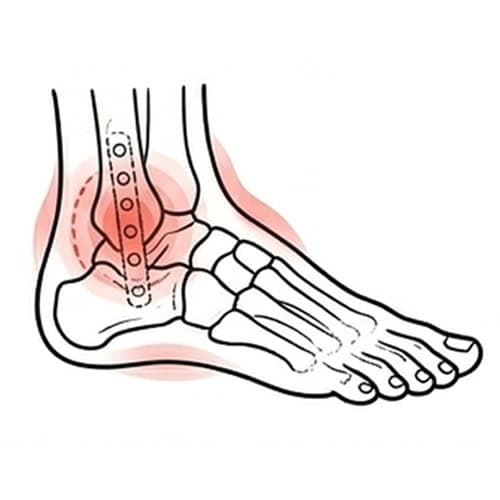
A smaller group has ligaments that healed long and lax after significant or repeated tears, so the joint itself moves further than it should. The ankle may feel loose rather than merely unreliable, and giving way happens even on flat, predictable ground. Assessment separates the two by testing the ligaments directly, and the distinction matters because a loose ligament needs a different, longer plan, occasionally including a surgical opinion.
Why One Sprain Leads To The Next
The repeat-sprain cycle runs on untrained sensors, and each turn of the loop makes the next easier.
The sequence is consistent. A sprain tears ligament fibres and the sensors woven through them. Pain settles, swelling fades, walking returns, and everything feels finished, the deceptive milestone covered in our guide to how long a sprained ankle takes to heal.
The sensors, though, were never retrained, because ordinary walking on flat pavement barely tests them. The first kerb, tree root, or five-a-side pivot asks a question the ankle can no longer answer in time, and it rolls again.
The new sprain adds new sensor damage, confidence drops, activity drops, the supporting muscles weaken, and the loop tightens. Breaking the cycle means training the one thing rest never touches, and rest is what most sprains get.
The One-Minute Balance Check

Single-leg balance, eyes open then closed, reads your position sense honestly.
Stand near a wall or worktop for safety. Rise onto the suspect leg, hands off support, and hold for thirty seconds. Manageable for most people, even with a wobble. Now repeat with your eyes closed. Closing the eyes removes vision from the balancing team and forces the ankle’s own sensors to run the show, which is exactly the skill a sprain damages.
A leg that lasts twenty-plus seconds eyes-closed has decent position sense. A leg that lurches for support within five to ten seconds, while the uninjured side lasts far longer, has found your problem. The gap between your two legs tells you more than the raw number, and a big gap on an ankle that keeps giving way points firmly at the sensor story.
What Breaks The Cycle
Balance retraining rebuilds position sense, and the giving way stops when the sensors catch up.
The fix matches the fault. Sensor-driven instability responds to progressive balance training: teaching the ankle to answer harder and harder questions, from standing still, to eyes closed, to uneven surfaces, to hopping and landing, alongside strength work for the muscles that catch the roll.
The progression matters more than any single exercise, and the right starting rung depends on assessment, which is why a guided programme beats a borrowed one. Mechanical instability follows a different road, longer strengthening with the ligament tested along the way.
An assessment through our sprained ankle team in London sorts sensor from hinge in one session, and the general thresholds for booking any ankle problem sit in our guide to when to see a physio for ankle pain, where recurrence and instability already outrank the calendar.
An ankle that has given way more than once has met the threshold. Our ankle pain team in London assesses instability within days through direct access, no referral needed.
Note. Some giving-way ankles need assessment sooner than a routine booking. Seek prompt review for giving way with locking or catching inside the joint, giving way that has caused a fall or new injury, or an ankle that feels loose on flat, predictable ground. Seek urgent care after any fresh injury with inability to take four steps, tenderness directly on the ankle bones, visible deformity, or a foot turning cold, pale, or numb. Physiotherapists screen for all of these at first assessment and refer onward the same day when they appear. Contact NHS 111 when unsure.
Frequently Asked Questions
We answer the giving-way questions ankle patients ask most.
Why does my ankle keep giving way?
The most common cause is damaged position sense after a sprain: the sensors in the ligament report late, so the correction arrives after the roll has started. The ligament itself is usually intact. A smaller group has genuinely lax ligaments, and assessment separates the two.
Can weak ankles be fixed?
Yes, sensor-driven instability responds well to progressive balance retraining, and most giving-way ankles are exactly that. The training rebuilds position sense the way strength work rebuilds muscle. Guided progression works better than borrowed exercises, because the starting level depends on assessment.
Does ankle instability need surgery?
Rarely. Most instability is a position-sense problem that retrains without surgery. Surgical opinions enter for genuinely lax ligaments that have not responded to a proper rehabilitation course. Assessment establishes which type your ankle is before any of that conversation.
Should I wear an ankle support if my ankle gives way?
A brace can protect during sport or risky ground in the short term, and a brace trains nothing. Position sense rebuilds through balance work, not through external support. Supports serve best as a bridge while the retraining happens, not as the plan itself.
References
- National Health Service. Sprains and strains: recovery and prevention.
- National Institute for Health and Care Excellence. Ankle sprain and chronic instability: clinical knowledge summary.
- Chartered Society of Physiotherapy. Rehabilitation after ankle injury.
- Health and Care Professions Council. The register of physiotherapists.
