



You are a few sessions into physiotherapy and the exercises have changed, the load has gone up, and you want to know where this is going and how the physiotherapist decides when to move you on. Rehabilitation runs in phases, and every injury, operation and overuse problem passes through the same four: settling the tissue, restoring movement and basic strength, building strength and control under load, and returning to the specific demands of your work or sport.
The phases are the same for a sprained ankle and a knee replacement; the time spent in each and the criteria for leaving each are what differ. This guide explains the four phases of rehabilitation, what each one is for, what has to be achieved before the next begins, how a physiotherapist decides on progression and what goes wrong when the phases are skipped or stalled.
Key takeaways
- Rehabilitation runs in four phases: protection and settling, restoring movement and activation, building strength and control under load, and returning to function or sport.
- Progression between phases is decided by criteria such as range, swelling, strength compared with the other side and movement quality, not by the number of weeks or sessions.
- Tissue healing sets the floor for the early phases, and adaptation to load sets the ceiling for the later ones, so the later phases take longer than the early ones.
- The third phase, strength under load, is the one most often cut short, and a joint discharged at the end of phase two fails under the loads of phase four.
- Pain during rehabilitation is acceptable up to a mild level that settles within 24 hours; pain above that or swelling the next day means the load was too high for the phase.
What are the four phases of rehabilitation?
Rehabilitation runs through four phases in a fixed order: protection and settling, restoring movement and activation, building strength and control under load, and returning to function, and each phase ends when its criteria are met rather than when a number of weeks has passed.
| Phase | Purpose | Typical share of the programme | Criteria to leave |
| 1. Protection and settling | Control pain and swelling, protect healing tissue, keep everything else moving | First days to two weeks | Swelling settling, pain at rest low, safe movement established |
| 2. Movement and activation | Restore range of movement, re-activate inhibited muscle, normalise walking or arm use | Two to six weeks | Full or near-full range, no limp, muscle switching on |
| 3. Strength and control | Build strength, endurance and control under progressive load; balance and coordination | Six weeks to three months or longer | Strength within 80 to 90 per cent of the other side, controlled single-leg or single-arm tasks |
| 4. Return to function | Train the specific demands of work, sport or daily life; power, speed, reaction, endurance | Final weeks to months | Task-specific tests passed, confidence in the limb, no flare after full-load sessions |
Why the order is fixed. Strength cannot be built on a joint that does not move, and sport cannot be trained on a limb that is not strong. Each phase supplies what the next one needs. Our physiotherapy service applies the same four phases to every condition we treat, from a sprained ankle to a joint replacement.
What happens in phase one, protection and settling?
Phase one protects the injured or repaired tissue while it begins to heal, brings pain and swelling under control, and keeps the rest of the body moving, and it lasts days for a minor strain and up to two weeks for a surgical repair. Rest is relative, not complete.
What is done. Compression, elevation and ice for swelling. A brace, boot, sling or crutches where the tissue needs protection. Gentle movement within the protected range to keep the joint from stiffening. Isometric contractions to keep the muscle working without moving the joint. Walking, cycling or upper-body work for everything that is not injured.
What is not done. Stretching into pain, loading the injured tissue, or resting the whole body. Two weeks of complete rest costs more strength than the injury did.
How you know it is over. Swelling is falling day by day, pain at rest is mild, and the protected movements are comfortable.
What happens in phase two, movement and activation?
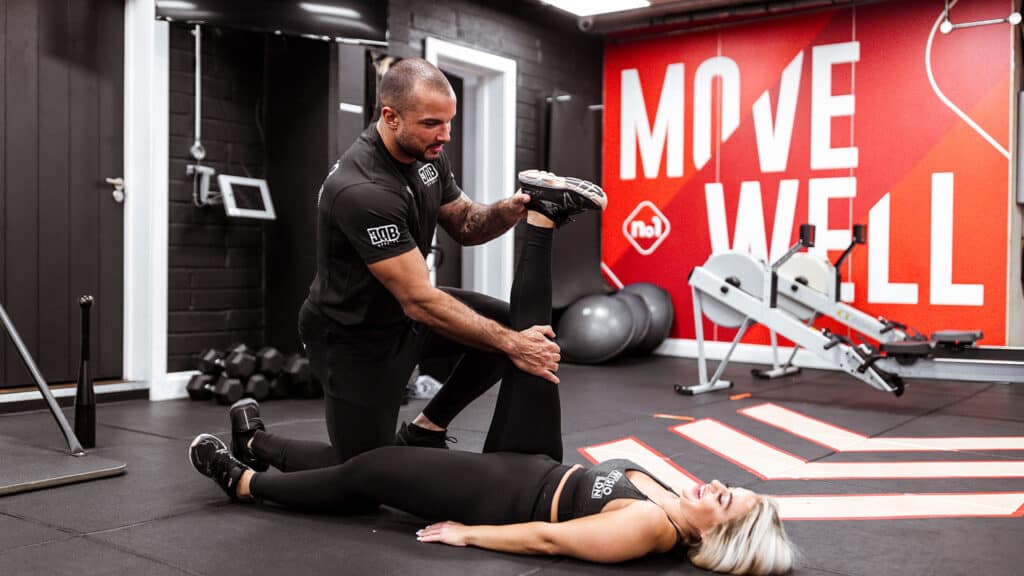
Phase two restores the full range of movement of the joint, re-activates muscles that switched off after the injury or operation, and returns walking or arm use to normal, and it runs from about week two to week six in most programmes. Full range comes before strength because strength trained in a reduced range stays in that range.
What is done. Progressive range of movement work, with the end of range held rather than forced. Hands-on treatment where the joint is stiff or guarded. Muscle activation drills such as quadriceps setting, gluteal bridging or scapular setting. Gait or arm-use retraining in front of a mirror. Low-load, high-repetition strengthening within the available range.
The muscle that switches off. The quadriceps after a knee injury, the gluteals after a hip or back problem and the rotator cuff after a shoulder injury all inhibit within days. Re-activation is deliberate work, and a muscle that is not switched back on in this phase fails to strengthen in the next.
How you know it is over. Range matches the other side or the protocol limit, you walk or use the arm without compensation, and the key muscle contracts on demand.
What happens in phase three, strength and control?
Phase three builds strength, endurance and control under progressively heavier load, and it is the longest phase, running from about week six to three months or more, because muscle and tendon adapt to load over weeks and months rather than days. This is the phase most often cut short, and the one that decides whether the problem returns.
What is done. Resistance training two to three times a week, with load added every one to two weeks. Single-leg and single-arm work to expose and correct side-to-side differences. Balance and reaction drills for the ankle, knee and hip. Tendon loading with slow, heavy repetitions for tendinopathy. Endurance work for the muscles that have to last a working day.
How load is set. The load is raised to a level that produces mild symptoms during the session that settle within 24 hours. Symptoms above that, or swelling the next morning, mean the step was too large, and the load drops back one step rather than to zero.
Measurement. Strength is tested against the other side at the start and end of the phase. A limb that feels strong at 70 per cent of the other side fails under the loads of phase four, which is why the number is measured rather than assumed.
How you know it is over. Strength is within 80 to 90 per cent of the other side, single-leg or single-arm tasks are controlled, and heavy sessions do not provoke a flare.
What happens in phase four, return to function?
Phase four trains the specific demands of your work, sport or daily life, adds power, speed, reaction and fatigue to the strength built in phase three, and ends with a staged return rather than a single day of clearance.
What is done. Running, jumping, landing and change of direction for sport. Lifting, carrying, kneeling and sustained postures for manual work. Stairs, walking distance and getting down to the floor for older adults. Sessions are built to mimic the hardest version of the task you need to return to, and the limb is tested under fatigue.
The staged return. Work or sport is resumed in stages: partial hours or non-contact training, then full hours or full training, then the full load. A flare at any stage means one step back, not a return to the start.
How you know it is over. The task-specific tests are passed, you trust the limb, and a week of full load produces no swelling, no pain above mild and no loss of range.
How does a physiotherapist decide when to progress?
A physiotherapist decides on progression by testing the criteria for the current phase at each session and moving on only when they are met, with the response to the previous session as the second check. The calendar and the protocol give the earliest date; the criteria give the actual one.
At each session. Swelling is compared with the previous visit. Range is measured. The key muscle is tested. The previous session’s load is reviewed: did the symptoms settle within 24 hours? A yes on all four moves the load up one step. A no on any one holds or reduces it.
At each phase boundary. The criteria in the table above are tested formally and written down. We will tell you which criterion is holding you in a phase and what will change it.
Why not by the week. Two people with the same injury on the same date can be three weeks apart at the end of phase two. Progressing by the week pushes one too fast and holds the other back. Our guide on how physiotherapists diagnose explains how the first assessment sets the starting phase.
What goes wrong with rehabilitation phases?
Skipping phase two, cutting phase three short, stalling in phase one and treating pain as a stop sign rather than a dial are the four errors that make rehabilitation fail.
Skipping range. Strength built before full range is restored stays in the reduced range, and the joint remains stiff under load for months.
Cutting strength short. Discharge at the end of phase two, when the limb moves well and walks well, leaves it at 60 to 70 per cent of its strength. The problem returns at the first heavy week.
Stalling in protection. Resting for weeks because the injury still hurts loses strength, range and confidence, and lengthens every later phase.
Pain as a stop sign. Mild pain during loading that settles within a day is part of adaptation. Avoiding all pain keeps the load below the level at which tissue adapts, and nothing changes.
When to get your rehabilitation reviewed
Rehabilitation that has not moved phase in four weeks, a programme that has not changed in three sessions, a limb that has never been measured against the other side, or a discharge that left you walking well but not lifting, running or working warrants a physiotherapy review, and no GP referral is needed.
A review places you in the correct phase and resets the criteria.Our physiotherapy clinics across London run every programme to the four phases described here.
Note. Some symptoms during rehabilitation need urgent medical care rather than a physiotherapy review. Calf pain, swelling or warmth with or without shortness of breath, a hot, red and swollen joint with fever, a sudden loss of movement or new deformity after a fall, or numbness and weakness spreading down a limb with changes to bladder or bowel control are reasons to call NHS 111 or go to A&E.
Book your London rehabilitation assessment
Rehabilitation is a sequence of phases with criteria, and the assessment tells you which phase you are in. You can book physiotherapy in London at any of our clinics in 60 seconds, with no GP referral needed.
Common questions about rehabilitation phases
How long does each phase of rehabilitation take?
Phase one takes days to two weeks, phase two about two to six weeks, phase three six weeks to three months or longer, and phase four the final weeks to months. The injury, the operation and your response to load set the actual times, and the criteria decide each move.
What are the stages of recovery after an injury?
Tissue passes through inflammation in the first days, repair over the following weeks and remodelling over months. The four rehabilitation phases follow that biology: protection during inflammation, movement during repair, and strength and return to function during remodelling.
Can I skip a phase if I feel ready?
No. Each phase supplies what the next one needs, and feeling ready is checked against measured criteria. A limb that feels strong and tests at 70 per cent of the other side is not ready for phase four.
Is it normal for rehabilitation to hurt?
Yes, up to a mild level that settles within 24 hours. Pain above that during a session, or swelling and stiffness the next morning, means the load was too high for the phase and is reduced one step.
Why has my physiotherapist changed my exercises?
Exercises change when a criterion is met and the next phase begins, or when the response to the previous load shows the step was too large or too small. A programme that never changes is a programme that is not progressing.
References
- Blanchard S, Glasgow P. A theoretical model to describe progressions and regressions for exercise rehabilitation. Physical Therapy in Sport.
- Ardern CL, Glasgow P, Schneiders A, et al. 2016 consensus statement on return to sport from the First World Congress in Sports Physical Therapy, Bern. British Journal of Sports Medicine.
- van Melick N, van Cingel REH, Brooijmans F, et al. Evidence-based clinical practice update: practice guidelines for anterior cruciate ligament rehabilitation based on a systematic review and multidisciplinary consensus. British Journal of Sports Medicine.
- Smith BE, Hendrick P, Smith TO, et al. Should exercises be painful in the management of chronic musculoskeletal pain? A systematic review and meta-analysis. British Journal of Sports Medicine.
- Chartered Society of Physiotherapy. What to expect from physiotherapy.
- NHS. Physiotherapy: how it works.
