



Your knee has been sore for a month, your GP has mentioned physiotherapy, and you are weighing a free NHS referral with a wait against a private appointment this week. Both routes are staffed by physiotherapists registered with the same regulator, and both treat knee pain with the same evidence base: a diagnosis, a loading programme and a review.
The differences are the wait, the format of the sessions and how much one-to-one time you get. NHS England’s own figures in 2026 show community musculoskeletal services still working to bring waits under 18 weeks in many areas. This guide explains how each route works for knee pain, where they differ, which knee problems can wait and which should not, and how to use both at once.
Key takeaways
- NHS physiotherapy for knee pain is free, often reachable by self-referral, and the wait in many areas of England still runs to several weeks or months in 2026.
- Private physiotherapy for knee pain starts within days, costs £45 to £120 for the first assessment, and gives 45 to 60 minutes of one-to-one time.
- NHS and private physiotherapists hold the same HCPC registration and use the same evidence for knee pain; the difference is access and format, not the treatment.
- Knee osteoarthritis and most kneecap pain tolerate a wait; a locked knee, a knee that gives way, or a knee recovering from surgery lose ground with every week.
- Keeping an NHS referral open while starting privately is allowed and is often the most sensible route.
How does NHS physiotherapy for knee pain work?
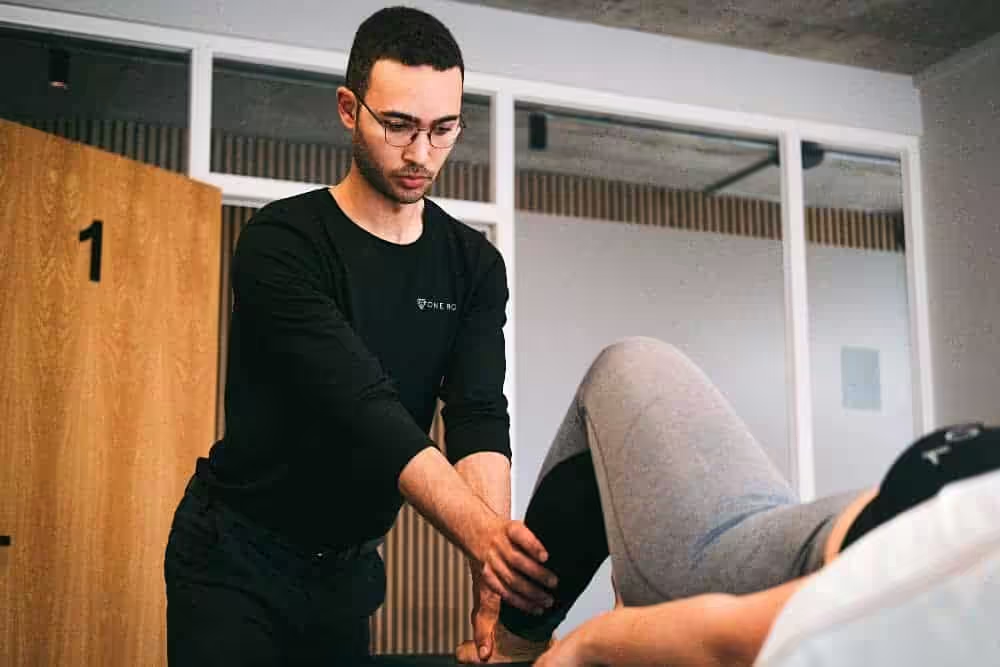
NHS physiotherapy for knee pain is free, reached through self-referral in many areas or through your GP, and delivered by the local community musculoskeletal service. Many GP practices now have a first contact physiotherapist who assesses knee pain at the practice without a GP appointment first.
The pathway. Your referral is triaged, you wait for a first appointment, and you are seen by a physiotherapist for 20 to 30 minutes. Knee osteoarthritis is often treated through a group exercise programme over six weeks rather than one-to-one sessions.
Most NHS knee pathways offer a set number of appointments, then discharge you with a home programme and the option to re-refer.
What works well. NHS musculoskeletal physiotherapists see a high volume of knees and sit inside the same system as orthopaedic surgeons, so onward referral for imaging or a surgical opinion runs through one record. Nothing about the exercises or the diagnosis is second-rate.
The limit. The wait is the cost. NHS England launched a national MSK Community Delivery Programme in May 2026 and added £4.6 million in July 2026 for services with waits over 18 weeks, which tells you how common those waits remain.
How does private physiotherapy for knee pain work?
Private physiotherapy for knee pain is booked directly, usually within a few days, and the first appointment runs 45 to 60 minutes one-to-one with the same physiotherapist you then see for follow-ups. No GP referral is needed, because HCPC-registered physiotherapists assess and treat knee pain independently.
The pathway. You book, you are examined, you leave with a working diagnosis, a loading programme and an expected number of sessions. Follow-ups run 30 to 45 minutes and progress the load each visit. A private physiotherapist who suspects a structural injury refers you for a scan or to a consultant, privately or through a letter to your GP.
The cost. You pay per session, or your insurer does. Our guide to the cost of private physiotherapy for knee pain sets out UK fee ranges and what each knee diagnosis tends to cost in total.
The limit. Private care is only as good as the clinician. Check for HCPC registration and MCSP after the name, and expect a session count at the first visit, not an open-ended course.
How do NHS and private physiotherapy compare for knee pain?
NHS and private physiotherapy differ for knee pain in waiting time, session length, format and continuity, and match each other in regulation, evidence base and the exercises prescribed.
| NHS physiotherapy | Private physiotherapy | |
| Cost | Free | £45 to £120 first visit, £35 to £85 follow-up |
| Time to first appointment | Weeks to months, varies by area | Days |
| First appointment length | 20 to 30 minutes | 45 to 60 minutes |
| Format for knee osteoarthritis | Often group exercise class | One-to-one |
| Same clinician each visit | Not guaranteed | Usual |
| Number of sessions | Set by the service | Agreed with you at the first visit |
| Referral needed | GP or self-referral | None |
| Regulation | HCPC | HCPC |
What this means for your knee. The treatment for patellofemoral pain, a meniscal irritation or early osteoarthritis is a progressive loading programme in both settings. The private route buys earlier assessment and more time to get the exercises right. The NHS route buys the same programme for nothing, if your knee can tolerate the wait.
Which knee problems can wait for NHS physiotherapy?
Knee osteoarthritis, most kneecap pain and mild tendinopathy tolerate a wait of several weeks without losing ground, provided you stay active in the meantime. NICE guideline NG226 names exercise, weight management and education as the core treatment for osteoarthritis, and none of those three depends on an appointment date.
What to do while you wait. Keep walking, use the stairs, and begin simple quadriceps and hip strengthening. A knee that is stiff in the morning for under 30 minutes and aches after activity is behaving like osteoarthritis, and movement helps it. Our knee pain causes and treatment guide explains which pattern of pain points to which diagnosis.
The honest caveat. Waiting is safe. Waiting and resting completely is not, because the quadriceps weaken within weeks and the knee hurts more when you return to activity. Our comparison of NHS and private physiotherapy waiting times in London covers how long London waits run in 2026.
Which knee problems should not wait?

A knee that locks, gives way, cannot bear weight, or is recovering from surgery should be assessed within days, because each of these loses ground with every week of delay.
A locked knee. A knee that will not fully straighten after a twist often has a displaced meniscal fragment. Early assessment decides between a loading programme and an arthroscopy, and the decision is time-sensitive.
A knee that gives way. Instability after an injury points to a ligament tear, and repeated episodes of giving way damage the cartilage and meniscus. Our guide on knee instability and giving way explains the self-checks and what an assessment tests.
After surgery. The first 6 to 12 weeks after ACL reconstruction or knee replacement set the range of movement you keep. A gap in rehabilitation during that window is harder to recover than a gap at any other point.
Pain that stops work or sport. A knee that keeps you off work or out of training has a cost of its own each week, and that cost usually exceeds the fee for an early assessment.
Can you use the NHS and private physiotherapy together?
You can keep an NHS referral open while starting private physiotherapy, and most people with knee pain are best served by doing both. The private assessment gives you a diagnosis and a programme now. The NHS appointment, when it arrives, continues the same programme at no cost, or confirms you no longer need it.
How to do it well. Tell both clinicians what the other has prescribed. Ask the private physiotherapist for a short written summary of the diagnosis and the plan, which you take to the NHS appointment. Keep one exercise programme, not two, and let the clinician who sees you most often own it.
When to get your knee assessed
Knee pain that has lasted more than two weeks, that limits stairs or walking, or that followed a twist or fall warrants an assessment, on the NHS or privately, and no GP referral is needed for either. Our knee pain physiotherapy service in London sees new knee assessments within days across all our clinics, and we will tell you at the first visit if the NHS route is the better one for your knee.
Note. Some knee symptoms need urgent medical care rather than a physiotherapy appointment. A knee that is hot, red and swollen with a fever, a knee you cannot put weight on after an injury, an obvious deformity, a knee locked and unable to straighten, or calf pain and swelling with shortness of breath are reasons to call NHS 111 or go to A&E.
Common questions about NHS and private physiotherapy for knee pain
Is private physiotherapy better than NHS physiotherapy for knee pain?
Private physiotherapy is faster and gives more one-to-one time; the treatment itself is the same. Both are delivered by HCPC-registered physiotherapists working from the same evidence, so the better route is the one that gets your knee assessed and loaded in the time it has.
Can I self-refer to NHS physiotherapy for knee pain?
Yes, in many areas of England you can self-refer to the community musculoskeletal service without seeing a GP. The NHS website lists the self-referral option by area, and some GP practices offer a first contact physiotherapist appointment instead.
Will going private affect my NHS referral?
No. A private assessment does not cancel an NHS referral, and you can attend the NHS appointment when it arrives. Tell each clinician what the other has prescribed.
How long do you wait for NHS knee physiotherapy in 2026?
Waits vary by area. NHS England is funding services with waits over 18 weeks, so a wait of several weeks to a few months remains common, and some areas are shorter.
Does private insurance cover knee physiotherapy?
Most UK private medical insurance policies cover physiotherapy for knee pain, often by self-referral to an approved clinic, with an excess and a session limit. Check your policy before booking.
Book your London knee assessment
The right route for knee pain is the one that gets your knee diagnosed and loading before it loses strength. We publish every price on our knee pain physiotherapy in London page, and you can book your first assessment at any of our clinics in 60 seconds, with no GP referral needed.
References
- NHS. Physiotherapy: how to access.
- National Institute for Health and Care Excellence. Osteoarthritis in over 16s: diagnosis and management. NICE guideline NG226, October 2022.
- Chartered Society of Physiotherapy. CSP welcomes nationwide rollout of MSK programme to cut waits and support people back to work. 26 May 2026.
- HTN. £4.6 million funding for initiatives and interventions to reduce community MSK waiting times. 20 July 2026.
- TreatCompare. Private Physiotherapy Costs UK 2026. Fees as of April 2026.
- Health and Care Professions Council. Check the register.
