



Hip bursitis produces a recognisable pattern of lateral hip pain that a simple set of home tests can help you identify. The tests do not diagnose. They classify the pattern so a physiotherapist can assess efficiently and rule in or out the other conditions that mimic bursitis. Modern MSK practice increasingly uses the term greater trochanteric pain syndrome, or GTPS, because gluteal tendon involvement usually drives the presentation alongside the bursa.
We wrote this piece to give you a clean symptom picture and four tests you can run in ten minutes. Our MCSP-registered team at One Body LDN treats hip bursitis and GTPS presentations daily across our London locations.
Key Takeaways
- Lateral hip pain over the greater trochanter is the hallmark of hip bursitis.
- Side-lying pain, particularly on the affected side, is present in most cases.
- Four home tests help you recognise the pattern before booking assessment.
- Bursitis and gluteal tendinopathy usually coexist under the GTPS umbrella.
- Book physiotherapy assessment if two or more tests reproduce your pain.
Hip bursitis symptoms
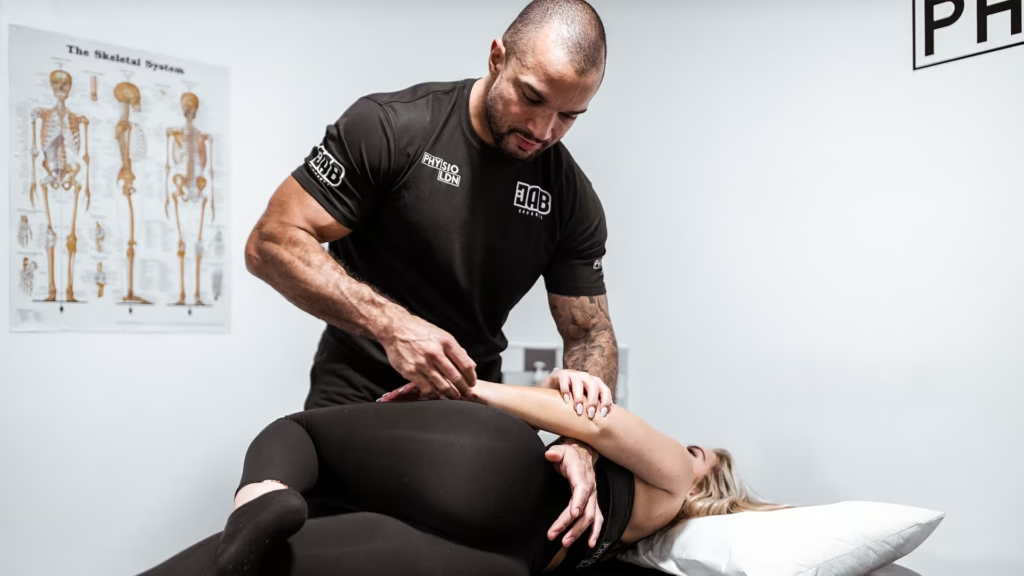
Hip bursitis produces lateral hip pain with a distinct set of accompanying features.
The symptoms below appear in most bursitis presentations. Not every patient shows all of them:
- Pain over the outer hip, felt at the bony prominence you can palpate on the side (the greater trochanter).
- Pain worse when lying on the affected side, often waking you at night.
- Pain sometimes present when lying on the unaffected side, from adductor pull on the affected leg.
- Tenderness on direct pressure over the outer hip.
- Pain on standing on the affected leg (single-leg stance).
- Pain worse after prolonged sitting or long drives.
- Pain when climbing stairs, particularly stepping up on the affected leg.
- Pain radiating down the outer thigh, sometimes to the knee.
- Antalgic gait (favouring the affected leg while walking).
Symptom onset can be gradual or follow a period of load change (new running programme, weight change, prolonged bed rest).
Who tends to develop hip bursitis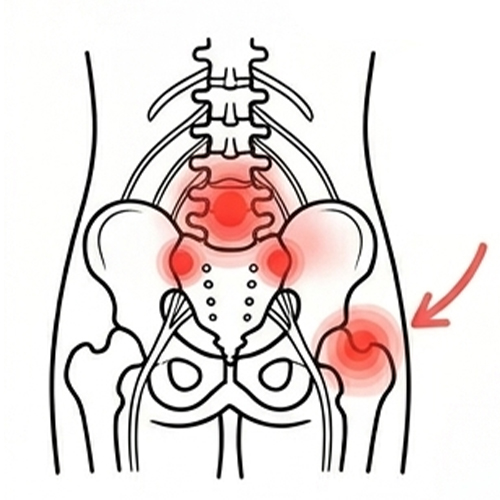
Hip bursitis affects females aged forty to sixty at meaningfully higher rates than other groups.
Peer-reviewed prevalence data places the female-to-male ratio at roughly four to one. Postmenopausal women carry the highest risk. Runners, hikers, and people with recent weight gain also present frequently. L
eg length discrepancy, biomechanical patterns that overload the gluteal tendons, previous hip or spinal surgery, and prolonged bed rest all increase risk. Recognising the demographic pattern helps you weigh the likelihood of bursitis against other causes of lateral hip pain such as spinal referral or hip osteoarthritis.
Four home tests you can run in ten minutes
Four tests together produce a reliable pattern for hip bursitis recognition.
Run all four for the fullest picture. Stop any test that reproduces sharp or increasing pain.
Test 1: Palpation of the greater trochanter
How to do it. Locate the bony prominence on the outer hip about a hand-width below the top of the pelvis. Press firmly with two or three fingertips.
Positive sign. Pain directly under your fingers reproducing your usual outer hip pain.
Test 2: Side-lying provocation
How to do it. Lie on the affected side on a firm surface for one minute. Then roll onto the unaffected side with your legs together for one minute.
Positive sign. Pain reproduced on the affected side (compression). Pain reproduced on the unaffected side too (adductor pull). Either or both count as positive.
Test 3: Single-leg stance (modified Trendelenburg)
How to do it. Stand near a wall for balance. Lift the unaffected leg off the floor. Hold your affected-side stance for thirty seconds.
Positive sign. Pain reproduced at the outer hip. Pelvis dropping on the unaffected side also signals hip abductor weakness commonly associated with bursitis.
Test 4: Resisted hip abduction
How to do it. Lie on the unaffected side. Slowly lift the affected leg upward against gravity, ten centimetres above your other leg. Hold for five seconds.
Positive sign. Pain reproduction at the outer hip, weakness during the lift, or both.
Interpreting the tests
Two or more positive tests suggest a hip bursitis or GTPS pattern.
One positive test alone is not a strong signal. Two or more positive tests, together with the symptom pattern above, points strongly to a bursitis or GTPS presentation. Booking physiotherapy assessment is the appropriate next step. Zero positive tests but ongoing lateral hip pain still warrants assessment, because the pain source may be spinal referral, hip osteoarthritis, or another pathology outside the scope of self-testing.
What self-tests cannot tell you
Home tests classify the pattern. They do not diagnose the condition.
Self-tests cannot distinguish bursal inflammation from gluteal tendinopathy. Both usually coexist. They cannot exclude concurrent hip osteoarthritis, hip labral pathology, or spinal referral. They cannot detect early fragility fracture in older adults or systemic inflammatory conditions.
A physiotherapist adds range-of-motion testing, palpation depth, imaging referral, and clinical reasoning that self-testing cannot replicate. For a wider picture of hip pain assessment, our main hip pain guide covers the common differentials.
Frequently asked questions
We answer the questions patients ask most before booking.
Can hip bursitis go away without treatment?
Mild hip bursitis sometimes settles with load reduction and side-lying position changes over two to four weeks. Persistent lateral hip pain lasting beyond three weeks, or pain that wakes you at night, rarely resolves without assessment. Structured physiotherapy typically improves function across four to six sessions for early presentations.
What is the difference between hip bursitis and GTPS?
GTPS is the modern clinical umbrella term that covers hip bursitis and gluteal tendinopathy together. Both usually coexist. Our team assesses lateral hip pain using the GTPS framework because tendon involvement often drives symptoms alongside the bursa.
Should I see a physiotherapist or GP for hip bursitis?
Physiotherapy is first-line for lateral hip pain in the UK, and no GP referral is required. See a GP first if red flags are present. Our hip pain team in London assesses lateral hip pain typically within forty-eight hours.
Note. Some lateral hip pain patterns warrant urgent medical review rather than physiotherapy. Seek same-day GP or A&E assessment for hip pain after any fall in adults over sixty, hip pain with fever or feeling systemically unwell, sudden severe hip pain with inability to weight-bear, skin redness or warmth over the outer hip, progressive night pain unrelieved by position change, and bilateral leg symptoms with bladder or bowel changes. Physiotherapy is first-line for most lateral hip pain but never replaces medical review of red flags.
References
- Grimaldi A, Fearon A. Gluteal tendinopathy: integrating pathomechanics and clinical features in its management.
- Mellor R, et al. LEAP-GLoBE trial: education plus exercise versus corticosteroid injection for gluteal tendinopathy.
- National Institute for Health and Care Excellence. Musculoskeletal conditions guidance.
- Chartered Society of Physiotherapy. Direct access to physiotherapy.
- National Health Service. Hip pain overview.
