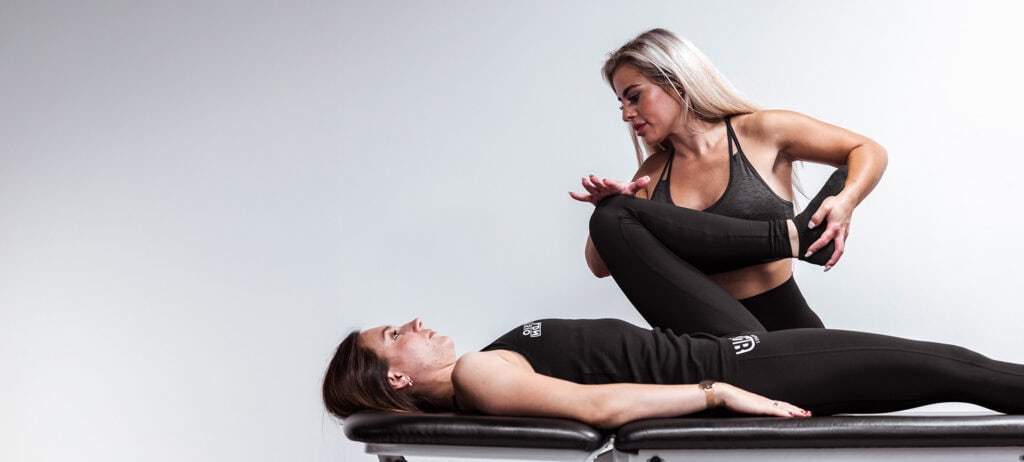
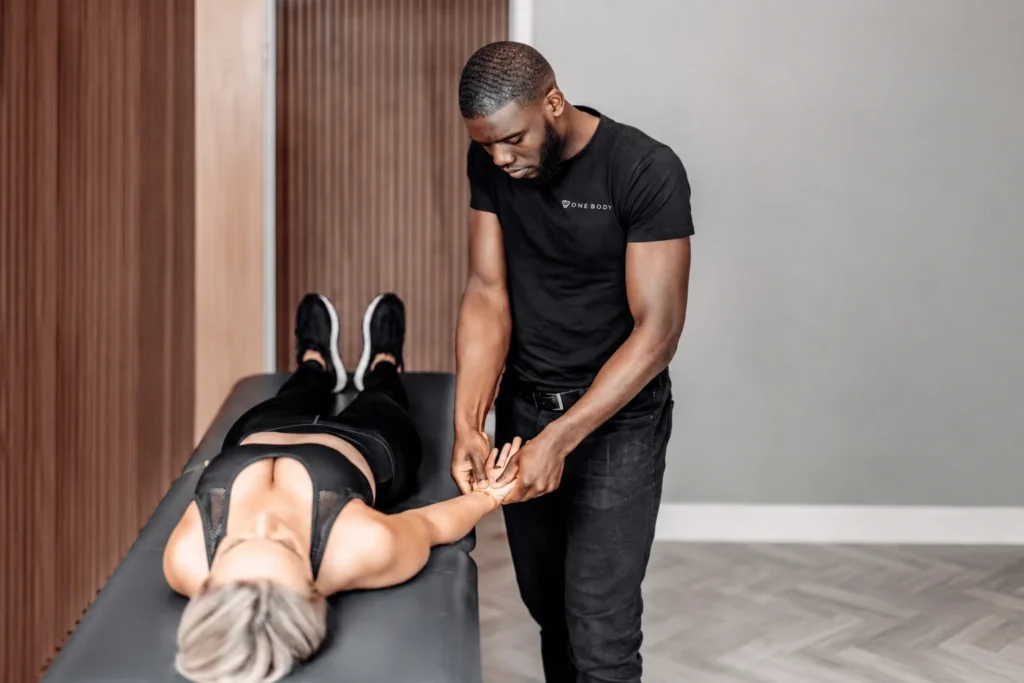
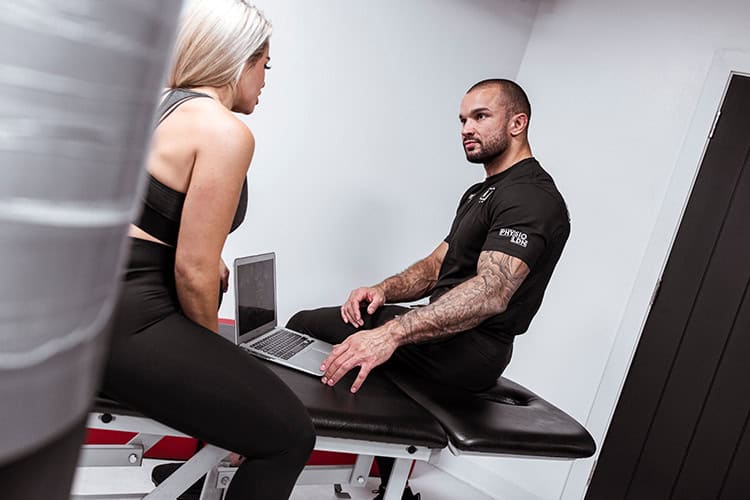
Dry needling in London is a physiotherapy technique that inserts a fine, sterile needle into a tight band of muscle, called a myofascial trigger point, to reduce pain and restore movement. Our HCPC-registered physiotherapists use dry needling within a standard physiotherapy session, alongside hands-on treatment and exercise rehabilitation, never as a treatment on its own. Dry needling is available with selected clinicians who hold the additional training, and we say so clearly when another treatment suits the problem better. Deep tissue massage treats the same muscle tightness without needles and is the better choice for many patients. Appointments are available same day, early and late across our London clinics.
Delivered inside a physiotherapy assessment and rehabilitation plan
Available with selected trained clinicians across London
Rated Excellent on Trustpilot, with thousands of 5-star Google reviews across One Body LDN clinics.
“Within weeks my pain started to decrease and within months I was back at the gym doing most of the things I wanted to be able to do.”
Jake Whittaker
“The treatment plans were clear, effective and tailored to my needs, and the improvement in my pain and mobility has been excellent.”
Nik Ollek
“Through rigorous sports massage and a clear, well structured physio exercise programme, I was back playing within a month.”
Nicholas Morgan
“Six weeks on, I’m deadlifting weights in the gym and my back feels completely renewed.“
Catherine Gratwicke
“After his treatment, massages and the exercises he gave me, I saw big improvements very fast. Within the same week I was even able to complete a half marathon.”
Mirela
“I went to see Meher after struggling with shoulder and lower back pain due to long office hours, and the difference after starting treatment has been incredible.”
Nandu Krishna Anil Kumar
“I started physio with her 3 months ago and since then my knees pain has improved massively with her personalised program and custom exercises and manual therapy.”
Jessica Foster
“I came in with serious neck tension and frequent headaches from spending long hours at the computer. Preeti … did an excellent job targeting the problem areas with a focused sports massage.”
Tony French
“Her sports massages are outstanding! Easily some of the most effective I’ve had.”
IC OM
“I have been working with Matt for almost two years as part of my rehabilitation journey, and I cannot recommend him highly enough.”
Catherine
“I started going to One Body LDN only to improve my posture … After just a few sessions with my physiotherapist Om, I can tell my posture has already started improving.”
Bozhidara-Maria Opanska
“I feel now I am more aware of my foot placement, and my legs are definitely stronger than ever before. Roll on next ‘long run’ challenge.”
aine121
“Within just a few sessions, she managed to relieve a significant amount of the pain in my shoulder, and I’ve already noticed a real improvement.”
Rob And
“I went to see him with significant back pain, and after just one appointment the difference was remarkable.”
Anvit Desai
“My therapist assessed my issue quickly and got straight to hands on therapy. It did the trick perfectly. After one session my neck pain was considerably better.”
EP
“Very impressed with the in depth assessment and treatment plan I was given.”
Joel Greensite
“I came in with lower back pain, probably caused by spending long hours sitting at a computer … this was the first place where I started to notice a real improvement.”
Bruna Francyne
“The team is very professional, welcoming, and truly cares about their clients. From the moment I arrived, I felt comfortable and well looked after.”
Юлія Беген
“Best physio in London! Have tried multiple One Body clinics and always have such a good experience and knowledgeable physiotherapists.”
Amy Perring
“The trainers are incredibly knowledgeable and take the time to understand your goals, making every session feel personalised and effective.”
Yawar Hayat
“Her knowledge and expertise were immediately evident, and she took the time to understand my specific needs and concerns in a way I haven’t experienced before.”
Andrew G. T
“This is a first class service and the Physios are all excellent and very professional and go the extra mile to help people get back to things they want to do as soon as they can!”
Engine Room
Find a Dry Needling Physiotherapist Near You in London
Find a Clinic Near Me ▼
2–8 mins from major stations
Same-day, early & late appointments
What is dry needling and how does it differ from acupuncture?
Dry needling involves inserting a thin filament needle into a myofascial trigger point or tight muscle band, without injecting anything, to reduce pain and muscle tension. The word “dry” separates the technique from injection therapy, where a substance such as a local anaesthetic or corticosteroid is delivered through the needle.
Dry needling and traditional acupuncture use the same type of needle and differ in reasoning. Traditional acupuncture places needles on points defined by Chinese medicine theory. Dry needling places the needle in the muscle structure the physiotherapist has examined and found to be the source of pain, following Western anatomy and clinical reasoning.
UK physiotherapists who practise needling techniques typically belong to the Acupuncture Association of Chartered Physiotherapists, which sets training and safety standards for needling within physiotherapy, and selected One Body LDN clinicians hold that membership. All needles used in our clinics are sterile and single-use.
Which conditions is dry needling used for?
Dry needling treats muscle pain and tightness that an examination traces to trigger points, including the neck and upper shoulder muscles, tension-type headache from the neck, lower back and gluteal muscles, tennis elbow, calf tightness, and plantar heel pain. The conditions where we most often add dry needling to a treatment plan are listed below:
Calf tightness and Achilles-related muscle tension in runners
Plantar heel pain where calf and foot muscle tightness contributes
Hip and thigh muscle tightness in runners and cyclists
Dry needling targets muscle, not joints, ligaments or bone. We treat joint stiffness, ligament injury, nerve root pain, and tendon injury with other methods, and add dry needling only when we find a muscle component on examination.
How does dry needling work in a physiotherapy session at One Body LDN?
At One Body LDN, dry needling may be included as part of a standard physiotherapy appointment, depending on your therapist’s clinical assessment, expertise and the suitability of the treatment. Dry needling is not guaranteed, is available with selected clinicians only and will only be offered where clinically appropriate. A session that includes dry needling still covers the assessment, hands-on treatment, exercise prescription and the plan for the next appointment.
The sequence of a session that includes dry needling is given below:
Assessment
Your physiotherapist takes your history, examines your movement and strength, and locates trigger points by palpation.
Explanation and consent
Your physiotherapist explains the reason for needling, the expected sensation, the side effects, and the alternatives, and proceeds only with your consent.
Needling
Each trigger point is needled for a short period, from a few seconds to a few minutes, depending on the muscle and response.
Hands-on treatment and exercise
Soft-tissue techniques and the first rehabilitation exercises follow, because the gains from needling are maintained only when the muscle is loaded and moved.
Plan
You leave with exercises on Physitrack and a clear next step, which may or may not include further needling.
What does dry needling feel like and what are the side effects?
Dry needling produces a brief deep ache or a muscle twitch at the point of insertion, followed in many patients by soreness for 24 to 48 hours. Bruising at the needle site and light bleeding on removal occur in a minority of sessions and settle without treatment.
Serious adverse events are rare when a trained clinician performs needling following the Acupuncture Association of Chartered Physiotherapists safety guidance. Needling near the chest wall carries a small risk of pneumothorax, so we control depth and angle and avoid needling over the lungs in patients at higher risk. Dry needling is not offered to patients with a needle phobia, a bleeding disorder, anticoagulant medication without medical clearance, local skin infection or lymphoedema, or during the first trimester of pregnancy, and every patient is screened for these before the first needle.
Does dry needling work?
Dry needling reduces pain in the short term for myofascial trigger points and muscle pain, but evidence for benefit beyond 12 weeks is limited, so we use dry needling as an addition to exercise rehabilitation, never as the sole treatment. A 2017 systematic review and meta-analysis by Gattie and colleagues in the Journal of Orthopaedic and Sports Physical Therapy found that physical therapists’ dry needling reduced pain and improved function in the short term compared with no treatment or sham, with less certainty about longer-term effects.
The strength of the evidence varies by condition. NICE guideline NG59 on low back pain and sciatica states that acupuncture should not be offered for managing low back pain, so for back pain our treatment plans are built on exercise and manual therapy, with needling used only where a specific muscle trigger point is found and the patient prefers it as part of the plan. Short-term benefits are better supported for neck pain, tension-type headache, and myofascial pain. Your physiotherapist states the evidence for your condition before proposing needling, and a plan that does not include needling is a complete plan.
What should you expect at your first appointment?
Your first appointment is a full assessment and treatment session, with no GP referral needed, and dry needling is included within the session at no separate charge when needling is clinically indicated and you consent. The session covers the history, the examination, the working diagnosis, treatment and the rehabilitation plan.
Dry needling is booked as a physiotherapy appointment through the same online system as all private physiotherapy on our physiotherapy London page. Insured patients use AXA Health, Bupa, Aviva, Vitality, Cigna, WPA and other policies subject to authorisation, because the appointment is billed as physiotherapy rather than as a separate needling treatment. Patients should eat beforehand, wear loose clothing that gives access to the area, and avoid heavy training for the rest of the day after a needling session.
As featured In
Dry needling or deep tissue massage: which is better for you?
Deep tissue massage treats the same muscle tightness as dry needling without needles, and for many patients deep tissue massage is the more useful choice. The two methods differ in how they work, who they suit and how they fit into a plan.
Deep tissue massage works across a whole muscle group with sustained pressure, so tightness across the upper back, hips or calves is treated in one session, and the treatment doubles as recovery between training sessions. Deep tissue massage suits patients who dislike needles, patients with a bleeding disorder or on anticoagulants, pregnant patients, and athletes who want regular soft-tissue maintenance rather than a one-off intervention. Dry needling targets a specific trigger point that resists pressure, and suits patients whose pain is traced to one or two points on examination.
The evidence for both is modest and short term, and both work only when followed by movement and strength. Patients who are unsure start with deep tissue massage, because the benefits arrive without needle-related side effects. Our sports massage in London page sets out the deep tissue options, and a physiotherapist who finds a trigger point that massage has not resolved can add dry needling at a later appointment.
Why choose One Body LDN for dry needling in London?
HCPC-registered physiotherapists with needling training
Dry needling is delivered only by HCPC-registered physiotherapists who hold additional needling training, within the safety guidance of the Acupuncture Association of Chartered Physiotherapists.
Thousands of patient reviews and an NPS of +79
One Body LDN has 7,000+ Google reviews at 4.9 and thousands of five-star reviews across Google and Trustpilot. Our structured analysis of 4,859 client survey responses recorded a Net Promoter Score of +79.
Needling inside a full treatment plan
Dry needling is one part of a session that includes assessment, hands-on treatment, exercise prescription through Physitrack and a plan for the next step.
Clear pricing and treatment plans, no pressure to overbook
Dry needling is included within a physiotherapy appointment where indicated, at no separate charge. Appointments are paid individually with no packages or multi-session commitments.
Same-day, early and late appointments across London
Our clinics sit 2 to 8 minutes from major Tube and train stations, with same-day, early, late and weekend appointments available at many locations.
Private health insurance and health cash plans accepted
We work with AXA Health, Bupa, Cigna Healthcare, WPA, Vitality, Aviva, Allianz, Aetna and Healix, and support cash plans including Medicash, Simplyhealth, Health Shield and Westfield Health. Details are on our private health insurance page.
Dry needling London: FAQs
Is dry needling painful?
Dry needling can cause a brief deep ache or a muscle twitch when the needle reaches the trigger point, which most patients describe as uncomfortable rather than painful. Muscle soreness for 24 to 48 hours afterwards is common and eases with gentle movement and heat.
How many dry needling sessions will I need?
There is no fixed number, it depends on your problem, how long you’ve had it, your goals and how you respond to treatment.
Some people may only need a small number of appointments, while longer-standing injuries or post-surgery rehabilitation can require a longer programme.
After your assessment, your physiotherapist will explain what they recommend and why, and your progress will be reviewed as treatment continues.
If you don’t need further physiotherapy, we’ll tell you.
How much does dry needling cost in London?
New clients can book a 45-minute physiotherapy assessment and treatment for £89.
Your appointment includes a comprehensive assessment, hands-on treatment where appropriate, and a personalised treatment plan tailored to your needs and recovery goals.
If further treatment is recommended, you can book your next appointment directly with your physiotherapist and access our lower follow-up rates. There are no contracts or multi-session commitments, appointments are paid for individually.
We also accept private health insurance from major UK and international insurers, subject to your policy coverage and authorisation requirements.
Is dry needling covered by private health insurance?
Yes, when delivered within a physiotherapy appointment by an HCPC-registered physiotherapist, because the session is billed as physiotherapy. Insurers do not cover needling as a standalone treatment, so they authorise physiotherapy in the usual way.
Is dry needling the same as acupuncture?
No. Both use fine filament needles. Dry needling places the needle in the examined muscle trigger point based on Western anatomy, while traditional acupuncture places needles at points defined by Chinese medicine theory. Physiotherapists in the UK practise needling under the Acupuncture Association of Chartered Physiotherapists’ standards.
Can I have dry needling if I am pregnant?
Avoid dry needling in the first trimester, and use it with caution later in pregnancy, avoiding needling over the abdomen and lower back. Deep tissue massage and exercise rehabilitation are the usual alternatives during pregnancy.
Can I exercise after dry needling?
Light activity such as walking is encouraged on the day of needling, and heavy training is avoided until the next day. Soreness in the needled muscle usually settles within 48 hours.
Does dry needling help with headaches?
Dry needling can reduce tension-type headaches caused by trigger points in the neck and upper shoulder muscles, as part of a plan that also addresses neck mobility, posture at work, and strength. Headaches with visual disturbance, sudden severe onset or neurological symptoms need medical assessment before any physiotherapy.
Does dry needling help lower back pain?
Dry needling has a limited role in lower back pain. NICE guidance for low back pain does not recommend acupuncture, so our plans for back pain are built on exercise and manual therapy, with needling added only where a specific muscle trigger point is found and the patient prefers it.
Is dry needling safe?
Dry needling by a trained physiotherapist following AACP safety guidance has a low rate of serious adverse events. Common effects are soreness, bruising and light bleeding at the needle site. Every patient is screened for bleeding disorders, anticoagulant use, infection, needle phobia and pregnancy before needling is offered.
What is the difference between dry needling and a sports massage?
Dry needling uses a needle to release one or two specific trigger points found on examination. Sports massage uses sustained hand pressure across a whole muscle group and doubles as recovery between training sessions. Many patients get the result they need from massage alone, and needling is reserved for a trigger point that massage has not resolved.
Ready to treat the muscle pain?
Dry needling in London from One Body LDN is one tool inside a physiotherapy plan that assesses the cause, treats the muscle and restores movement, with deep tissue massage as the needle-free alternative. Same-day appointments across London. Insurance accepted.